Mechanism of Action
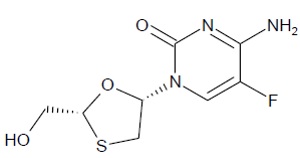
Emtricitabine: FTC, a synthetic nucleoside analog of cytidine, is phosphorylated by cellular enzymes to form emtricitabine 5'-triphosphate. Emtricitabine 5'-triphosphate inhibits the activity of the HIV-1 RT by competing with the natural substrate deoxycytidine 5'-triphosphate and by being incorporated into nascent viral DNA, which results in chain termination. Emtricitabine 5′-triphosphate is a weak inhibitor of mammalian DNA polymerases α, β, ε, and mitochondrial DNA polymerase γ.
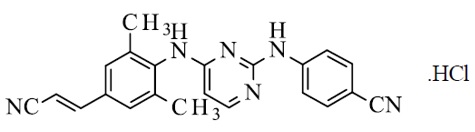
Rilpivirine: RPV is a diarylpyrimidine non-nucleoside reverse transcriptase inhibitor of HIV-1 and inhibits HIV-1 replication by non-competitive inhibition of HIV-1 RT. RPV does not inhibit the human cellular DNA polymerases α, β, and mitochondrial DNA polymerase γ.
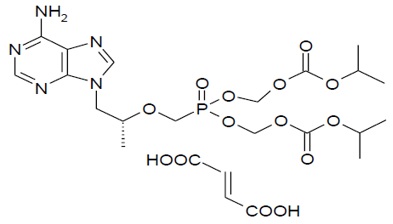
Tenofovir DF: TDF is an acyclic nucleoside phosphonate diester analog of adenosine monophosphate. TDF requires initial diester hydrolysis for conversion to tenofovir and subsequent phosphorylations by cellular enzymes to form tenofovir diphosphate. Tenofovir diphosphate inhibits the activity of HIV-1 RT by competing with the natural substrate deoxyadenosine 5′-triphosphate and, after incorporation into DNA, by DNA chain termination. Tenofovir diphosphate is a weak inhibitor of mammalian DNA polymerases α, β, and mitochondrial DNA polymerase γ.
Antiviral Activity
Emtricitabine, Rilpivirine, and TDF: The triple combination of FTC, RPV, and TDF was not antagonistic in cell culture.
Emtricitabine: The antiviral activity of FTC against laboratory and clinical isolates of HIV-1 was assessed in lymphoblastoid cell lines, the MAGI-CCR5 cell line, and peripheral blood mononuclear cells. The 50% effective concentration (EC50) values for FTC were in the range of 0.0013 to 0.64 mcM. FTC displayed antiviral activity in cell culture against HIV-1 clades A, B, C, D, E, F, and G (EC50 values ranged from 0.007 to 0.075 mcM) and showed strain specific activity against HIV-2 (EC50 values ranged from 0.007 to 1.5 mcM). In drug combination studies of FTC with nucleoside reverse transcriptase inhibitors (abacavir, lamivudine, stavudine, tenofovir, zidovudine), non-nucleoside reverse transcriptase inhibitors (delavirdine, EFV, nevirapine, and RPV), and protease inhibitors (amprenavir, nelfinavir, ritonavir, saquinavir), no antagonistic effects were observed.
Rilpivirine: RPV exhibited activity against laboratory strains of wild-type HIV-1 in an acutely infected T-cell line with a median EC50 value for HIV-1IIIB of 0.73 nM. RPV demonstrated limited activity in cell culture against HIV-2 with a median EC50 value of 5,220 nM (range 2,510 to 10,830 nM). RPV demonstrated antiviral activity against a broad panel of HIV-1 group M (subtype A, B, C, D, F, G, H) primary isolates with EC50 values ranging from 0.07 to 1.01 nM and was less active against group O primary isolates with EC50 values ranging from 2.88 to 8.45 nM. The antiviral activity of RPV was not antagonistic when combined with the NNRTIs EFV, etravirine, or nevirapine; the N(t)RTIs abacavir, didanosine, FTC, lamivudine, stavudine, tenofovir, or zidovudine; the PIs amprenavir, atazanavir, darunavir, indinavir, lopinavir, nelfinavir, ritonavir, saquinavir, or tipranavir; the gp41 fusion inhibitor enfuvirtide; the CCR5 co-receptor antagonist maraviroc; or the integrase strand transfer inhibitor raltegravir.
Tenofovir DF: The antiviral activity of tenofovir against laboratory and clinical isolates of HIV-1 was assessed in lymphoblastoid cell lines, primary monocyte/macrophage cells, and peripheral blood lymphocytes. The EC50 values for tenofovir were in the range of 0.04 to 8.5 mcM. Tenofovir displayed antiviral activity in cell culture against HIV-1 clades A, B, C, D, E, F, G, and O (EC50 values ranged from 0.5 to 2.2 mcM) and showed strain specific activity against HIV-2 (EC50 values ranged from 1.6 to 5.5 mcM). In drug combination studies of tenofovir with NRTIs (abacavir, didanosine, FTC, lamivudine, stavudine, and zidovudine), NNRTIs (delavirdine, EFV, nevirapine, and RPV), and PIs (amprenavir, indinavir, nelfinavir, ritonavir, saquinavir), no antagonistic effects were observed.
Resistance
In Cell Culture
Emtricitabine and Tenofovir DF: HIV-1 isolates with reduced susceptibility to FTC or tenofovir have been selected in cell culture. Reduced susceptibility to FTC was associated with M184V/I substitutions in HIV-1 RT. HIV-1 isolates selected by tenofovir expressed a K65R substitution in HIV-1 RT and showed a 2 to 4 fold reduction in susceptibility to tenofovir. In addition, a K70E substitution in HIV-1 RT has been selected by tenofovir and results in low-level reduced susceptibility to abacavir, FTC, lamivudine, and tenofovir.
Rilpivirine: RPV-resistant strains were selected in cell culture starting from wild-type HIV-1 of different origins and subtypes as well as NNRTI-resistant HIV-1. The frequently observed amino acid substitutions that emerged and conferred decreased phenotypic susceptibility to RPV included: L100I, K101E, V106I and A, V108I, E138K and G, Q, R, V179F and I, Y181C and I, V189I, G190E, H221Y, F227C, and M230I and L.
In HIV-1-Infected Adult Subjects With No Antiretroviral Treatment History
In the Week 96 pooled resistance analysis for adult subjects receiving RPV or EFV in combination with FTC/TDF in the Phase 3 clinical trials C209 and C215, the emergence of resistance was greater among subjects’ viruses in the RPV + FTC/TDF arm compared to the EFV + FTC/TDF arm and was dependent on baseline viral load. In the pooled resistance analysis, 61% (47/77) of the subjects who qualified for resistance analysis (resistance analysis subjects) in the RPV + FTC/TDF arm had virus with genotypic and/or phenotypic resistance to RPV compared to 42% (18/43) of the resistance analysis subjects in the EFV + FTC/TDF arm who had genotypic and/or phenotypic resistance to EFV. Moreover, genotypic and/or phenotypic resistance to FTC or tenofovir emerged in viruses from 57% (44/77) of the resistance analysis subjects in the RPV arm compared to 26% (11/43) in the EFV arm.
Emerging NNRTI substitutions in the RPV resistance analysis of subjects’ viruses included V90I, K101E/P/T, E138K/A/Q/G, V179I/L, Y181C/I, V189I, H221Y, F227C/L, and M230L, which were associated with an RPV phenotypic fold change range of 2.6 to 621. The E138K substitution emerged most frequently during RPV treatment, commonly in combination with the M184I substitution. The FTC and lamivudine resistance-associated substitutions M184I or V and NRTI resistance-associated substitutions (K65R/N, A62V, D67N/G, K70E, Y115F, K219E/R) emerged more frequently in the RPV resistance analysis subjects than in EFV resistance analysis subjects (See Table 15).
NNRTI- and NRTI-resistance substitutions emerged less frequently in the resistance analysis of viruses from subjects with baseline viral loads of ≤100,000 copies/mL compared to viruses from subjects with baseline viral loads of >100,000 copies/mL: 23% (10/44) compared to 77% (34/44) of NNRTI-resistance substitutions and 20% (9/44) compared to 80% (35/44) of NRTI-resistance substitutions. This difference was also observed for the individual FTC/lamivudine and tenofovir resistance substitutions: 22% (9/41) compared to 78% (32/41) for M184I/V and 0% (0/8) compared to 100% (8/8) for K65R/N. Additionally, NNRTI and/or NRTI-resistance substitutions emerged less frequently in the resistance analysis of the viruses from subjects with baseline CD4+ cell counts ≥200 cells/mm3 compared to the viruses from subjects with baseline CD4+ cell counts <200 cells/mm3: 32% (14/44) compared to 68% (30/44) of NNRTI-resistance substitutions and 27% (12/44) compared to 73% (32/44) of NRTI-resistance substitutions.
Table 15 Proportion of Frequently Emerging Reverse Transcriptase Substitutions in the HIV-1 Virus of Resistance Analysis Adult Subjectsa Who Received RPV or EFV in Combination with FTC/TDF from Pooled Phase 3 TMC278-C209 and TMC278-C215 Trials in the Week 96 Analysis
a. Subjects who qualified for resistance analysis
b. V90, L100, K101, K103, V106, V108, E138, V179, Y181, Y188, V189, G190, H221, P225, F227, and M230
c. This combination of NRTI and NNRTI substitutions is a subset of those with the E138K.
d. A62V, K65R/N, D67N/G, K70E, L74I, Y115F, M184V/I, L210F, K219E/R
e. These substitutions emerged in addition to the primary substitutions M184V/I or K65R; A62V (n=2), D67N/G (n=3), K70E (n=4), Y115F (n=2), K219E/R (n=8) in RPV resistance analysis subjects.
|
| C209 and C215
N=1,096
|
RPV
+ FTC/TDF
| EFV
+ FTC/TDF
|
N=550
| N=546
|
Subjects who Qualified for
Resistance Analysis
| 14% (77/550)
| 8% (43/546)
|
Subjects with Evaluable
Postbaseline Resistance Data
| 70
| 31
|
Emergent NNRTI Substitutionsb
|
Any
| 63% (44/70)
| 55% (17/31)
|
V90I
| 14% (10/70)
| 0
|
K101E/P/T/Q
| 19% (13/70)
| 10% (3/31)
|
K103N
| 1% (1/70)
| 39% (12/31)
|
E138K/A/Q/G
| 40% (28/70)
| 0
|
E138K+M184Ic
| 30% (21/70)
| 0
|
V179I/D
| 6% (4/70)
| 10% (3/31)
|
Y181C/I/S
| 13% (9/70)
| 3% (1/31)
|
V189I
| 9% (6/70)
| 0
|
H221Y
| 10% (7/70)
| 0
|
Emergent NRTI Substitutionsd
|
Any
| 63% (44/70)
| 32% (10/31)
|
M184I/V
| 59% (41/70)
| 26% (8/31)
|
K65R/N
| 11% (8/70)
| 6% (2/31)
|
A62V, D67N/G, K70E, Y115F, or
K219E/Re
| 20% (14/70)
| 3% (1/31)
|
In Virologically Suppressed HIV-1-Infected Adult Subjects
Study 106: Through Week 48, 4 subjects who switched to emtricitabine, rilpivirine and tenofovir disoproxil fumarate tablets (4 of 469 subjects, 0.9%) and 1 subject who maintained their ritonavir-boosted protease inhibitor-based regimen (1 of 159 subjects, 0.6%) developed genotypic and/or phenotypic resistance to a study drug. All 4 of the subjects who had resistance emergence on emtricitabine, rilpivirine and tenofovir disoproxil fumarate tablets had evidence of FTC resistance and 3 of the subjects had evidence of RPV resistance.
Cross Resistance
Rilpivirine, Emtricitabine, and Tenofovir DF:
In Cell Culture
No significant cross-resistance has been demonstrated between RPV-resistant HIV-1 variants and FTC or tenofovir, or between FTC- or tenofovir-resistant variants and RPV.
Rilpivirine:
Site-Directed NNRTI Mutant Virus
Cross-resistance has been observed among NNRTIs. The single NNRTI substitutions K101P, Y181I, and Y181V conferred 52-fold, 15-fold, and 12-fold decreased susceptibility to RPV, respectively. The combination of E138K and M184I showed 6.7-fold reduced susceptibility to RPV compared to 2.8-fold for E138K alone. The K103N substitution did not show reduced susceptibility to RPV by itself. However, the combination of K103N and L100I resulted in a 7-fold reduced susceptibility to RPV. In another study, the Y188L substitution resulted in a reduced susceptibility to RPV of 9-fold for clinical isolates and 6-fold for site-directed mutants. Combinations of 2 or 3 NNRTI resistance-associated substitutions gave decreased susceptibility to RPV (fold change range of 3.7 to 554) in 38% and 66% of mutants, respectively.
In HIV-1-Infected Adult Subjects With No Antiretroviral Treatment History
Considering all available cell culture and clinical data, any of the following amino acid substitutions, when present at baseline, are likely to decrease the antiviral activity of RPV: K101E, K101P, E138A, E138G, E138K, E138R, E138Q, V179L, Y181C, Y181I, Y181V, Y188L, H221Y, F227C, M230I, M230L, and the combination of L100I+K103N.
Cross-resistance to EFV, etravirine, and/or nevirapine is likely after virologic failure and development of RPV resistance. In a pooled 96-week analysis for adult subjects receiving RPV in combination with FTC/TDF in the Phase 3 clinical trials TMC278-C209 and TMC278-C215, 43 of the 70 (61%) RPV resistance analysis subjects with postbaseline resistance data had virus with decreased susceptibility to RPV (≥2.5 fold change). Of these, 84% (n=36/43) were resistant to EFV (≥3.3-fold change), 88% (n=38/43) were resistant to etravirine (≥3.2-fold change), and 60% (n=26/43) were resistant to nevirapine (≥6-fold change). In the EFV arm, 3 of the 15 (20%) EFV resistance analysis subjects had viruses with resistance to etravirine and RPV, and 93% (14/15) had resistance to nevirapine. Virus from subjects experiencing virologic failure on RPV in combination with FTC/TDF developed more NNRTI resistance-associated substitutions conferring more cross-resistance to the NNRTI class and had a higher likelihood of cross-resistance to all NNRTIs in the class than subjects who failed on EFV.
Emtricitabine: FTC-resistant isolates (M184V/I) were cross-resistant to lamivudine but retained susceptibility in cell culture to didanosine, stavudine, tenofovir, zidovudine, and NNRTIs (delavirdine, EFV, nevirapine, and RPV). HIV-1 isolates containing the K65R substitution, selected in vivo by abacavir, didanosine, and tenofovir, demonstrated reduced susceptibility to inhibition by FTC. Viruses harboring substitutions conferring reduced susceptibility to stavudine and zidovudine (M41L, D67N, K70R, L210W, T215Y/F, K219Q/E), or didanosine (L74V), remained sensitive to FTC. HIV-1 containing the substitutions associated with NNRTI resistance K103N or RPV-associated substitutions were susceptible to FTC.
Tenofovir DF: The K65R and K70E substitutions selected by tenofovir are also selected in some HIV-1-infected patients treated with abacavir or didanosine. HIV-1 isolates with the K65R and K70E substitutions also showed reduced susceptibility to FTC and lamivudine. Therefore, cross-resistance among these NRTIs may occur in patients whose virus harbors the K65R substitution. HIV-1 isolates from patients (N=20) whose HIV-1 expressed a mean of 3 zidovudine-associated RT amino acid substitutions (M41L, D67N, K70R, L210W, T215Y/F, or K219Q/E/N) showed a 3.1-fold decrease in the susceptibility to tenofovir.
Subjects whose virus expressed an L74V substitution without zidovudine resistance-associated substitutions (N=8) had reduced response to TDF. Limited data are available for patients whose virus expressed a Y115F substitution (N=3), Q151M substitution (N=2), or T69 insertion (N=4), all of whom had a reduced response.
HIV-1 containing the substitutions associated with NNRTI resistance K103N and Y181C, or RPV-associated substitutions, were susceptible to tenofovir.