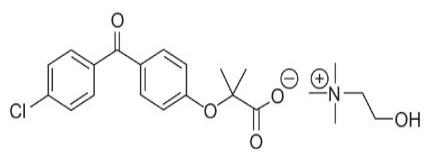
Fenofibric acid delayed-release capsules contains fenofibric acid, which is the only circulating pharmacologically active moiety in plasma after oral administration of fenofibric acid. Fenofibric acid is also the circulating pharmacologically active moiety in plasma after oral administration of fenofibrate, the ester of fenofibric acid.
Plasma concentrations of fenofibric acid after administration of one 135 mg fenofibric acid delayed-release capsules are equivalent to those after one 200 mg capsule of micronized fenofibrate administered under fed conditions.
Absorption
Fenofibric acid is well absorbed throughout the gastrointestinal tract. The absolute bioavailability of fenofibric acid is approximately 81%.
Peak plasma levels of fenofibric acid occur within 4 to 5 hours after a single dose administration of fenofibric acid delayed-release capsules under fasting conditions.
Fenofibric acid exposure in plasma, as measured by Cmax and AUC, is not significantly different when a single 135 mg dose of fenofibric acid delayed-release capsules are administered under fasting or nonfasting conditions.
Distribution
Upon multiple dosing of fenofibric acid, fenofibric acid levels reach steady state within 8 days. Plasma concentrations of fenofibric acid at steady state are approximately slightly more than double those following a single dose. Serum protein binding is approximately 99% in normal and dyslipidemic subjects.
Metabolism
Fenofibric acid is primarily conjugated with glucuronic acid and then excreted in urine. A small amount of fenofibric acid is reduced at the carbonyl moiety to a benzhydrol metabolite which is, in turn, conjugated with glucuronic acid and excreted in urine.
In vivo metabolism data after fenofibrate administration indicate that fenofibric acid does not undergo oxidative metabolism (e.g., cytochrome P450) to a significant extent.
Elimination
After absorption, fenofibric acid is primarily excreted in the urine in the form of fenofibric acid and fenofibric acid glucuronide.
Fenofibric acid is eliminated with a half-life of approximately 20 hours, allowing once daily administration of fenofibric acid delayed-release capsules.
Specific Populations
Geriatrics
In five elderly volunteers 77 to 87 years of age, the oral clearance of fenofibric acid following a single oral dose of fenofibrate was 1.2 L/h, which compares to 1.1 L/h in young adults. This indicates that an equivalent dose of fenofibric acid can be used in elderly subjects with normal renal function, without increasing accumulation of the drug or metabolites [see Use in Specific Populations (8.5)].
Pediatrics
The pharmacokinetics of fenofibric acid has not been studied in pediatric populations.
Gender
No pharmacokinetic difference between males and females has been observed for fenofibric acid.
Race
The influence of race on the pharmacokinetics of fenofibric acid has not been studied; however, fenofibric acid is not metabolized by enzymes known for exhibiting inter-ethnic variability.
Renal Impairment
The pharmacokinetics of fenofibric acid was examined in patients with mild, moderate, and severe renal impairment. Patients with severe renal impairment (estimated glomerular filtration rate [eGFR] <30 mL/min/1.73 m2) showed a 2.7-fold increase in exposure for fenofibric acid and increased accumulation of fenofibric acid during chronic dosing compared to that of healthy subjects. Patients with mild to moderate renal impairment (eGFR 30 to 59 mL/min/1.73 m2) had similar exposure but an increase in the half-life for fenofibric acid compared to that of healthy subjects. Based on these findings, the use of fenofibric acid should be avoided in patients who have severe renal impairment and dose reduction is required in patients having mild to moderate renal impairment [see Dosage and Administration (2.4)].
Hepatic Impairment
No pharmacokinetic studies have been conducted in patients with hepatic impairment.
Drug-drug Interactions
In vitro studies using human liver microsomes indicate that fenofibric acid is not an inhibitor of cytochrome (CYP) P450 isoforms CYP3A4, CYP2D6, CYP2E1, or CYP1A2. It is a weak inhibitor of CYP2C8, CYP2C19, and CYP2A6, and mild-to-moderate inhibitor of CYP2C9 at therapeutic concentrations.
Comparison of atorvastatin exposures when atorvastatin (80 mg once daily for 10 days) is given in combination with fenofibric acid (fenofibric acid delayed-release capsules 135 mg once daily for 10 days) and ezetimibe (10 mg once daily for 10 days) versus when atorvastatin is given in combination with ezetimibe only (ezetimibe 10 mg once daily and atorvastatin, 80 mg once daily for 10 days): The Cmax decreased by 1% for atorvastatin and ortho-hydroxy-atorvastatin and increased by 2% for parahydroxy-atorvastatin. The AUC decreased 6% and 9% for atorvastatin and orthohydroxy-atorvastatin, respectively, and did not change for para-hydroxy-atorvastatin.
Comparison of ezetimibe exposures when ezetimibe (10 mg once daily for 10 days) is given in combination with fenofibric acid (fenofibric acid delayed-release capsules 135 mg once daily for 10 days) and atorvastatin (80 mg once daily for 10 days) versus when ezetimibe is given in combination with atorvastatin only (ezetimibe 10 mg once daily and atorvastatin, 80 mg once daily for 10 days): The Cmax increased by 26% and 7% for total and free ezetimibe, respectively. The AUC increased by 27% and 12% for total and free ezetimibe, respectively.
Table 2 describes the effects of co-administered drugs on fenofibric acid systemic exposure.
Table 3 describes the effects of co-administered fenofibric acid on other drugs.
Table 2. Effects of Co-Administered Drugs on Fenofibric Acid Systemic Exposure from Fenofibric Acid Delayed-Release Capsules or Fenofibrate Administration Co-Administered
Drug
| Dosage Regimen of
Co-Administered Drug
| Dosage Regimen of
Fenofibric acid or Fenofibrate
| Changes in Fenofibric
Acid Exposure
|
| | | AUC
| Cmax
|
Lipid-lowering agents
|
Rosuvastatin
| 40 mg once daily for 10 days
| Fenofibric acid 135 mg once daily
for 10 days
| ↓2%
| ↓2%
|
Atorvastatin
| 20 mg once daily for 10 days
| Fenofibrate 160 mg1 once
daily for 10 days
| ↓2%
| ↓4%
|
Atorvastatin +
ezetimibe
| Atorvastatin, 80 mg once daily and
ezetimibe, 10 mg once daily for 10 days
| Fenofibric acid 135 mg once daily
for 10 days
| ↑5%
| ↑5%
|
Pravastatin
| 40 mg as a single dose
| Fenofibrate 3 x 67 mg2 as a
single dose
| ↓1%
| ↓2%
|
Fluvastatin
| 40 mg as a single dose
| Fenofibrate 160 mg1 as a
single dose
| ↓2%
| ↓10%
|
Simvastatin
| 80 mg once daily for 7 days
| Fenofibrate 160 mg1 once
daily for 7 days
| ↓5%
| ↓11%
|
Anti-diabetic agents
|
Glimepiride
| 1 mg as a single dose
| Fenofibrate 145 mg1 once
daily for 10 days
| ↑1%
| ↓1%
|
Metformin
| 850 mg 3 times daily for 10 days
| Fenofibrate 54 mg1 3 times
daily for 10 days
| ↓9%
| ↓6%
|
Rosiglitazone
| 8 mg once daily for 5 days
| Fenofibrate 145 mg1 once
daily for 14 days
| ↑10%
| ↑3%
|
Gastrointestinal agents
|
Omeprazole
| 40 mg once daily for 5 days
| Fenofibric acid 135 mg as a single
dose fasting
| ↑6%
| ↑17%
|
Omeprazole
| 40 mg once daily for 5 days
| Fenofibric acid 135 mg as a single
dose with food
| ↑4%
| ↓2%
|
1 TriCor (fenofibrate) oral tablet
2 TriCor (fenofibrate) oral micronized capsule
|
Table 3. Effects of Fenofibric Acid or Fenofibrate Co-Administration on Systemic Exposure of Other Drugs Dosage Regimen of
fenofibric acid or Fenofibrate
| Dosage Regimen of
Co-Administered Drug
| Change in Co-Administered Drug
Exposure
|
| | Analyte
| AUC
| Cmax
|
Lipid-lowering agents
|
Fenofibric acid 135 mg once daily for 10 days
| Rosuvastatin, 40 mg once daily for 10 days
| Rosuvastatin
| ↑6%
| ↑20%
|
Fenofibrate 160 mg1 once daily for 10 days
| Atorvastatin, 20 mg once daily for 10 days
| Atorvastatin
| ↓17%
| 0%
|
Fenofibrate 3 x 67 mg2 as a single dose
| Pravastatin, 40 mg as a single dose
| Pravastatin
| ↑13%
| ↑13%
|
|
| 3α-Hydroxyl-iso-pravastatin
| ↑26%
| ↑29%
|
Fenofibrate 160 mg1 as a single dose
| Fluvastatin, 40 mg as a single dose
| (+)-3R, 5S-Fluvastatin
| ↑15%
| ↑16%
|
Fenofibrate 160 mg1 once daily for 7 days
| Simvastatin, 80 mg once daily for 7 days
| Simvastatin acid
| ↓36%
| ↓11%
|
| | Simvastatin
| ↓11%
| ↓17%
|
| | Active HMG-CoA
Inhibitors
| ↓12%
| ↓1%
|
| | Total HMG-CoA Inhibitors
| ↓8%
| ↓10%
|
Anti-diabetic agents
|
Fenofibrate 145 mg1 once daily for 10 days
| Glimepiride, 1 mg as a single dose
| Glimepiride
| ↑35%
| ↑18%
|
Fenofibrate 54 mg1 3 times daily for 10 days
| Metformin, 850 mg 3 times daily for 10 days
| Metformin
| ↑3%
| ↑6%
|
Fenofibrate 145 mg1 once daily for 14 days
| Rosiglitazone, 8 mg once daily for 5 days
| Rosiglitazone
| ↑6%
| ↓1%
|
1 TriCor (fenofibrate) oral tablet
2 TriCor (fenofibrate) oral micronized capsule
|