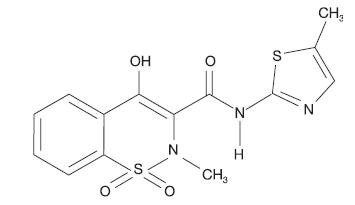
The use of meloxicam for the treatment of the signs and symptoms of osteoarthritis of the knee and hip was evaluated in a 12-week double-blind controlled trial. Meloxicam (3.75 mg, 7.5 mg and 15 mg daily) was compared to placebo. The four primary endpoints were investigator's global assessment, patient global assessment, patient pain assessment, and total WOMAC score (a self-administered questionnaire addressing pain, function and stiffness). Patients on meloxicam 7.5 mg daily and meloxicam 15 mg daily showed significant improvement in each of these endpoints compared with placebo.
The use of meloxicam for the management of signs and symptoms of osteoarthritis was evaluated in six double-blind, active-controlled trials outside the U.S. ranging from 4 weeks to 6 months duration. In these trials, the efficacy of meloxicam, in doses of 7.5 mg/day and 15 mg/day, was comparable to piroxicam 20 mg/day and diclofenac SR 100 mg/day and consistent with the efficacy seen in the U.S. trial.
The use of meloxicam for the treatment of the signs and symptoms of rheumatoid arthritis was evaluated in a 12-week double-blind, controlled multinational trial. Meloxicam (7.5 mg, 15 mg and 22.5 mg daily) was compared to placebo. The primary endpoint in this study was the ACR20 response rate, a composite measure of clinical, laboratory and functional measures of RA response. Patients receiving meloxicam 7.5 mg and 15 mg daily showed significant improvement in the primary endpoint compared with placebo. No incremental benefit was observed with the 22.5 mg dose compared to the 15 mg dose.
Higher doses of meloxicam (22.5 mg and greater) have been associated with an increased risk of serious GI events; therefore the daily dose of meloxicam should not exceed 15 mg.
The meloxicam Phase 2/3 clinical trial database includes 10,122 OA patients and 1012 RA patients treated with meloxicam 7.5 mg/day, 3,505 OA patients and 1351 RA patients treated with meloxicam 15 mg/day. Meloxicam at these doses was administered to 661 patients for at least 6 months and to 312 patients for at least one year. Approximately 10,500 of these patients were treated in ten placebo and/or active-controlled osteoarthritis trials and 2363 of these patients were treated in ten placebo and/or active-controlled rheumatoid arthritis trials. Gastrointestinal (GI) adverse events were the most frequently reported adverse events in all treatment groups across meloxicam trials.
A 12-week multicenter, double-blind, randomized trial was conducted in patients with osteoarthritis of the knee or hip to compare the efficacy and safety of meloxicam with placebo and with an active control. Two 12-week multicenter, double-blind, randomized trials were conducted in patients with rheumatoid arthritis to compare the efficacy and safety of meloxicam with placebo.
Table 2a depicts adverse events that occurred in ≥ 2% of the meloxicam treatment groups in a 12-week placebo and active-controlled osteoarthritis trial.
Table 2b depicts adverse events that occurred in ≥ 2% of the meloxicam treatment groups in two 12-week
placebo controlled rheumatoid arthritis trials.
Table 2a Adverse Events (%) Occurring in ≥ 2% of Meloxicam Patients in a 12-Week Osteoarthritis Placebo and Active-Controlled Trial| | Placebo | Meloxicam
7.5 mg daily | Meloxicam
15 mg daily | Diclofenac
100 mg daily |
|---|
| No. of Patients | 157 | 154 | 156 | 153 |
|---|
1 WHO preferred terms edema, edema dependent, edema peripheral and edema legs combined
2 WHO preferred terms rash, rash erythematous and rash maculo-papular combined |
| Gastrointestinal | 17.2
| 20.1
| 17.3
| 28.1
|
Abdominal Pain
| 2.5
| 1.9
| 2.6
| 1.3
|
Diarrhea
| 3.8
| 7.8
| 3.2
| 9.2
|
Dyspepsia
| 4.5
| 4.5
| 4.5
| 6.5
|
Flatulence
| 4.5
| 3.2
| 3.2
| 3.9
|
Nausea
| 3.2
| 3.9
| 3.8
| 7.2
|
| Body as a Whole |
|
|
|
|
| Accident Household | 1.9
| 4.5
| 3.2
| 2.6
|
Edema1
| 2.5
| 1.9
| 4.5
| 3.3
|
Fall
| 0.6
| 2.6
| 0.0
| 1.3
|
Influenza-Like Symptoms
| 5.1
| 4.5
| 5.8
| 2.6
|
| Central and Peripheral Nervous System |
|
|
|
|
Dizziness
| 3.2
| 2.6
| 3.8
| 2.0
|
Headache
| 10.2
| 7.8
| 8.3
| 5.9
|
| Respiratory |
|
|
|
|
| Pharyngitis | 1.3
| 0.6
| 3.2
| 1.3
|
Upper Respiratory Tract Infection
| 1.9
| 3.2
| 1.9
| 3.3
|
| Skin |
|
|
|
|
Rash2
| 2.5
| 2.6
| 0.6
| 2.0
|
Table 2b Adverse Events (%) Occurring in ≥ 2% of Meloxicam Patients in two 12-Week Rheumatoid Arthritis Placebo Controlled Trials| | Placebo | Meloxicam
7.5 mg
daily | Meloxicam
15 mg
daily |
|---|
1MedDRA high level term (preferred terms): dyspeptic signs and symptoms (dyspepsia, dyspepsia aggravated, eructation, gastrointestinal irritation), upper respiratory tract infections-pathogen unspecified (laryngitis NOS, pharyngitis NOS, sinusitis NOS), joint related signs and symptoms (arthralgia, arthralgia aggravated, joint crepitation, joint effusion, joint swelling), and musculoskeletal and connective tissue signs and symptoms NEC (back pain, back pain aggravated, muscle spasms, musculoskeletal pain)
2MedDRA preferred term: diarrhea NOS, nausea, abdominal pain NOS, influenza like illness, headaches NOS, dizziness (excl vertigo), and rash NOS |
| No. of Patients | 469 | 481 | 477 |
Gastrointestinal disorders
Abdominal pain NOS2
Diarrhea NOS2
Dyspeptic signs and symptoms1
Nausea2 | 14.1
0.6
5.1
3.8
2.6 | 18.9
2.9
4.8
5.8
3.3 | 16.8
2.3
3.4
4.0
3.8 |
General disorders and administration site conditions
Influenza like illness2 |
2.1 |
2.9 |
2.3 |
Infection and infestations
Upper respiratory tract infections pathogen class unspecified2 |
4.1 |
7.0 |
6.5 |
Musculoskeletal and connective tissue disorders
Joint related signs and symptoms1
Musculoskeletal and connective tissue
signs and symptoms NEC1 |
1.9
3.8 |
1.5
1.7 |
2.3
2.9 |
Nervous system disorders
Headaches NOS2
Dizziness (excl vertigo)2 |
6.4
3.0 |
6.4
2.3 |
5.5
0.4 |
Skin and subcutaneous tissue disorders
Rash NOS2 |
1.7 |
1.0 |
2.1 |
The adverse events that occurred with meloxicam in ≥ 2% of patients treated short-term (4-6 weeks) and long-term (6 months) in active-controlled osteoarthritis trials are presented in Table 3.
Table 3 Adverse Events (%) Occurring in ≥ 2% of Meloxicam Patients in 4 to 6 Weeks and 6 Month Active-Controlled Osteoarthritis Trials
| 4-6 Weeks Controlled Trials | 6 Month Controlled Trials |
|---|
| | Meloxicam
7.5 mg daily | Meloxicam
15 mg daily | Meloxicam
7.5 mg daily | Meloxicam
15 mg daily |
|---|
| No. of Patients | 8955 | 256 | 169 | 306 |
|---|
1 WHO preferred terms edema, edema dependent, edema peripheral and edema legs combined
2 WHO preferred terms rash, rash erythematous and rash maculo-papular combined |
| Gastrointestinal | 11.8
| 18.0
| 26.6
| 24.2
|
Abdominal Pain
| 2.7
| 2.3
| 4.7
| 2.9
|
Constipation
| 0.8
| 1.2
| 1.8
| 2.6
|
Diarrhea
| 1.9
| 2.7
| 5.9
| 2.6
|
Dyspepsia
| 3.8
| 7.4
| 8.9
| 9.5
|
Flatulence
| 0.5
| 0.4
| 3.0
| 2.6
|
Nausea
| 2.4
| 4.7
| 4.7
| 7.2
|
Vomiting
| 0.6
| 0.8
| 1.8
| 2.6
|
Body as a Whole
|
|
|
|
|
| Accident Household | 0.0 | 0.0 | 0.6 | 2.9 |
Edema1
| 0.6
| 2.0
| 2.4
| 1.6
|
Pain
| 0.9
| 2.0
| 3.6
| 5.2
|
Central and Peripheral Nervous System
|
|
|
|
|
Dizziness
| 1.1
| 1.6
| 2.4
| 2.6
|
Headache
| 2.4
| 2.7
| 3.6
| 2.6
|
Hematologic
|
|
|
|
|
Anemia
| 0.1
| 0.0
| 4.1
| 2.9
|
Musculoskeletal
|
|
|
|
|
Arthralgia
| 0.5
| 0.0
| 5.3
| 1.3
|
Back Pain
| 0.5
| 0.4
| 3.0
| 0.7
|
Psychiatric Disorders
|
|
|
|
|
Insomnia
| 0.4
| 0.0
| 3.6
| 1.6
|
Respiratory
|
|
|
|
|
Coughing
| 0.2
| 0.8
| 2.4
| 1.0
|
Upper Respiratory Tract Infection
| 0.2
| 0.0
| 8.3
| 7.5
|
Skin
|
|
|
|
|
Pruritus
| 0.4
| 1.2
| 2.4
| 0.0
|
Rash2
| 0.3
| 1.2
| 3.0
| 1.3
|
Urinary
|
|
|
|
|
Micturition Frequency
| 0.1
| 0.4
| 2.4
| 1.3
|
Urinary Tract Infection
| 0.3
| 0.4
| 4.7
| 6.9
|
Higher doses of meloxicam (22.5 mg and greater) have been associated with an increased risk of serious GI events; therefore the daily dose of meloxicam should not exceed 15 mg.
The following is a list of adverse drug reactions occurring in < 2% of patients receiving meloxicam in clinical trials involving approximately 16,200 patients. Adverse reactions reported only in worldwide postmarketing experience or the literature are shown in italics
Body as a Whole
| allergic reaction, anaphylactoid reactions including shock, face edema,
fatigue, fever, hot flushes, malaise, syncope, weight decrease, weight
increase |
Cardiovascular
| angina pectoris, cardiac failure, hypertension, hypotension, myocardial
infarction, vasculitis
|
Central and Peripheral
Nervous System
|
convulsions, paresthesia, tremor, vertigo
|
Gastrointestinal
| colitis, dry mouth, duodenal ulcer, eructation, esophagitis, gastric ulcer,
gastritis, gastroesophageal reflux, gastrointestinal hemorrhage, hematemesis,
hemorrhagic duodenal ulcer, hemorrhagic gastric ulcer, intestinal perforation,
melena, pancreatitis, perforated duodenal ulcer, perforated gastric ulcer,
stomatitis ulcerative
|
Heart Rate and Rhythm
| arrhythmia, palpitation, tachycardia
|
Hematologic
| agranulocytosis, leukopenia, purpura, thrombocytopenia
|
Liver and Biliary System
| ALT increased, AST increased, bilirubinemia, GGT increased, hepatitis,
jaundice, liver failure
|
Metabolic and Nutritional
| dehydration
|
Psychiatric
|
abnormal dreaming, alterations in mood (such as mood elevation), anxiety, appetite increased, confusion, depression,nervousness, somnolence
|
Respiratory
| asthma, bronchospasm, dyspnea
|
Skin and Appendages
| alopecia, angioedema, bullous eruption, erythema multiforme, photosensitivity
reaction, pruritus, exfoliative dermatitis, Stevens-Johnson syndrome,
sweating increased, toxic epidermal necrolysis, urticaria
|
Special Senses
| abnormal vision, conjunctivitis, taste perversion, tinnitus
|
Urinary System
| acute urinary retention, albuminuria, BUN increased, creatinine increased, hematuria,
interstitial nephritis, renal failure
|
Carefully consider the potential benefits and risks of meloxicam tablets and other treatment options before deciding to use meloxicam tablets. Use the lowest effective dose for the shortest duration consistent with individual patient treatment goals (see WARNINGS).
After observing the response to initial therapy with meloxicam tablets, the dose should be adjusted to suit an individual patient's needs.
For the relief of the signs and symptoms of osteoarthritis the recommended starting and maintenance oral dose of meloxicam is 7.5 mg once daily. Some patients may receive additional benefit by increasing the dose to 15 mg once daily. For the relief of the signs and symptoms of rheumatoid arthritis, the recommended starting and maintenance oral dose of meloxicam is 7.5 mg once daily. Some patients may receive additional benefit by increasing the dose to 15 mg once daily.
The maximum recommended daily oral dose of meloxicam is 15 mg regardless of formulation.
Meloxicam may be taken without regard to timing of meals.