The ED
95(dose required to produce 95% suppression of the first [T
1] mechanomyographic [MMG] response of the adductor pollicis muscle [thumb] to indirect supramaximal train-of-four stimulation of the ulnar nerve) during opioid/nitrous oxide/oxygen anesthesia is approximately 0.3 mg/kg. Patient variability around the ED
95dose suggests that 50% of patients will exhibit T
1depression of 91% to 97%.
Table 4presents intubating conditions in patients with intubation initiated at 60 to 70 seconds.
Table 4: Percent of Excellent or Good Intubating Conditions and Median (Range) Time to Completion of Intubation in Patients with Intubation Initiated at 60 to 70 Seconds
Rocuronium Bromide Dose (mg/kg) Administered Over 5 sec | Percent of Patients with Excellent or Good Intubating Conditions | Time to Completion of Intubation (min) |
Adults* 18 to 64 yrs 0.45 (n=43) 0.6 (n=51) | 86% 96% | 1.6 (1.0 to 7.0) 1.6 (1.0 to 3.2) |
Infants† 3 mo to 1 yr 0.6 (n=18) | 100% | 1.0 (1.0 to 1.5) |
Pediatric† 1 to 12 yrs 0.6 (n=12) | 100% | 1.0 (0.5 to 2.3) |
*Excludes patients undergoing Cesarean section.
†Pediatric patients were under halothane anesthesia.
Excellent intubating conditions=jaw relaxed, vocal cords apart and immobile, no diaphragmatic movement.
Good intubating conditions=same as excellent but with some diaphragmatic movement.
Table 5presents the time to onset and clinical duration for the initial dose of rocuronium bromide injection under opioid/nitrous oxide/oxygen anesthesia in adults and geriatric patients, and under halothane anesthesia in pediatric patients.
Table 5: Median (Range) Time to Onset and Clinical Duration Following Initial (Intubating) Dose during Opioid/Nitrous Oxide/Oxygen Anesthesia (Adults) and Halothane Anesthesia (Pediatric Patients) | Rocuronium Bromide Dose (mg/kg) Administered over 5 sec | Time to 80% Block (min) | Time to Maximum Block (min) | Clinical Duration (min) |
Adults 18 to 64 yrs
0.45 (n=50)
0.6 (n=142)
0.9 (n=20)
1.2 (n=18)
| 1.3 (0.8-6.2)
1.0 (0.4-6.0)
1.1 (0.3-3.8)
0.7 (0.4-1.7)
| 3.0 (1.3-8.2)
1.8 (0.6-13.0)
1.4 (0.8-6.2)
1.0 (0.6-4.7)
| 22 (12-31)
31 (15-85)
58 (27-111)
67 (38-160)
|
Geriatric 65 yrs
0.6 (n=31)
0.9 (n=5)
1.2 (n=7)
| 2.3 (1.0-8.3)
2.0 (1.0-3.0)
1.0 (0.8-3.5)
| 3.7 (1.3-11.3)
2.5 (1.2-5.0)
1.3 (1.2-4.7)
| 46 (22-73)
62 (49-75)
94 (64-138)
|
Infants 3 mo to 1 yr
0.6 (n=17)
0.8 (n=9)
| -
-
| 0.8 (0.3-3.0)
0.7 (0.5-0.8)
| 41 (24-68)
40 (27-70)
|
Pediatric 1 to 12 yrs
0.6 (n=27)
0.8 (n=18)
| 0.8 (0.4-2.0)
-
| 1.0 (0.5-3.3)
0.5 (0.3-1.0)
| 26 (17-39)
30 (17-56)
|
n=the number of patients who had time to maximum block recorded.
Clinical duration=time until return to 25% of control T1. Patients receiving doses of 0.45 mg/kg who achieved less than 90% block (16% of these patients) had about 12 to 15 minutes to 25% recovery.
Table 6presents the time to onset and clinical duration for the initial dose of rocuronium bromide injection under sevoflurane (induction) and isoflurane/nitrous oxide (maintenance) anesthesia in pediatric patients.
Table 6: Median (Range) Time to Onset and Clinical Duration Following Initial (Intubating) Dose During Sevoflurane (induction) and Isoflurane/Nitrous Oxide (maintenance) Anesthesia (Pediatric Patients)| Rocuronium Bromide Dose (mg/kg) Administered Over 5 sec | Time to Maximum Block (min) | Time to Reappearance T3 (min) |
Neonates birth to <28 days
0.45 (n=5)
0.6 (n=10)
1 (n=6)
| 1.1 (0.6-2.2)
1.0 (0.2-2.1)
0.6 (0.3-1.8)
| 40.3 (32.5-62.6)
49.7 (16.6-119.0)
114.4 (92.6-136.3)
|
Infants 28 days to ≤3 mo
0.45 (n=9)
0.6 (n=11)
1 (n=5)
| 0.5 (0.4-1.3)
0.4 (0.2-0.8)
0.3 (0.2-0.7)
| 49.1 (13.5-79.9)
59.8 (32.3-87.8)
103.3 (90.8-155.4)
|
Toddlers >3 mo to ≤2 yrs
0.45 (n=17)
0.6 (n=29)
1 (n=15)
| 0.8 (0.3-1.9)
0.6 (0.2-1.6)
0.5 (0.2-1.5)
| 39.2 (16.9-59.4)
44.2 (18.9-68.8)
72.0 (36.2-128.2)
|
Children >2 yrs to ≤11 yrs
0.45 (n=14)
0.6 (n=37)
1 (n=16)
| 0.9 (0.4-1.9)
0.8 (0.3-1.7)
0.7 (0.4-1.2)
| 21.5 (17.5-38.0)
36.7 (20.1-65.9)
53.1 (31.2-89.9)
|
Adolescents >11 to ≤17 yrs
0.45 (n=18)
0.6 (n=31)
1 (n=14)
| 1.0 (0.5-1.7)
0.9 (0.2-2.1)
0.7 (0.5-1.2)
| 37.5 (18.3-65.7)
41.4 (16.3-91.2)
67.1 (25.6-93.8)
|
n=the number of patients with the highest number of observations for time to maximum block or reappearance T
3.
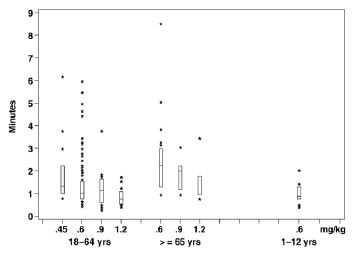
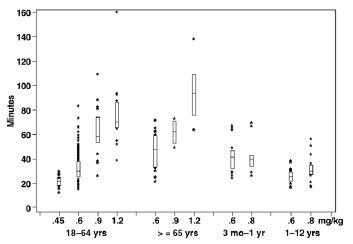
The time to 80% or greater block and clinical duration as a function of dose are presented in
Figures 1and
2.
Figure 1: Time to 80% or Greater Block vs. Initial Dose of Rocuronium Bromide by Age Group (Median, 25th and 75th Percentile, and Individual Values)
Figure 2: Duration of Clinical Effect vs. Initial Dose of Rocuronium Bromide by Age Group (Median, 25th and 75th Percentile, and Individual Values)
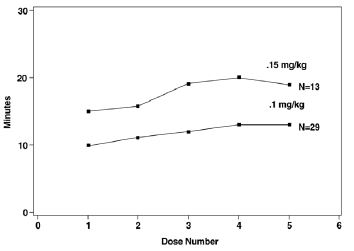
The clinical durations for the first 5 maintenance doses, in patients receiving 5 or more maintenance doses are represented in
Figure 3[see Dosage and Administration (2.4)].
Figure 3: Duration of Clinical Effect vs. Number of Rocuronium Bromide Maintenance Doses, by Dose
Once spontaneous recovery has reached 25% of control T1, the neuromuscular block produced by rocuronium bromide is readily reversed with anticholinesterase agents, e.g., edrophonium or neostigmine.
The median spontaneous recovery from 25% to 75% T
1was 13 minutes in adult patients. When neuromuscular block was reversed in 36 adults at a T
1of 22% to 27%, recovery to a T
1of 89 (50 to 132)% and T
4/T
1of 69 (38 to 92)% was achieved within 5 minutes. Only 5 of 320 adults reversed received an additional dose of reversal agent. The median (range) dose of neostigmine was 0.04 (0.01 to 0.09) mg/kg and the median (range) dose of edrophonium was 0.5 (0.3 to 1.0) mg/kg.
In geriatric patients (n=51) reversed with neostigmine, the median T
4/T
1increased from 40% to 88% in 5 minutes.
In clinical trials with halothane, pediatric patients (n=27) who received 0.5 mg/kg edrophonium had increases in the median T
4/T
1from 37% at reversal to 93% after 2 minutes. Pediatric patients (n=58) who received 1 mg/kg edrophonium had increases in the median T
4/T
1from 72% at reversal to 100% after 2 minutes. Infants (n=10) who were reversed with 0.03 mg/kg neostigmine recovered from 25% to 75% T
1within 4 minutes.
There were no reports of less than satisfactory clinical recovery of neuromuscular function.
The neuromuscular blocking action of rocuronium bromide may be enhanced in the presence of potent inhalation anesthetics
[see Drug Interactions (7.3)].
Hemodynamics
There were no dose-related effects on the incidence of changes from baseline (30% or greater) in mean arterial blood pressure (MAP) or heart rate associated with rocuronium bromide administration over the dose range of 0.12 to 1.2 mg/kg (4 × ED
95) within 5 minutes after rocuronium bromide administration and prior to intubation. Increases or decreases in MAP were observed in 2% to 5% of geriatric and other adult patients, and in about 1% of pediatric patients. Heart rate changes (30% or greater) occurred in 0% to 2% of geriatric and other adult patients. Tachycardia (30% or greater) occurred in 12 of 127 pediatric patients. Most of the pediatric patients developing tachycardia were from a single study where the patients were anesthetized with halothane and who did not receive atropine for induction
[see Clinical Studies (14.3)]. In U.S. studies, laryngoscopy and tracheal intubation following rocuronium bromide administration were accompanied by transient tachycardia (30% or greater increases) in about one-third of adult patients under opioid/nitrous oxide/oxygen anesthesia. Animal studies have indicated that the ratio of vagal: neuromuscular block following rocuronium bromide administration is less than vecuronium but greater than pancuronium. The tachycardia observed in some patients may result from this vagal blocking activity.
Histamine Release
In studies of histamine release, clinically significant concentrations of plasma histamine occurred in 1 of 88 patients. Clinical signs of histamine release (flushing, rash, or bronchospasm) associated with the administration of rocuronium bromide were assessed in clinical trials and reported in 9 of 1137 (0.8%) patients.