1 Indications And Usage
POTELIGEO is indicated for the treatment of adult patients with relapsed or refractory mycosis fungoides (MF) or Sézary syndrome (SS) after at least one prior systemic therapy.
The following Structured Product Label (SPL) was submitted to the FDA by Kyowa Kirin, Inc. for the product Poteligeo (NDC 42747-761). This document serves as the official prescribing information, containing essential scientific data and clinical materials required for healthcare providers and patients.
This specific version of the label includes detailed information regarding 1 indications and usage, 2.1 recommended dosage, 3 dosage forms and strengths, 4 contraindications, 5.1 dermatologic toxicity, 5.2 infusion reactions, 5.3 infections, 5.4 autoimmune complications, and other regulatory disclosures. Use the navigation below to review specific sections of the FDA submission.
POTELIGEO is indicated for the treatment of adult patients with relapsed or refractory mycosis fungoides (MF) or Sézary syndrome (SS) after at least one prior systemic therapy.
The recommended dose of POTELIGEO is 1 mg/kg administered as an intravenous infusion over at least 60 minutes. Administer on days 1, 8, 15, and 22 of the first 28-day cycle, then on days 1 and 15 of each subsequent 28-day cycle until disease progression or unacceptable toxicity.
Administer POTELIGEO within 2 days of the scheduled dose. If a dose is missed, administer the next dose as soon as possible and resume dosing schedule.
Do not administer POTELIGEO subcutaneously or by rapid intravenous administration.
Injection: 20 mg/5 mL (4 mg/mL) as a clear to slightly opalescent colorless solution in a single-dose vial.
None.
Fatal and life-threatening skin adverse reactions, including Stevens-Johnson syndrome (SJS) and toxic epidermal necrolysis (TEN), have occurred in recipients of POTELIGEO. Rash (drug eruption) is one of the most common adverse reactions associated with POTELIGEO. In Study 0761-010, 25% (80/319) of patients treated with POTELIGEO had an adverse reaction of drug eruption, with 18% of these cases being severe (Grade 3) and 82% of these cases being Grade 1 or 2. Of 528 patients treated with POTELIGEO in clinical trials, Grade 3 skin adverse reactions were reported in 3.6%, Grade 4 skin adverse reactions in <1%, and SJS in <1%.
The onset of drug eruption is variable, and the affected areas and appearance vary. In Study 0761-010, the median time to onset was 15 weeks, with 25% of cases occurring after 31 weeks. The more common presentations reported included papular or maculopapular rash, lichenoid, spongiotic or granulomatous dermatitis, and morbilliform rash. Other presentations included scaly plaques, pustular eruption, folliculitis, non-specific dermatitis, and psoriasiform dermatitis.
Monitor patients for rash throughout the treatment course. Management of dermatologic toxicity includes topical corticosteroids and interruption or permanent cessation of POTELIGEO [see Dosage and Administration (2.2)]. Consider skin biopsy to help distinguish drug eruption from disease progression.
Discontinue POTELIGEO permanently for SJS or TEN or for any life-threatening (Grade 4) reaction. For possible SJS or TEN, interrupt POTELIGEO and do not restart unless SJS or TEN is ruled out and the cutaneous reaction has resolved to Grade 1 or less.
Fatal and life-threatening infusion reactions have been reported in patients treated with POTELIGEO. In Study 0761-010, infusion reactions occurred in 35% (112/319) of patients treated with POTELIGEO, with 8% of these reactions being severe (Grade 3). Most reactions (approximately 90%) occur during or shortly after the first infusion. Infusion reactions can also occur with subsequent infusions. The most commonly reported signs include chills, nausea, fever, tachycardia, rigors, headache, and vomiting.
Consider premedication (such as diphenhydramine and acetaminophen) for the first infusion of POTELIGEO in all patients. Whether premedication reduces the risk or severity of these reactions is not established. In Study 0761-010, infusion reactions occurred in 42% of patients without premedication and 32% of patients with premedication. Monitor patients closely for signs and symptoms of infusion reactions and interrupt the infusion for any grade reaction and treat promptly [see Dosage and Administration (2.2)].
Fatal and life-threatening infections have occurred in patients treated with POTELIGEO, including sepsis, pneumonia, and skin infection. In Study 0761-010, 18% (34/184) of patients randomized to POTELIGEO had Grade 3 or higher infection or an infection-related serious adverse reaction. Monitor patients for signs and symptoms of infection and treat promptly.
Fatal and life-threatening immune-mediated complications have been reported in recipients of POTELIGEO. Grade 3 or higher immune-mediated or possibly immune-mediated reactions have included myositis, myocarditis, polymyositis, hepatitis, pneumonitis, glomerulonephritis and a variant of Guillain-Barré syndrome. Use of systemic immunosuppressants for immune-mediated reactions was reported in 1.9% (6/319) of recipients of POTELIGEO in Study 0761-010, including for a case of Grade 2 polymyalgia rheumatica. New-onset hypothyroidism (Grade 1 or 2) was reported in 1.3% of patients and managed with observation or levothyroxine. Interrupt or permanently discontinue POTELIGEO as appropriate for suspected immune-mediated adverse reactions. Consider the benefit/risk of POTELIGEO in patients with a history of autoimmune disease.
Increased risks of transplant complications have been reported in patients who receive allogeneic HSCT after POTELIGEO including severe (Grade 3 or 4) acute graft-versus-host disease (GVHD), steroid-refractory GVHD, and transplant-related death. Among recipients of pre-transplantation POTELIGEO, a higher risk of transplant complications has been reported if POTELIGEO is given within a shorter time frame (approximately 50 days) before HSCT. Follow patients closely for early evidence of transplant-related complications.
The following serious adverse reactions are discussed in greater detail in other sections of the labeling:
Because clinical trials are conducted under widely varying conditions, adverse reaction rates observed in the clinical trials of a drug cannot be directly compared to rates in the clinical trials of another drug and may not reflect the rates observed in practice.
The following adverse reactions have been identified during post-approval use of POTELIGEO. Because these reactions are reported voluntarily from a population of uncertain size, it is not always possible to reliably estimate their frequency or establish a causal relationship to drug exposure.
POTELIGEO is not recommended during pregnancy or in women of childbearing potential not using contraception.
The safety and effectiveness of POTELIGEO in pediatric patients have not been established.
Of 319 patients with MF or SS who received POTELIGEO in Study 0761-010, 162 (51%) were ≥65 years. No overall differences in effectiveness were observed between these patients and younger patients. In patients aged ≥65, Grade 3 or higher adverse reactions were reported in 45% and serious adverse reactions in 36%, whereas in patients aged <65, Grade 3 or higher adverse reactions were reported in 36% and serious adverse reactions in 29%.
Mogamulizumab-kpkc is a recombinant humanized monoclonal antibody that targets CC chemokine receptor 4 (CCR4)-expressing cells. Mogamulizumab-kpkc is an IgG1 kappa immunoglobulin that has a calculated molecular mass of approximately 149 kDa. Mogamulizumab-kpkc is produced by recombinant DNA technology in Chinese hamster ovary cells.
POTELIGEO (mogamulizumab-kpkc) injection is a sterile, ready-to-use, preservative-free, clear to slightly opalescent colorless solution in a single-dose vial for dilution prior to intravenous infusion. Each vial contains 20 mg of mogamulizumab-kpkc in 5 mL of solution. Each mL of solution contains 4 mg of mogamulizumab-kpkc and is formulated in: citric acid monohydrate (0.44 mg), glycine (22.5 mg), polysorbate 80 (0.2 mg), and Water for Injection, USP. May contain hydrochloric acid/sodium hydroxide to adjust pH to 5.5.
Mogamulizumab-kpkc is a defucosylated, humanized IgG1 kappa monoclonal antibody that binds to CCR4, a G protein-coupled receptor for CC chemokines that is involved in the trafficking of lymphocytes to various organs. Non-clinical in vitro studies demonstrate mogamulizumab-kpkc binding targets a cell for antibody-dependent cellular cytotoxicity (ADCC) resulting in depletion of the target cells. CCR4 is expressed on the surface of some T-cell malignancies and is expressed on regulatory T-cells (Treg) and a subset of Th2 T-cells.
Mogamulizumab-kpkc exposure-response relationships and the time course of pharmacodynamics response are unknown.
Mogamulizumab-kpkc pharmacokinetics (PK) was evaluated in patients with T-cell malignancies. Parameters are presented as the geometric mean [% coefficient of variation (%CV)] unless otherwise specified. Mogamulizumab-kpkc concentrations increased proportionally with dose over the dose range of 0.01 to 1.0 mg/kg (0.01 to 1 times the approved recommended dosage).
Following repeated dosing of the approved recommended dosage, steady state concentrations were reached after 8 doses (12 weeks), and the systemic accumulation was 1.6-fold. At steady state, the peak concentration (Cmax,ss) is 32 (68%) µg/mL, the trough concentration (Cmin,ss) is 11 (239%) µg/mL, and AUCss is 5,577 (125%) µg∙hr/mL.
As with all therapeutic proteins, there is a potential for immunogenicity. The detection of antibody formation is highly dependent on the sensitivity and specificity of the assay. Additionally, the observed incidence of antibody (including neutralizing antibody) positivity in an assay may be influenced by several factors, including assay methodology, sample handling, timing of sample collection, concomitant medications, and underlying disease. For these reasons, comparison of incidence of antibodies to POTELIGEO with the incidences of antibodies in other studies or to other products may be misleading.
Among 313 patients treated with POTELIGEO and whose antibodies were tested, 44 (14.1%) tested positive for anti-mogamulizumab-kpkc antibodies. There was no identified clinically significant effect of anti-drug antibodies on pharmacokinetics, safety, or effectiveness of POTELIGEO. There were no positive neutralizing antibody responses.
No carcinogenicity or genotoxicity studies have been conducted with POTELIGEO.
No specific studies have been conducted to evaluate potential effects of POTELIGEO on fertility. No mogamulizumab-kpkc -related toxic effects in the male and female reproductive organs were observed in sexually mature monkeys in repeat-dose toxicology studies up to 26 weeks in duration.
POTELIGEO (mogamulizumab-kpkc) injection is a sterile, preservative-free, clear to slightly opalescent colorless solution supplied in a carton containing one 20 mg/5 mL (4 mg/mL), single-dose glass vial (NDC 42747-761-01).
Advise the patient to read the FDA-approved patient labeling (Patient Information).
Inform patients of the risk of the following adverse reactions that may require additional treatment and/or withholding or discontinuation of POTELIGEO including:
Rx only
NDC 42747-761-01
POTELIGEO®
(mogamulizumab-kpkc)
Injection
20 mg/5 mL (4 mg/mL)
For Intravenous Infusion
After Dilution
Single-dose vial.
Discard unused portion.
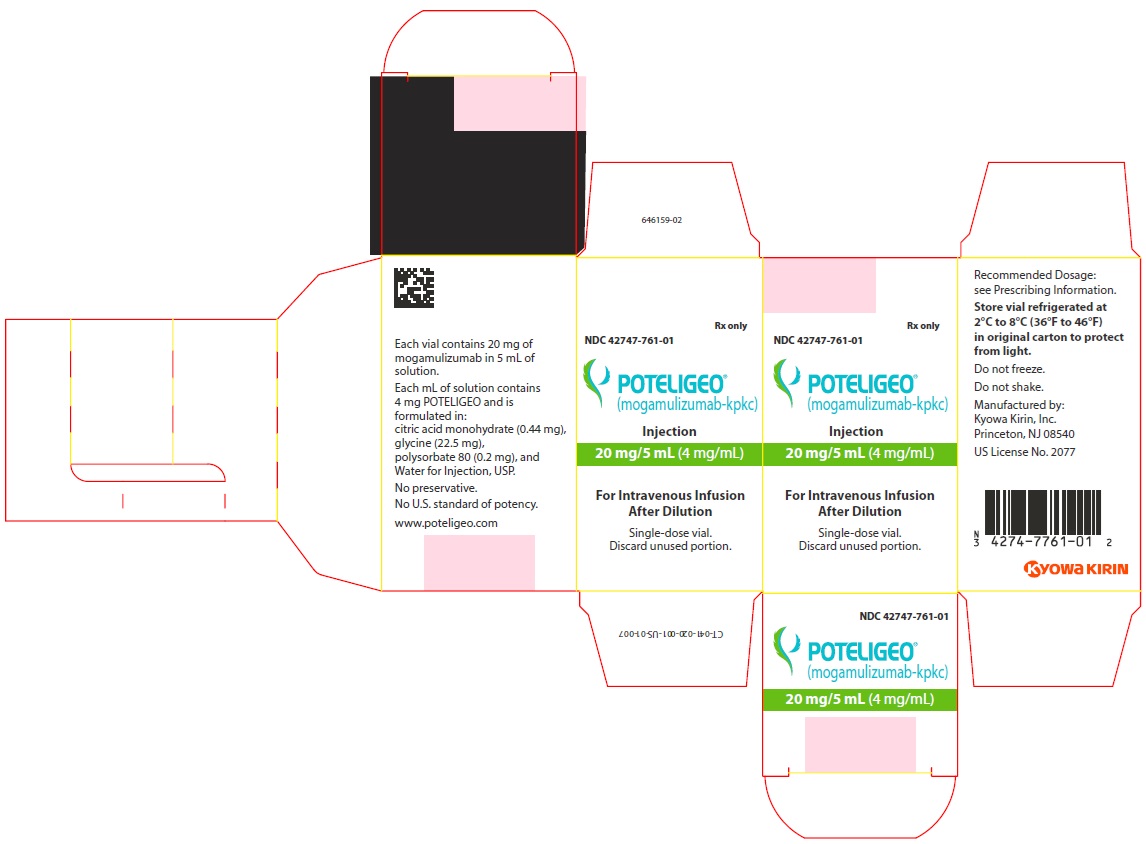
Principal Display Panel (4 mg/mL Vial Carton)
* Please review the disclaimer below.
