Pharmacokinetics
Absorption
Calcitriol is rapidly absorbed from the intestine. Peak serum concentrations (above basal values) were reached within 3 to 6 hours following oral administration of single doses of 0.25 to 1.0 mcg of Calcitriol. Following a single oral dose of 0.5 mcg, mean serum concentrations of calcitriol rose from a baseline value of 40.0±4.4 (SD) pg/mL to 60.0±4.4 pg/mL at 2 hours, and declined to 53.0±6.9 at 4 hours, 50±7.0 at 8 hours, 44±4.6 at 12 hours, and 41.5±5.1 at 24 hours. Following multiple-dose administration, serum calcitriol levels reached steady-state within 7 days.
Distribution
Calcitriol is approximately 99.9% bound in blood. Calcitriol and other vitamin D metabolites are transported in blood, by an alpha-globulin vitamin D binding protein. There is evidence that maternal calcitriol may enter the fetal circulation. Calcitriol is transferred into human breast milk at low levels (ie, 2.2±0.1 pg/mL).
Metabolism
In vivo and
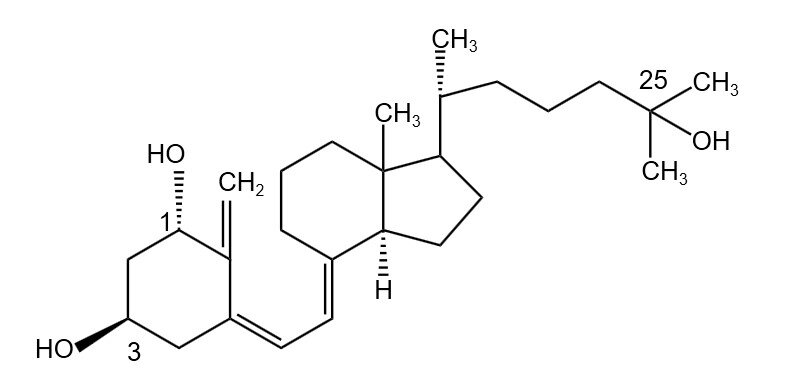
in vitro studies indicate the presence of two pathways of metabolism for calcitriol. The first pathway involves the 24-hydroxylase as the first step in catabolism of calcitriol. There is definite evidence of 24-hydroxylase activity in the kidney; this enzyme is also present in many target tissues which possess the vitamin D receptor such as the intestine. The end product of this pathway is a side chain shortened metabolite, calcitroic acid. The second pathway involves the conversion of calcitriol via the stepwise hydroxylation of carbon-26 and carbon-23, and cyclization to yield ultimately 1α,25R(OH) -26, 23S-lactone D
3. The lactone appears to be the major metabolite circulating in humans, with mean serum concentrations of 131±17 pg/mL. In addition, several other metabolites of calcitriol have been identified: 1α,25(OH)2-24-oxo-D
3; 1α,23,25(OH)
3-24-oxo-D
3; 1α,24R,25(OH)
3D
3; 1α,25S,26(OH)
3D
3; 1α,25(OH)
2-23-oxo-D
3; 1α, 25R,26(OH) 3-23-oxo-D
3; 1α,(OH)24,25,26,27-tetranor-COOH-D
3.
Excretion
Enterohepatic recycling and biliary excretion of calcitriol occur. The metabolites of calcitriol are excreted primarily in feces. Following intravenous administration of radiolabeled calcitriol in normal subjects, approximately 27% and 7% of the radioactivity appeared in the feces and urine, respectively, within 24 hours. When a 1-mcg oral dose of radiolabeled calcitriol was administered to normal subjects, approximately 10% of the total radioactivity appeared in urine within 24 hours. Cumulative excretion of radioactivity on the sixth day following intravenous administration of radiolabeled calcitriol averaged 16% in urine and 49% in feces. The elimination half-life of calcitriol in serum after single oral doses is about 5 to 8 hours in normal subjects.
Special Populations
Pediatric Pharmacokinetics
The steady-state pharmacokinetics of oral calcitriol were determined in a small group of pediatric patients (age range: 1.8 to 16 years) undergoing peritoneal dialysis. Calcitriol was administered for 2 months at an average dose of 10.2 ng/kg (SD 5.5ng/kg). In this pediatric population, mean C
maxwas 116 pmol/L, mean serum half-life was 27.4 hours, and mean clearance was 15.3 mL/hr/kg
1.
Geriatric
No studies have examined the pharmacokinetics of calcitriol in geriatric patients.
Gender
Controlled studies examining the influence of gender on calcitriol have not been conducted.
Hepatic Insufficiency
Controlled studies examining the influence of hepatic disease on calcitriol have not been conducted.
Renal Insufficiency
Lower predose and peak calcitriol levels in serum were observed in patients with nephrotic syndrome and in patients undergoing hemodialysis compared with healthy subjects. The elimination half-life of calcitriol increased by at least twofold in chronic renal failure and hemodialysis patients compared with healthy subjects. Peak serum levels in patients with nephrotic syndrome were reached in 4 hours. For patients requiring hemodialysis peak serum levels were reached in 8 to 12 hours; half-lives were estimated to be 16.2 and 21.9 hours, respectively.