Motion Sickness
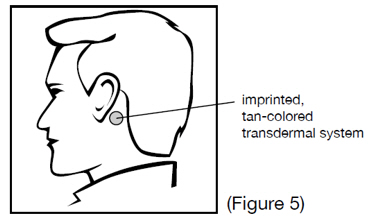
Apply one scopolamine transdermal system to the hairless area behind one ear at least 4 hours before the antiemetic effect is required – for use up to 3 days. If therapy is required for longer than 3 days, remove the first transdermal system and apply a new scopolamine transdermal system behind the other ear.
PONV
For surgeries other than cesarean section: Apply one scopolamine transdermal system the evening before scheduled surgery. Remove the transdermal system 24 hours following surgery.
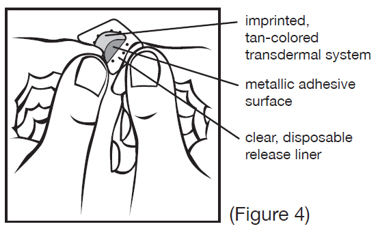
Transdermal system: round patch with a tan coloured backing layer placed on a squarish release liner. The release liner is dimpled. The backing has an imprint of "Scopolamine 1 mg/3 days". The matrix is dispersed white and may contain light spots and is free of visible crystals.
Psychiatric Adverse Reactions
Scopolamine has been reported to exacerbate psychosis. Other psychiatric reactions have also been reported, including acute toxic psychosis, agitation, speech disorder, hallucinations, paranoia, and delusions [see Adverse Reactions (6.2)]. Monitor patients for new or worsening psychiatric symptoms during treatment with scopolamine transdermal system. Also, monitor patients for new or worsening psychiatric symptoms during concomitant treatment with other drugs that are associated with similar psychiatric effects [see Drug Interactions (7.1)]. In cases of psychiatric reactions occurring, scopolamine transdermal system should be removed at once. If, despite this, the symptoms persist in a severe form, instruct patients to seek medical attention.
Seizures
Seizures and seizure-like activity have been reported in patients receiving scopolamine. Weigh this potential risk against the benefits before prescribing scopolamine transdermal system to patients with a history of seizures, including those receiving anti-epileptic medication or who have risk factors that can lower the seizure threshold.
Cognitive Adverse Reactions
Scopolamine can cause drowsiness, disorientation, and confusion. Discontinue scopolamine transdermal system if signs or symptoms of cognitive impairment develop. If, despite this, the symptoms persist in a severe form, instruct patients to seek medical attention. Elderly and pediatric patients may be more sensitive to the neurological and psychiatric effects of scopolamine transdermal system. Consider more frequent monitoring during treatment with scopolamine transdermal system in elderly patients [see Use in Specific Populations (8.5)]. Scopolamine transdermal system is not approved for use in pediatric patients [see Use in Specific Populations (8.4)].
Hazardous Activities
Scopolamine transdermal system may impair the mental and/or physical abilities required for the performance of hazardous tasks such as driving a motor vehicle, operating machinery, or participating in underwater sports. Concomitant use of other drugs that cause central nervous system (CNS) adverse reactions (e.g., alcohol, sedatives, hypnotics, opiates, and anxiolytics) or have anticholinergic properties (e.g., other belladonna alkaloids, sedating antihistamines, meclizine, tricyclic antidepressants, and muscle relaxants) may increase this effect [see Drug Interactions (7.1)]. Inform patients not to operate motor vehicles or other dangerous machinery or participate in underwater sports until they are reasonably certain that scopolamine transdermal system does not affect them adversely.
Motion Sickness
The most common adverse reaction (approximately two thirds) was dry mouth. Less common adverse reactions included drowsiness (less than one sixth), blurred vision, and dilation of the pupils.
PONV
Common adverse reactions, occurring in at least 3% of patients in PONV clinical trials, are shown in Table 1.
Table 1 Common Adverse Reactionsoccurring in at least 3% of patients and at a rate higher than placebo
in Surgical Patients for the Prevention of PONV | Scopolamine Transdermal System % (N=461) | Placebo
% (N=457) |
|---|
| % | % |
|---|
| Dry Mouth | 29 | 16 |
| Dizziness | 12 | 7 |
| Somnolence | 8 | 4 |
| Agitation | 6 | 4 |
| Visual Impairment | 5 | 3 |
| Confusion | 4 | 3 |
| Mydriasis | 4 | 0 |
| Pharyngitis | 3 | 2 |
Risk Summary
Eclamptic seizures have been reported in pregnant women with severe preeclampsia soon after injection of intravenous or intramuscular scopolamine. Avoid use of scopolamine transdermal system in patients with severe preeclampsia [see Warnings and Precautions (5.3) and Data]. Available data from observational studies and postmarketing reports with scopolamine use in pregnant women have not identified a drug associated risk of major birth defects, miscarriage, or adverse fetal outcomes.
In animal studies, there was no evidence of adverse developmental effects with intravenous administration of scopolamine hydrobromide revealed in rats. Embryotoxicity was observed in rabbits at intravenous doses producing plasma levels approximately 100 times the levels achieved in humans using a transdermal system.
The background risk of major birth defects and miscarriage for the indicated population is unknown. All pregnancies have a background risk of birth defect, loss, or other adverse outcomes. In the U.S. general population, the background risk of major birth defects and miscarriage in clinically recognized pregnancies is 2% to 4% and 15% to 20%, respectively.
Data
Human Data
In published case reports, two pregnant patients with severe preeclampsia were administered intravenous and intramuscular scopolamine, respectively, and developed eclamptic seizures soon after scopolamine administration [see Warnings and Precautions (5.3)].
Animal Data
In animal reproduction studies, when pregnant rats and rabbits received scopolamine hydrobromide by daily intravenous injection, no adverse effects were observed in rats. An embryotoxic effect was observed in rabbits at doses producing plasma levels approximately 100 times the levels achieved in humans using a transdermal system. Scopolamine administered parenterally to rats and rabbits at doses higher than the dose delivered by scopolamine transdermal system did not affect uterine contractions or increase the duration of labor.
Risk Summary
Scopolamine is present in human milk. There are no available data on the effects of scopolamine on the breastfed infant or the effects on milk production. The developmental and health benefits of breastfeeding should be considered along with the mother's clinical need for scopolamine transdermal system and any potential adverse effects on the breastfed child from scopolamine transdermal system or from the underlying maternal condition.
Absorption
Following application to the skin behind the ear, circulating plasma concentrations are detected within 4 hours with peak concentrations being obtained, on average, within 24 hours. The average plasma concentration produced is 87 pg/mL (0.28 nM) for free scopolamine and 354 pg/mL for total scopolamine (free + conjugates). Following removal of the used transdermal system, there is some degree of continued systemic absorption of scopolamine bound in the skin layers.
Distribution
The distribution of scopolamine is not well characterized. It crosses the placenta and the blood brain barrier and may be reversibly bound to plasma proteins.
Elimination
Metabolism and Excretion
Scopolamine is metabolized and conjugated with less than 5% of the total dose appearing unchanged in the urine. The enzymes responsible for metabolizing scopolamine are unknown. The exact elimination pattern of scopolamine has not been determined. Following transdermal system removal, plasma concentrations of scopolamine decline in a log linear fashion with an observed half-life of 9.5 hours. Less than 10% of the total dose is excreted in the urine as the parent drug and metabolites over 108 hours.
Drug Interaction Studies
An in vitro study using human hepatocytes examined the induction of CYP1A2 and CYP3A4 by scopolamine. Scopolamine did not induce CYP1A2 and CYP3A4 isoenzymes at the concentrations up to 10 nM. In an in vitro study using human liver microsomes which evaluated the inhibition of CYP1A2, 2C8, 2C9, 2C19, 2D6 and 3A4, scopolamine did not inhibit these cytochrome P450 isoenzymes at the concentrations up to 1 micromolar. No in vivo drug-drug interaction studies have been conducted.
Administration Instructions
Counsel patients on how to apply and remove the transdermal system [see Dosage and Administration (2.1)]:
- Only wear one transdermal system at any time.
- Do not cut the transdermal system.
- Apply the transdermal system to the skin in the postauricular (hairless area behind one ear) area.
- After the transdermal system is applied on the dry skin behind the ear, wash hands thoroughly with soap and water and dry hands.
- If the transdermal system becomes displaced, discard the transdermal system, and apply a new transdermal system on the hairless area behind the other ear.
- Once the transdermal system has been affixed, avoid touching or applying pressure to the transdermal system, since pressure exerted on it may cause scopolamine to ooze out at the edge.
- Upon removal, fold the used transdermal system in half with the sticky side together, and discard in household trash in a manner that prevents accidental contact or ingestion by children, pets, or others.
- Wash the hands and application site with soap and water after transdermal system removal.
Patients with Open-Angle Glaucoma
Advise patients with open-angle glaucoma to remove the scopolamine transdermal system immediately and contact their healthcare provider if they experience symptoms of acute angle closure glaucoma, including pain and reddening of the eyes, accompanied by dilated pupils, blurred vision and/or seeing halos around lights [see Warnings and Precautions (5.1)].
Neuropsychiatric Adverse Reactions
- Advise patients that psychiatric adverse reactions may occur, especially in patients with a past psychiatric history or in those receiving other drugs also associated with psychiatric effects, and to report to their healthcare provider any new or worsening psychiatric symptoms.
- Advise patients to discontinue scopolamine transdermal system and contact a healthcare provider immediately if they experience a seizure.
- Advise patients, especially elderly patients, that cognitive impairment may occur during treatment with scopolamine transdermal system, especially in those receiving other drugs also associated with CNS effects, and to report to their healthcare provider if they develop signs or symptoms of cognitive impairment such as hallucinations, confusion, or dizziness.
- Inform patients not to operate motor vehicles or other dangerous machinery or participate in underwater sports until they are reasonably certain that scopolamine transdermal system does not affect them adversely [see Warnings and Precautions (5.2)].
Decreased Gastrointestinal Motility and Urinary Retention
Instruct patients to remove the transdermal system if they develop symptoms of intestinal obstruction (abdominal pain, nausea, or vomiting) or any difficulties in urinating [see Warnings and Precautions (5.4)].
Drug Withdrawal/Post-Removal Symptoms
Inform patients that if they remove the scopolamine transdermal system before treatment is complete, withdrawal symptoms may occur and to seek immediate medical care if they develop severe symptoms after removing scopolamine transdermal system [see Warnings and Precautions (5.5)].
Blurred Vision
Inform patients that temporary dilation of the pupils and blurred vision may occur if scopolamine transdermal system comes in contact with the eyes. Instruct patients to wash their hands thoroughly with soap and water immediately after handling the transdermal system, do not touch the system while wearing it, and wash hands and the application site with soap and water after transdermal system removal [see Dosage and Administration (2.1), Warnings and Precautions (5.6)].
MRI Skin Burns
Instruct patients to remove the scopolamine transdermal system before undergoing an MRI [see Warnings and Precautions (5.7)].
Manufactured by:
LTS Lohmann Therapie-Systeme AG
Andernach, 56626, Germany
Marketed by:
Rhodes Pharmaceuticals
Wilson, NC 27893 USA
For more information, call Rhodes Pharmaceuticals at 1-888-827-0616
Revised: 4/2024