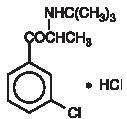
(See also WARNINGS and PRECAUTIONS.)
The information included under the Incidence in Controlled Trials subsection of ADVERSE REACTIONS is based primarily on data from controlled clinical trials with bupropion hydrochloride extended-release tablets (SR). Information on additional adverse events associated with the sustained-release formulation of bupropion in smoking cessation trials, as well as the immediate-release formulation of bupropion, is included in a separate section (see Other Events Observed During the Clinical Development and Postmarketing Experience of Bupropion).
Incidence in Controlled Trials With Bupropion:
Adverse Events Associated With Discontinuation of Treatment Among Patients Treated With Bupropion Hydrochloride Extended-Release Tablets (SR): In placebo-controlled clinical trials, 9% and 11% of patients treated with 300 and 400 mg/day, respectively, of bupropion hydrochloride extended-release tablets (SR) and 4% of patients treated with placebo discontinued treatment due to adverse events. The specific adverse events in these trials that led to discontinuation in at least 1% of patients treated with either 300 mg or 400 mg/day of bupropion hydrochloride extended-release tablets (SR) and at a rate at least twice the placebo rate are listed in Table 4.
Table 4. Treatment Discontinuations Due to Adverse Events in Placebo-Controlled Trials
Adverse
Event Term | Bupropion Hydrochloride
Extended-Release Tablets (SR)
300 mg/day
(n=376) | Bupropion Hydrochloride
Extended-Release Tablets (SR)
400 mg/day
(n=114) |
Placebo
(n=385) |
Rash
Nausea
Agitation
Migraine | 2.4%
0.8%
0.3%
0.0% | 0.9%
1.8%
1.8%
1.8% | 0.0%
0.3%
0.3%
0.3% |
Adverse Events Occurring at an Incidence of 1% or More Among Patients Treated With Bupropion Hydrochloride Extended-Release Tablets (SR): Table 5 enumerates treatment-emergent adverse events that occurred among patients treated with 300 and 400 mg/day of bupropion hydrochloride extended-release tablets (SR) and with placebo in placebo-controlled trials. Events that occurred in either the 300- or 400-mg/day group at an incidence of 1% or more and were more frequent than in the placebo group are included. Reported adverse events were classified using a COSTART-based Dictionary.
Accurate estimates of the incidence of adverse events associated with the use of any drug are difficult to obtain. Estimates are influenced by drug dose, detection technique, setting, physician judgments, etc. The figures cited cannot be used to predict precisely the incidence of untoward events in the course of usual medical practice where patient characteristics and other factors differ from those that prevailed in the clinical trials. These incidence figures also cannot be compared with those obtained from other clinical studies involving related drug products as each group of drug trials is conducted under a different set of conditions.
Finally, it is important to emphasize that the tabulation does not reflect the relative severity and/or clinical importance of the events. A better perspective on the serious adverse events associated with the use of bupropion hydrochloride extended-release tablets (SR) is provided in the WARNINGS and PRECAUTIONS sections.
Table 5. Treatment-Emergent Adverse Events in Placebo-Controlled Trials*
Body System/
Adverse Event | Bupropion
Hydrochloride
Extended-Release
Tablets (SR)
300 mg/day
(n=376) | Bupropion
Hydrochloride
Extended-Release
Tablets (SR)
400 mg/day
(n=114) |
Placebo
(n=385) |
| * Adverse events that occurred in at least 1% of patients treated with either 300 or 400 mg/day of bupropion hydrochloride extended-release tablets (SR), but equally or more frequently in the placebo group, were: abnormal dreams, accidental injury, acne, appetite increased, back pain, bronchitis, dysmenorrhea, dyspepsia, flatulence, flu syndrome, hypertension, neck pain, respiratory disorder, rhinitis, and tooth disorder. |
| † Incidence based on the number of female patients. |
| - Hyphen denotes adverse events occurring in greater than 0 but less than 0.5% of patients. |
| Body (General) | | | |
| Headache | 26% | 25% | 23% |
| Infection | 8% | 9% | 6% |
| Abdominal pain | 3% | 9% | 2% |
| Asthenia | 2% | 4% | 2% |
| Chest pain | 3% | 4% | 1% |
| Pain | 2% | 3% | 2% |
| Fever | 1% | 2% | - |
| Cardiovascular | | | |
| Palpitation | 2% | 6% | 2% |
| Flushing | 1% | 4% | - |
| Migraine | 1% | 4% | 1% |
| Hot flashes | 1% | 3% | 1% |
| Digestive | | | |
| Dry mouth | 17% | 24% | 7% |
| Nausea | 13% | 18% | 8% |
| Constipation | 10% | 5% | 7% |
| Diarrhea | 5% | 7% | 6% |
| Anorexia | 5% | 3% | 2% |
| Vomiting | 4% | 2% | 2% |
| Dysphagia | 0% | 2% | 0% |
| Musculoskeletal | | | |
| Myalgia | 2% | 6% | 3% |
| Arthralgia | 1% | 4% | 1% |
| Arthritis | 0% | 2% | 0% |
| Twitch | 1% | 2% | - |
| Nervous system | | | |
| Insomnia | 11% | 16% | 6% |
| Dizziness | 7% | 11% | 5% |
| Agitation | 3% | 9% | 2% |
| Anxiety | 5% | 6% | 3% |
| Tremor | 6% | 3% | 1% |
| Nervousness | 5% | 3% | 3% |
| Somnolence | 2% | 3% | 2% |
| Irritability | 3% | 2% | 2% |
| Memory decreased | - | 3% | 1% |
| Paresthesia | 1% | 2% | 1% |
| Central nervous | | | |
| system stimulation | 2% | 1% | 1% |
| Respiratory | | | |
| Pharyngitis | 3% | 11% | 2% |
| Sinusitis | 3% | 1% | 2% |
| Increased cough | 1% | 2% | 1% |
| Skin | | | |
| Sweating | 6% | 5% | 2% |
| Rash | 5% | 4% | 1% |
| Pruritus | 2% | 4% | 2% |
| Urticaria | 2% | 1% | 0% |
| Special senses | | | |
| Tinnitus | 6% | 6% | 2% |
| Taste perversion | 2% | 4% | - |
| Blurred vision or diplopia | 3% | 2% | 2% |
| Urogenital | | | |
| Urinary frequency | 2% | 5% | 2% |
| Urinary urgency | - | 2% | 0% |
| Vaginal hemorrhage† | 0% | 2% | - |
| Urinary tract infection | 1% | 0% | - |
Incidence of Commonly Observed Adverse Events in Controlled Clinical Trials: Adverse events from Table 5 occurring in at least 5% of patients treated with bupropion hydrochloride extended-release tablets (SR) and at a rate at least twice the placebo rate are listed below for the 300- and 400-mg/day dose groups.
Bupropion Hydrochloride Extended-release Tablets (SR) 300 mg/day: Anorexia, dry mouth, rash, sweating, tinnitus, and tremor.
Bupropion Hydrochloride Extended-release Tablets (SR) 400 mg/day: Abdominal pain, agitation, anxiety, dizziness, dry mouth, insomnia, myalgia, nausea, palpitation, pharyngitis, sweating, tinnitus, and urinary frequency.
Other Events Observed During the Clinical Development and Postmarketing Experience of Bupropion:
In addition to the adverse events noted above, the following events have been reported in clinical trials and postmarketing experience with the sustained-release formulation of bupropion in depressed patients and in nondepressed smokers, as well as in clinical trials and postmarketing clinical experience with the immediate-release formulation of bupropion.
Adverse events for which frequencies are provided below occurred in clinical trials with the sustained-release formulation of bupropion. The frequencies represent the proportion of patients who experienced a treatment-emergent adverse event on at least one occasion in placebo-controlled studies for depression (n = 987) or smoking cessation (n = 1,013), or patients who experienced an adverse event requiring discontinuation of treatment in an open-label surveillance study with bupropion hydrochloride extended-release tablets (SR) (n = 3,100). All treatment-emergent adverse events are included except those listed in Tables 2 through 5, those events listed in other safety-related sections, those adverse events subsumed under COSTART terms that are either overly general or excessively specific so as to be uninformative, those events not reasonably associated with the use of the drug, and those events that were not serious and occurred in fewer than 2 patients. Events of major clinical importance are described in the WARNINGS and PRECAUTIONS sections of the labeling.
Events are further categorized by body system and listed in order of decreasing frequency according to the following definitions of frequency: Frequent adverse events are defined as those occurring in at least 1/100 patients. Infrequent adverse events are those occurring in 1/100 to 1/1,000 patients, while rare events are those occurring in less than 1/1,000 patients.
Adverse events for which frequencies are not provided occurred in clinical trials or postmarketing experience with bupropion. Only those adverse events not previously listed for sustained-release bupropion are included. The extent to which these events may be associated with bupropion hydrochloride extended-release tablets (SR) is unknown.
Body (General): Infrequent were chills, facial edema, musculoskeletal chest pain, and photosensitivity. Rare was malaise. Also observed were arthralgia, myalgia, and fever with rash and other symptoms suggestive of delayed hypersensitivity. These symptoms may resemble serum sickness (see PRECAUTIONS).
Cardiovascular: Infrequent were postural hypotension, stroke, tachycardia, and vasodilation. Rare was syncope. Also observed were complete atrioventricular block, extrasystoles, hypotension, hypertension (in some cases severe, see PRECAUTIONS), myocardial infarction, phlebitis, and pulmonary embolism.
Digestive: Infrequent were abnormal liver function, bruxism, gastric reflux, gingivitis, glossitis, increased salivation, jaundice, mouth ulcers, stomatitis, and thirst. Rare was edema of tongue. Also observed were colitis, esophagitis, gastrointestinal hemorrhage, gum hemorrhage, hepatitis, intestinal perforation, liver damage, pancreatitis, and stomach ulcer.
Endocrine: Also observed were hyperglycemia, hypoglycemia, and syndrome of inappropriate antidiuretic hormone.
Hemic and Lymphatic: Infrequent was ecchymosis. Also observed were anemia, leukocytosis, leukopenia, lymphadenopathy, pancytopenia, and thrombocytopenia. Altered PT and/or INR, infrequently associated with hemorrhagic or thrombotic complications, were observed when bupropion was coadministered with warfarin.
Metabolic and Nutritional: Infrequent were edema and peripheral edema. Also observed was glycosuria.
Musculoskeletal: Infrequent were leg cramps. Also observed were muscle rigidity/fever/rhabdomyolysis and muscle weakness.
Nervous System: Infrequent were abnormal coordination, decreased libido, depersonalization, dysphoria, emotional lability, hostility, hyperkinesia, hypertonia, hypesthesia, suicidal ideation, and vertigo. Rare were amnesia, ataxia, derealization, and hypomania. Also observed were abnormal electroencephalogram (EEG), akinesia, aggression, aphasia, coma, completed suicide, delirium, delusions, dysarthria, dyskinesia, dystonia, euphoria, extrapyramidal syndrome, hallucinations, hypokinesia, increased libido, manic reaction, neuralgia, neuropathy, paranoid ideation, restlessness, suicide attempt, and unmasking tardive dyskinesia.
Respiratory: Rare was bronchospasm. Also observed was pneumonia.
Skin: Rare was maculopapular rash. Also observed were alopecia, angioedema, exfoliative dermatitis, and hirsutism.
Special Senses: Infrequent were accommodation abnormality and dry eye. Also observed were deafness, diplopia, increased intraocular pressure, and mydriasis.
Urogenital: Infrequent were impotence, polyuria, and prostate disorder. Also observed were abnormal ejaculation, cystitis, dyspareunia, dysuria, gynecomastia, menopause, painful erection, salpingitis, urinary incontinence, urinary retention, and vaginitis.