Other adverse reactions reported in placebo-controlled studies include:
Body as a whole: malaise, pyrexia; Digestive system: abdominal discomfort, eructation, flatulence, hepatitis, cholestasis; Musculoskeletal system: musculoskeletal pain, muscle fatigue, neck pain, joint swelling; Metabolic and nutritional system: transaminases increase, liver function test abnormal, blood alkaline phosphatase increase, creatine phosphokinase increase, hyperglycemia; Nervous system: nightmare; Respiratory system: epistaxis; Skin and appendages: urticaria; Special senses: vision blurred, tinnitus; Urogenital system: white blood cells urine positive.
Anglo-Scandinavian Cardiac Outcomes Trial (ASCOT)
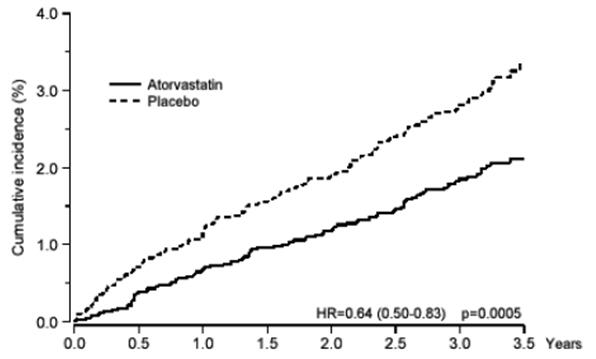
In ASCOT [see Clinical Studies (14.1)] involving 10,305 participants (age range 40–80 years, 19% women; 94.6% Caucasians, 2.6% Africans, 1.5% South Asians, 1.3% mixed/other) treated with atorvastatin calcium tablets 10 mg daily (n=5,168) or placebo (n=5,137), the safety and tolerability profile of the group treated with atorvastatin calcium tablets was comparable to that of the group treated with placebo during a median of 3.3 years of follow-up.
Collaborative Atorvastatin Diabetes Study (CARDS)
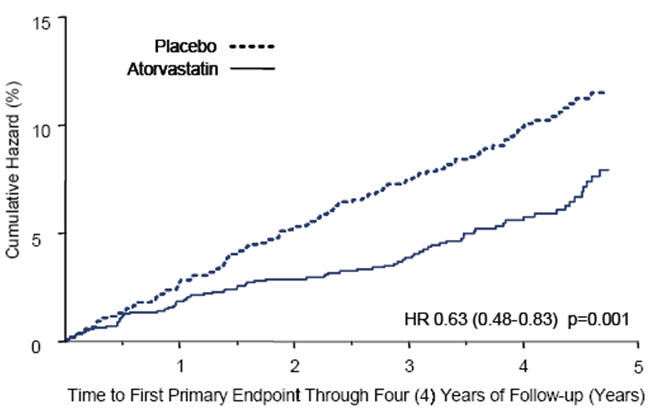
In CARDS [see Clinical Studies (14.1)] involving 2,838 subjects (age range 39–77 years, 32% women; 94.3% Caucasians, 2.4% South Asians, 2.3% Afro-Caribbean, 1.0% other) with type 2 diabetes treated with atorvastatin calcium tablets 10 mg daily (n=1,428) or placebo (n=1,410), there was no difference in the overall frequency of adverse reactions or serious adverse reactions between the treatment groups during a median follow-up of 3.9 years. No cases of rhabdomyolysis were reported.
Treating to New Targets Study (TNT)
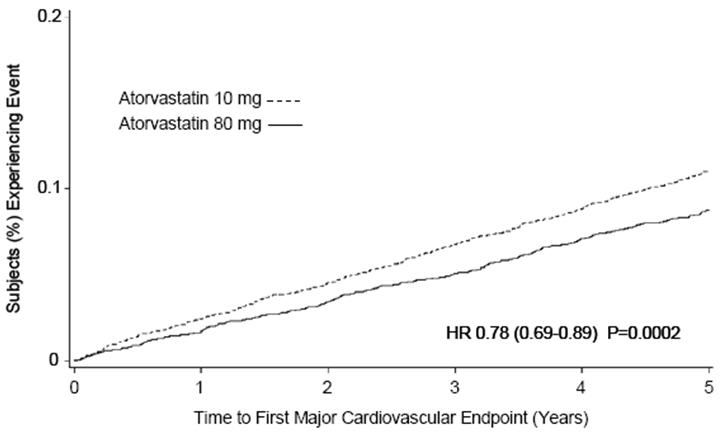
In TNT [see Clinical Studies (14.1)] involving 10,001 subjects (age range 29–78 years, 19% women; 94.1% Caucasians, 2.9% Blacks, 1.0% Asians, 2.0% other) with clinically evident CHD treated with atorvastatin calcium tablets 10 mg daily (n=5006) or atorvastatin calcium tablets 80 mg daily (n=4995), there were more serious adverse reactions and discontinuations due to adverse reactions in the high-dose atorvastatin group (92, 1.8%; 497, 9.9%, respectively) as compared to the low-dose group (69, 1.4%; 404, 8.1%, respectively) during a median follow-up of 4.9 years. Persistent transaminase elevations (≥3 × ULN twice within 4–10 days) occurred in 62 (1.3%) individuals with atorvastatin 80 mg and in nine (0.2%) individuals with atorvastatin 10 mg. Elevations of CK (≥ 10 × ULN) were low overall, but were higher in the high-dose atorvastatin treatment group (13, 0.3%) compared to the low-dose atorvastatin group (6, 0.1%).
Incremental Decrease in Endpoints through Aggressive Lipid Lowering Study (IDEAL)
In IDEAL [see Clinical Studies (14.1)] involving 8,888 subjects (age range 26–80 years, 19% women; 99.3% Caucasians, 0.4% Asians, 0.3% Blacks, 0.04% other) treated with atorvastatin calcium tablets 80 mg/day (n=4439) or simvastatin 20–40 mg daily (n=4449), there was no difference in the overall frequency of adverse reactions or serious adverse reactions between the treatment groups during a median follow-up of 4.8 years.
Stroke Prevention by Aggressive Reduction in Cholesterol Levels (SPARCL)
In SPARCL involving 4731 subjects (age range 21–92 years, 40% women; 93.3% Caucasians, 3.0% Blacks, 0.6% Asians, 3.1% other) without clinically evident CHD but with a stroke or transient ischemic attack (TIA) within the previous 6 months treated with atorvastatin calcium tablets 80 mg (n=2365) or placebo (n=2366) for a median follow-up of 4.9 years, there was a higher incidence of persistent hepatic transaminase elevations (≥ 3 x ULN twice within 4–10 days) in the atorvastatin group (0.9%) compared to placebo (0.1%). Elevations of CK (>10 x ULN) were rare, but were higher in the atorvastatin group (0.1%) compared to placebo (0.0%). Diabetes was reported as an adverse reaction in 144 subjects (6.1%) in the atorvastatin group and 89 subjects (3.8%) in the placebo group [see Warnings and Precautions (5.5)].
In a post-hoc analysis, atorvastatin calcium tablets 80 mg reduced the incidence of ischemic stroke (218/2365, 9.2% vs. 274/2366, 11.6%) and increased the incidence of hemorrhagic stroke (55/2365, 2.3% vs. 33/2366, 1.4%) compared to placebo. The incidence of fatal hemorrhagic stroke was similar between groups (17 atorvastatin calcium tablets vs. 18 placebo). The incidence of non-fatal hemorrhagic strokes was significantly greater in the atorvastatin group (38 non-fatal hemorrhagic strokes) as compared to the placebo group (16 non-fatal hemorrhagic strokes). Subjects who entered the study with a hemorrhagic stroke appeared to be at increased risk for hemorrhagic stroke [7 (16%) atorvastatin calcium tablets vs. 2 (4%) placebo].
There were no significant differences between the treatment groups for all-cause mortality: 216 (9.1%) in the atorvastatin calcium tablets 80 mg/day group vs. 211 (8.9%) in the placebo group. The proportions of subjects who experienced cardiovascular death were numerically smaller in the atorvastatin calcium tablets 80 mg group (3.3%) than in the placebo group (4.1%). The proportions of subjects who experienced non-cardiovascular death were numerically larger in the atorvastatin calcium tablets 80 mg group (5.0%) than in the placebo group (4.0%).
Clarithromycin: Atorvastatin AUC was significantly increased with concomitant administration of atorvastatin calcium tablets 80 mg with clarithromycin (500 mg twice daily) compared to that of atorvastatin calcium tablets alone [see Clinical Pharmacology (12.3)]. Therefore, in patients taking clarithromycin, caution should be used when the atorvastatin calcium tablets dose exceeds 20 mg [see Warnings and Precautions, Skeletal Muscle (5.1) and Dosage and Administration (2.6)].
Combination of Protease Inhibitors: Atorvastatin AUC was significantly increased with concomitant administration of atorvastatin calcium tablets with several combinations of HIV protease inhibitors, as well as with the hepatitis C protease inhibitor telaprevir, compared to that of atorvastatin calcium tablets alone [see Clinical Pharmacology (12.3)]. Therefore, in patients taking the HIV protease inhibitor tipranavir plus ritonavir, or the hepatitis C protease inhibitor telaprevir, concomitant use of atorvastatin calcium tablets should be avoided. In patients taking the HIV protease inhibitor lopinavir plus ritonavir, caution should be used when prescribing atorvastatin calcium tablets and the lowest dose necessary should be used. In patients taking the HIV protease inhibitors saquinavir plus ritonavir, darunavir plus ritonavir, fosamprenavir, or fosamprenavir plus ritonavir, the dose of atorvastatin calcium tablets should not exceed 20 mg and should be used with caution [see Warnings and Precautions, Skeletal Muscle (5.1) and Dosage and Administration (2.6)]. In patients taking the HIV protease inhibitor nelfinavir or the hepatitis C protease inhibitor boceprevir, the dose of atorvastatin calcium tablets should not exceed 40 mg and close clinical monitoring is recommended.
Itraconazole: Atorvastatin AUC was significantly increased with concomitant administration of atorvastatin calcium tablets 40 mg and itraconazole 200 mg [see Clinical Pharmacology (12.3)]. Therefore, in patients taking itraconazole, caution should be used when the atorvastatin calcium tablets dose exceeds 20 mg [see Warnings and Precautions, Skeletal Muscle (5.1) and Dosage and Administration (2.6)].
Pregnancy Category X
Atorvastatin calcium tablets is contraindicated in women who are or may become pregnant. Serum cholesterol and triglycerides increase during normal pregnancy. Lipid lowering drugs offer no benefit during pregnancy because cholesterol and cholesterol derivatives are needed for normal fetal development. Atherosclerosis is a chronic process, and discontinuation of lipid-lowering drugs during pregnancy should have little impact on long-term outcomes of primary hypercholesterolemia therapy.
There are no adequate and well-controlled studies of atorvastatin use during pregnancy. There have been rare reports of congenital anomalies following intrauterine exposure to statins. In a review of about 100 prospectively followed pregnancies in women exposed to other statins, the incidences of congenital anomalies, spontaneous abortions, and fetal deaths/stillbirths did not exceed the rate expected in the general population. However, this study was only able to exclude a three-to-four-fold increased risk of congenital anomalies over background incidence. In 89% of these cases, drug treatment started before pregnancy and stopped during the first trimester when pregnancy was identified.
Atorvastatin crosses the rat placenta and reaches a level in fetal liver equivalent to that of maternal plasma. Atorvastatin was not teratogenic in rats at doses up to 300 mg/kg/day or in rabbits at doses up to 100 mg/kg/day. These doses resulted in multiples of about 30 times (rat) or 20 times (rabbit) the human exposure based on surface area (mg/m2) [see Contraindications, Pregnancy (4.3)].
In a study in rats given 20, 100, or 225 mg/kg/day, from gestation day 7 through to lactation day 21 (weaning), there was decreased pup survival at birth, neonate, weaning, and maturity in pups of mothers dosed with 225 mg/kg/day. Body weight was decreased on days 4 and 21 in pups of mothers dosed at 100 mg/kg/day; pup body weight was decreased at birth and at days 4, 21, and 91 at 225 mg/kg/day. Pup development was delayed (rotorod performance at 100 mg/kg/day and acoustic startle at 225 mg/kg/day; pinnae detachment and eye-opening at 225 mg/kg/day). These doses correspond to 6 times (100 mg/kg) and 22 times (225 mg/kg) the human AUC at 80 mg/day.
Statins may cause fetal harm when administered to a pregnant woman. Atorvastatin calcium tablets should be administered to women of childbearing potential only when such patients are highly unlikely to conceive and have been informed of the potential hazards. If the woman becomes pregnant while taking atorvastatin calcium tablets, it should be discontinued immediately and the patient advised again as to the potential hazards to the fetus and the lack of known clinical benefit with continued use during pregnancy.
Absorption: Atorvastatin calcium tablets is rapidly absorbed after oral administration; maximum plasma concentrations occur within 1 to 2 hours. Extent of absorption increases in proportion to atorvastatin calcium tablets dose. The absolute bioavailability of atorvastatin (parent drug) is approximately 14% and the systemic availability of HMG-CoA reductase inhibitory activity is approximately 30%. The low systemic availability is attributed to presystemic clearance in gastrointestinal mucosa and/or hepatic first-pass metabolism. Although food decreases the rate and extent of drug absorption by approximately 25% and 9%, respectively, as assessed by Cmax and AUC, LDL-C reduction is similar whether atorvastatin calcium tablets is given with or without food. Plasma atorvastatin calcium tablets concentrations are lower (approximately 30% for Cmax and AUC) following evening drug administration compared with morning. However, LDL-C reduction is the same regardless of the time of day of drug administration [see Dosage and Administration (2)].
Distribution: Mean volume of distribution of atorvastatin calcium tablets is approximately 381 liters. Atorvastatin calcium tablets is ≥98% bound to plasma proteins. A blood/plasma ratio of approximately 0.25 indicates poor drug penetration into red blood cells. Based on observations in rats, atorvastatin calcium tablets is likely to be secreted in human milk [see Contraindications, Nursing Mothers (4.4) and Use in Specific Populations, Nursing Mothers (8.3)].
Metabolism: Atorvastatin calcium tablets is extensively metabolized to ortho- and parahydroxylated derivatives and various beta-oxidation products. In vitro inhibition of HMG-CoA reductase by ortho- and parahydroxylated metabolites is equivalent to that of atorvastatin calcium tablets. Approximately 70% of circulating inhibitory activity for HMG-CoA reductase is attributed to active metabolites. In vitro studies suggest the importance of atorvastatin calcium tablets metabolism by cytochrome P450 3A4, consistent with increased plasma concentrations of atorvastatin calcium tablets in humans following co-administration with erythromycin, a known inhibitor of this isozyme [see Drug Interactions (7.1)]. In animals, the ortho-hydroxy metabolite undergoes further glucuronidation.
Excretion: Atorvastatin calcium tablets and its metabolites are eliminated primarily in bile following hepatic and/or extra-hepatic metabolism; however, the drug does not appear to undergo enterohepatic recirculation. Mean plasma elimination half-life of atorvastatin calcium tablets in humans is approximately 14 hours, but the half-life of inhibitory activity for HMG-CoA reductase is 20 to 30 hours due to the contribution of active metabolites. Less than 2% of a dose of atorvastatin calcium tablets is recovered in urine following oral administration.
Specific Populations
Geriatric: Plasma concentrations of atorvastatin calcium tablets are higher (approximately 40% for Cmax and 30% for AUC) in healthy elderly subjects (age ≥65 years) than in young adults. Clinical data suggest a greater degree of LDL-lowering at any dose of drug in the elderly patient population compared to younger adults [see Use in Specific Populations, Geriatric Use (8.5)].
Pediatric: Pharmacokinetic data in the pediatric population are not available.
Gender: Plasma concentrations of atorvastatin calcium tablets in women differ from those in men (approximately 20% higher for Cmax and 10% lower for AUC); however, there is no clinically significant difference in LDL-C reduction with atorvastatin calcium tablets between men and women.
Renal Impairment: Renal disease has no influence on the plasma concentrations or LDL-C reduction of atorvastatin calcium tablets; thus, dose adjustment in patients with renal dysfunction is not necessary [see Dosage and Administration, Dosage in Patients with Renal Impairment (2.5), Warnings and Precautions, Skeletal Muscle (5.1)].
Hemodialysis: While studies have not been conducted in patients with end-stage renal disease, hemodialysis is not expected to significantly enhance clearance of atorvastatin calcium tablets since the drug is extensively bound to plasma proteins.
Hepatic Impairment: In patients with chronic alcoholic liver disease, plasma concentrations of atorvastatin calcium tablets are markedly increased. Cmax and AUC are each 4-fold greater in patients with Childs-Pugh A disease. Cmax and AUC are approximately 16-fold and 11-fold increased, respectively, in patients with Childs-Pugh B disease [see Contraindications (4.1)].
TABLE 3. Effect of Co-administered Drugs on the Pharmacokinetics of Atorvastatin| Co-administered drug and dosing regimen | Atorvastatin |
|---|
| Dose (mg) | Change in AUC Data given as x-fold change represent a simple ratio between co-administration and atorvastatin alone (i.e., 1-fold = no change). Data given as % change represent % difference relative to atorvastatin alone (i.e., 0% = no change). | Change in Cmax |
See Sections 5.1 and 7 for clinical significance. Cyclosporine 5.2 mg/kg/day, stable dose | 10 mg QD for 28 days | ↑ 8.7 fold | ↑10.7 fold |
| Tipranavir 500 mg BID/ ritonavir 200 mg BID, 7 days | 10 mg, SD | ↑ 9.4 fold | ↑ 8.6 fold |
| Telaprevir 750 mg q8h, 10 days | 20 mg, SD | ↑ 7.88 fold | ↑ 10.6 fold |
| , The dose of saquinavir plus ritonavir in this study is not the clinically used dose. The increase in atorvastatin exposure when used clinically is likely to be higher than what was observed in this study. Therefore, caution should be applied and the lowest dose necessary should be used. Saquinavir 400 mg BID/ ritonavir 400mg BID, 15 days | 40 mg QD for 4 days | ↑ 3.9 fold | ↑ 4.3 fold |
| Clarithromycin 500 mg BID, 9 days | 80 mg QD for 8 days | ↑ 4.4 fold | ↑ 5.4 fold |
| Darunavir 300 mg BID/ritonavir 100 mg BID, 9 days | 10 mg QD for 4 days | ↑ 3.4 fold | ↑ 2.25 fold |
| Itraconazole 200 mg QD, 4 days | 40 mg SD | ↑ 3.3 fold | ↑ 20% |
| Fosamprenavir 700 mg BID/ ritonavir 100 mg BID, 14 days | 10 mg QD for 4 days | ↑ 2.53 fold | ↑ 2.84 fold |
| Fosamprenavir 1400 mg BID, 14 days | 10 mg QD for 4 days | ↑ 2.3 fold | ↑ 4.04 fold |
| Nelfinavir 1250 mg BID, 14 days | 10 mg QD for 28 days | ↑ 74% | ↑ 2.2 fold |
| Grapefruit Juice, 240 mL QD Greater increases in AUC (up to 2.5 fold) and/or Cmax (up to 71%) have been reported with excessive grapefruit consumption (≥ 750 mL - 1.2 liters per day). | 40 mg, SD | ↑ 37% | ↑ 16% |
| Diltiazem 240 mg QD, 28 days | 40 mg, SD | ↑ 51% | No change |
| Erythromycin 500 mg QID, 7 days | 10 mg, SD | ↑ 33% | ↑ 38% |
| Amlodipine 10 mg, single dose | 80 mg, SD | ↑ 15% | ↓ 12 % |
| Cimetidine 300 mg QD, 4 weeks | 10 mg QD for 2 weeks | ↓ Less than 1% | ↓ 11% |
| Colestipol 10 mg BID, 28 weeks | 40 mg QD for 28 weeks | Not determined | ↓ 26% Single sample taken 8-16 h post dose. |
| Maalox TC® 30 mL QD, 17 days | 10 mg QD for 15 days | ↓ 33% | ↓ 34% |
| Efavirenz 600 mg QD, 14 days | 10 mg for 3 days | ↓ 41% | ↓ 1% |
| Rifampin 600 mg QD, 7 days (co-administered) Due to the dual interaction mechanism of rifampin, simultaneous co-administration of atorvastatin with rifampin is recommended, as delayed administration of atorvastatin after administration of rifampin has been associated with a significant reduction in atorvastatin plasma concentrations. | 40 mg SD | ↑ 30% | ↑ 2.7 fold |
| Rifampin 600 mg QD, 5 days (doses separated) | 40 mg SD | ↓ 80% | ↓ 40% |
| Gemfibrozil 600 mg BID, 7 days | 40 mg SD | ↑ 35% | ↓ Less than 1% |
| Fenofibrate 160 mg QD, 7 days | 40 mg SD | ↑ 3% | ↑ 2% |
| Boceprevir 800 mg TID, 7 days | 40 mg SD | ↑ 2.30 fold | ↑ 2.66 fold |
TABLE 4. Effect of Atorvastatin on the Pharmacokinetics of Co-administered Drugs| Atorvastatin | Co-administered drug and dosing regimen |
|---|
| Drug/Dose (mg) | Change in AUC | Change in Cmax |
| 80 mg QD for 15 days | Antipyrine, 600 mg SD | ↑ 3% | ↓ 11% |
| 80 mg QD for 14 days | See Section 7 for clinical significance. Digoxin 0.25 mg QD, 20 days | ↑ 15% | ↑ 20 % |
| 40 mg QD for 22 days | Oral contraceptive QD, 2 months
- norethindrone 1mg
- ethinyl estradiol 35μg |
↑ 28%
↑ 19% |
↑ 23%
↑ 30% |
| 10 mg, SD | Tipranavir 500 mg BID/ritonavir 200 mg BID, 7 days | No change | No change |
| 10 mg QD for 4 days | Fosamprenavir 1400 mg BID, 14 days | ↓ 27% | ↓ 18% |
| 10 mg QD for 4 days | Fosamprenavir 700 mg BID/ritonavir 100 mg BID, 14 days | No change | No change |
Rx Only
Manufactured for:
AvKARE, Inc.
Pulaski, TN 38478
Mfg. Rev. 4E 12/12 CIA75883D
AV Rev. 06/12 ( P)