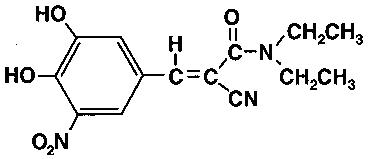
The effectiveness of Entacapone Tablets as an adjunct to levodopa in the treatment of Parkinson's disease was established in three 24-week multicenter, randomized, double-blind, placebo-controlled studies in patients with Parkinson's disease. In two of these studies, patients had motor "fluctuations", characterized by documented periods of "On" (periods of relatively good functioning) and "Off" (periods of relatively poor functioning), despite optimum levodopa therapy. There was also a withdrawal period following 6 months of treatment. In the third study, patients were not required to have motor fluctuations. Prior to the controlled part of the studies, patients were stabilized on levodopa for 2 weeks to 4 weeks. Entacapone has not been systematically evaluated in patients who have Parkinson's disease without motor fluctuations.
In the first two studies to be described, patients were randomized to receive placebo or entacapone 200 mg administered concomitantly with each dose of levodopa and carbidopa (up to 10 times daily, but averaging 4 doses to 6 doses per day). The formal double-blind portion of both studies was 6 months long. Patients recorded the time spent in the "On" and "Off" states in home diaries periodically throughout the duration of the study. In one study, conducted in the Nordic countries, the primary outcome measure was the total mean time spent in the "On" state during an 18-hour diary recorded day (6 AM to midnight). In the other study, the primary outcome measure was the proportion of awake time spent over 24 hours in the "On" state.
In addition to the primary outcome measure: the amount of time spent in the "Off" state, subparts of the Unified Parkinson's Disease Rating Scale (UPDRS) including mentation (Part I), activities of daily living (ADL) (Part II), motor function (Part III), complications of therapy (Part IV), and disease staging (Part V and VI) were assessed. Additional secondary endpoints included the investigator's and patient's global assessment of clinical condition, a 7-point subjective scale designed to assess global functioning in Parkinson's disease; and the change in daily levodopa and carbidopa dose.
In one of the studies, 171 patients were randomized in 16 centers in Finland, Norway, Sweden, and Denmark (Nordic study), all of whom received concomitant levodopa plus dopa-decarboxylase inhibitor (either levodopa and carbidopa or levodopa and benserazide). In the second study, 205 patients were randomized in 17 centers in North America (US and Canada); all patients received concomitant levodopa and carbidopa.
The following tables display the results of these two studies:
Table 1. Nordic StudyPrimary Measure from Home Diary (from an 18-hour Diary Day)
|
|
Baseline
| Change from
Baseline at
Month 6*
|
p-value
vs. placebo
|
Hours of Awake Time “On”
|
|
|
|
Placebo
| 9.2
| +0.1
| –
|
Entacapone Tablets
| 9.3
| +1.5
| less than 0.001
|
Duration of “On” time after first AM dose (hrs)
|
|
|
|
Placebo
| 2.2
| 0.0
| –
|
Entacapone Tablets
| 2.1
| +0.2
| less than 0.05
|
Secondary Measures from Home Diary (from an 18-hour Diary Day)‡‡
|
Hours of Awake Time “Off”
|
|
|
|
Placebo
| 5.3
| 0.0
| –
|
Entacapone Tablets
| 5.5
| -1.3
| less than 0.001
|
Proportion of Awake Time “On” *** (%)
|
|
|
|
Placebo
| 63.8
| +0.6
| –
|
Entacapone Tablets
| 62.7
| +9.3
| less than 0.001
|
Levodopa Total Daily Dose (mg)
|
|
|
|
Placebo
| 705
| +14
| –
|
Entacapone Tablets
| 701
| -87
| less than 0.001
|
Frequency of Levodopa Daily Intakes
|
|
|
|
Placebo
| 6.1
| +0.1
| –
|
Entacapone Tablets
| 6.2
| -0.4
| less than 0.001
|
Other Secondary Measures‡‡
|
|
Baseline
| Change from
Baseline at
Month 6*
|
p-value
vs. placebo
|
Investigator’s Global (overall) % Improved**
|
|
|
|
Placebo
| –
| 28
| –
|
Entacapone Tablets
| –
| 56
| less than 0.01
|
Patient’s Global (overall) % Improved**
|
|
|
|
Placebo
| –
| 22
| –
|
Entacapone Tablets
| –
| 39
| N.S.‡
|
UPDRS Total
|
|
|
|
Placebo
| 37.4
| -1.1
| –
|
Entacapone Tablets
| 38.5
| -4.8
| less than 0.01
|
UPDRS Motor
|
|
|
|
Placebo
| 24.6
| -0.7
| –
|
Entacapone Tablets
| 25.5
| -3.3
| less than 0.05
|
UPDRS ADL
|
|
|
|
Placebo
| 11.0
| -0.4
| –
|
Entacapone Tablets
| 11.2
| -1.8
| less than 0.05
|
* Mean; the month 6 values represent the average of weeks 8, 16, and 24, by protocol-defined outcome measure, except for Investigator’s and Patient’s Global Improvement.
|
** At least one category change at endpoint.
|
*** Not an endpoint for this study but primary endpoint in the North American Study.
|
‡ Not significant.
|
‡‡ P values for Secondary Measures and Other Secondary Measures are nominal P values without any adjustment for multiplicity.
|
Table 2. North American StudyPrimary Measure from Home Diary (for a 24-hour Diary Day)
|
|
Baseline
| Change from
Baseline at
Month 6*
|
p-value
vs. placebo
|
Percent of Awake Time “On”
|
|
|
|
Placebo
| 60.8
| +2.0
| –
|
Entacapone Tablets
| 60.0
| +6.7
| less than 0.05
|
Secondary Measures from Home Diary (for a 24-hour Diary Day)‡‡
|
Hours of Awake Time “Off”
|
|
|
|
Placebo
| 6.6
| -0.3
| –
|
Entacapone Tablets
| 6.8
| -1.2
| less than 0.01
|
Hours of Awake Time “On”
|
|
|
|
Placebo
| 10.3
| +0.4
| –
|
Entacapone Tablets
| 10.2
| +1.0
| N.S.‡
|
Levodopa Total Daily Dose (mg)
|
|
|
|
Placebo
| 758
| +19
| –
|
Entacapone Tablets
| 804
| -93
| less than 0.001
|
Frequency of Levodopa Daily Intakes
|
|
|
|
Placebo
| 6.0
| +0.2
| –
|
Entacapone Tablets
| 6.2
| 0.0
| N.S.‡
|
Other Secondary Measures‡‡
|
|
Baseline
| Change from
Baseline at
Month 6*
|
p-value
vs. placebo
|
Investigator’s Global (overall) % Improved**
|
|
|
|
Placebo
| –
| 21
| –
|
Entacapone Tablets
| –
| 34
| less than 0.05
|
Patient’s Global (overall) % Improved**
|
|
|
|
Placebo
| –
| 20
| –
|
Entacapone Tablets
| –
| 31
| less than 0.05
|
UPDRS Total***
|
|
|
|
Placebo
| 35.6
| +2.8
| –
|
Entacapone Tablets
| 35.1
| -0.6
| less than 0.05
|
UPDRS Motor***
|
|
|
|
Placebo
| 22.6
| +1.2
| –
|
Entacapone Tablets
| 22.0
| -0.9
| less than 0.05
|
UPDRS ADL***
|
|
|
|
Placebo
| 11.7
| +1.1
| –
|
Entacapone Tablets
| 11.9
| 0.0
| less than 0.05
|
* Mean; the month 6 values represent the average of weeks 8, 16, and 24, by protocol-defined outcome measure, except for Investigator’s and Patient’s Global Improvement.
|
** At least one category change at endpoint.
|
*** Score change at endpoint similarly to the Nordic Study.
|
‡ Not significant.
|
‡‡ P values for Secondary Measures and Other Secondary Measures are nominal P values without any adjustment for multiplicity.
|
Effects on "On" time did not differ by age, sex, weight, disease severity at baseline, levodopa dose and concurrent treatment with dopamine agonists or selegiline.
Withdrawal of entacapone: In the North American study, abrupt withdrawal of entacapone, without alteration of the dose of levodopa and carbidopa, resulted in a significant worsening of fluctuations, compared to placebo. In some cases, symptoms were slightly worse than at baseline, but returned to approximately baseline severity within two weeks following levodopa dose increase on average by 80 mg. In the Nordic study, similarly, a significant worsening of parkinsonian symptoms was observed after entacapone withdrawal, as assessed two weeks after drug withdrawal. At this phase, the symptoms were approximately at baseline severity following levodopa dose increase by about 50 mg.
In the third placebo-controlled study, a total of 301 patients were randomized in 32 centers in Germany and Austria. In this study, as in the other two studies, entacapone 200 mg was administered with each dose of levodopa and dopa decarboxylase inhibitor (up to 10 times daily) and UPDRS Parts II and III and total daily "On" time were the primary measures of effectiveness. The following results were observed for the primary measures, as well as for some secondary measures:
Table 3. German-Austrian StudyPrimary Measures
|
|
Baseline
| Change from
Baseline at
Month 6
| p-value
vs. placebo
(LOCF)
|
UPDRS ADL*
|
|
|
|
Placebo
| 12.0
| + 0.5
| –
|
Entacapone Tablets
| 12.4
| - 0.4
| less than 0.05
|
UPDRS Motor*
|
|
|
|
Placebo
| 24.1
| + 0.1
| –
|
Entacapone Tablets
| 24.9
| - 2.5
| less than 0.05
|
Hours of Awake Time “On” (Home diary)**
|
|
|
|
Placebo
| 10.1
| + 0.5
| –
|
Entacapone Tablets
| 10.2
| + 1.1
| N.S.‡
|
Secondary Measures‡‡
|
|
Baseline
| Change from
Baseline at
Month 6
| p-value
vs. placebo
|
UPDRS Total*
|
|
|
|
Placebo
| 37.7
| + 0.6
| –
|
Entacapone Tablets
| 39.0
| - 3.4
| less than 0.05
|
Percent of Awake Time “On” (Home diary)**
|
|
|
|
Placebo
| 59.8
| + 3.5
| –
|
Entacapone Tablets
| 62.0
| + 6.5
| N.S.‡
|
Hours of Awake Time “Off” (Home diary)**
|
|
|
|
Placebo
| 6.8
| - 0.6
| –
|
Entacapone Tablets
| 6.3
| - 1.2
| 0.07
|
Levodopa Total Daily Dose (mg)*
|
|
|
|
Placebo
| 572
| + 4
| –
|
Entacapone Tablets
| 566
| - 35
| N.S.‡
|
Frequency of Levodopa Daily Intake*
|
|
|
|
Placebo
| 5.6
| + 0.2
| –
|
Entacapone Tablets
| 5.4
| 0.0
| less than 0.01
|
Global (overall) % Improved***
|
|
|
|
Placebo
| –
| 34
| –
|
Entacapone Tablets
| –
| 38
| N.S.‡
|
* Total population; score change at endpoint.
|
** Fluctuating population, with 5 doses to 10 doses; score change at endpoint.
|
*** Total population; at least one category change at endpoint.
|
‡ Not significant.
|
‡‡ P values for Secondary Measures are nominal P values without any adjustment for multiplicity.
|