The efficacy and safety of dimethyl fumarate were demonstrated in two studies (Studies 1 and 2) that evaluated dimethyl fumarate taken either twice or three times a day in patients with relapsing- remitting multiple sclerosis (RRMS). The starting dose for dimethyl fumarate was 120 mg twice or three times a day for the first 7 days, followed by an increase to 240 mg twice or three times a day. Both studies included patients who had experienced at least 1 relapse over the year preceding the trial or had a brain Magnetic Resonance Imaging (MRI) scan demonstrating at least one gadolinium-enhancing (Gd+) lesion within 6 weeks of randomization. The Expanded Disability Status Scale (EDSS) was also assessed and patients could have scores ranging from 0 to 5. Neurological evaluations were performed at baseline, every 3 months, and at the time of suspected relapse. MRI evaluations were performed at baseline, month 6, and year 1 and 2 in a subset of patients (44% in Study 1 and 48% in Study 2).
Study 1: Placebo-Controlled Trial in RRMS
Study 1 was a 2-year randomized, double-blind, placebo-controlled study in 1234 patients with RRMS. The primary endpoint was the proportion of patients relapsed at 2 years. Additional endpoints at 2 years included the number of new or newly enlarging T2 hyperintense lesions, number of new T1 hypointense lesions, number of Gd+ lesions, annualized relapse rate (ARR), and time to confirmed disability progression. Confirmed disability progression was defined as at least a 1 point increase from baseline EDSS (1.5 point increase for patients with baseline EDSS of 0) sustained for 12 weeks.
Patients were randomized to receive dimethyl fumarate 240 mg twice a day (n=410), dimethyl fumarate 240 mg three times a day (n=416), or placebo (n=408) for up to 2 years. The median age was 39 years, median time since diagnosis was 4 years, and median EDSS score at baseline was 2. The median time on study drug for all treatment arms was 96 weeks. The percentages of patients who completed 96 weeks on study drug per treatment group were 69% for patients assigned to dimethyl fumarate 240 mg twice a day, 69% for patients assigned to dimethyl fumarate 240 mg three times a day and 65% for patients assigned to placebo groups.
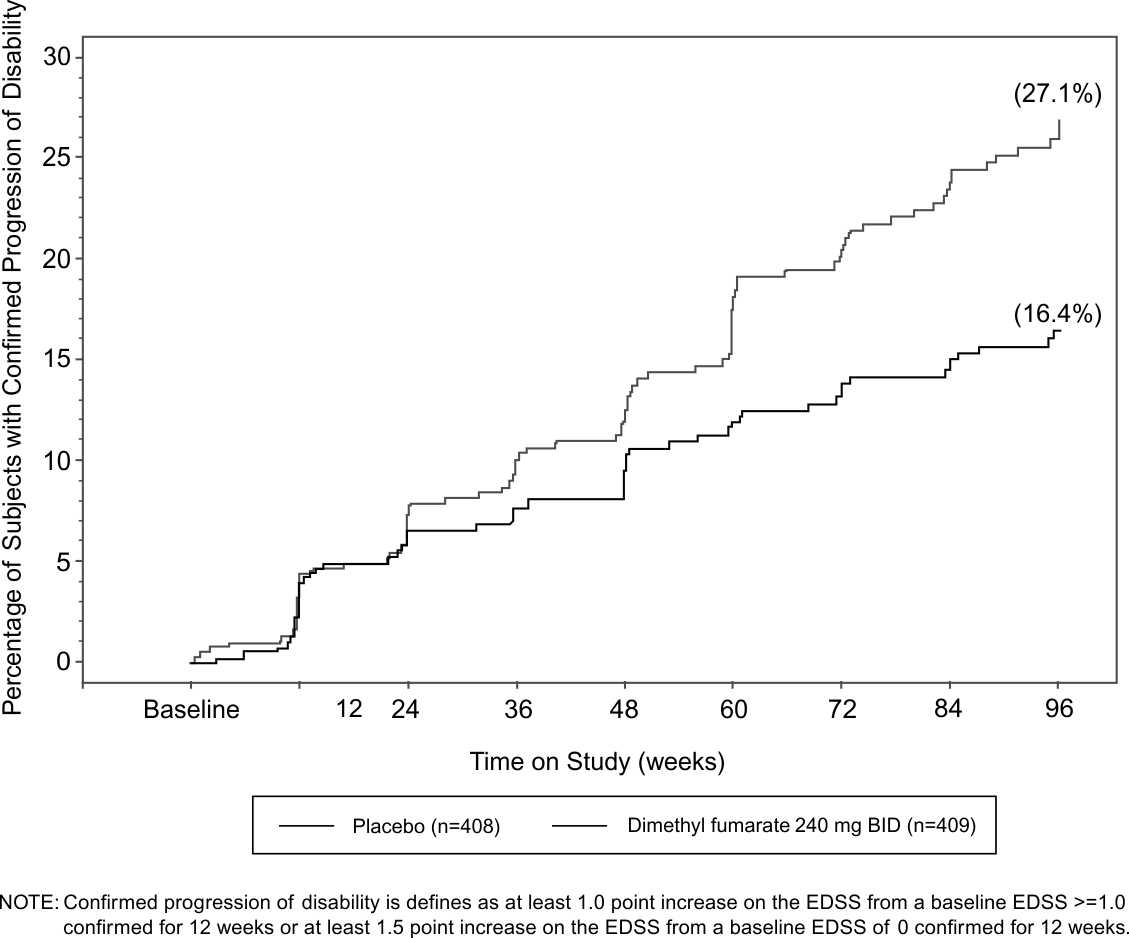
Dimethyl fumarate had a statistically significant effect on all of the endpoints described above and the 240 mg three times daily dose showed no additional benefit over the dimethyl fumarate 240 mg twice daily dose. The results for this study (240 mg twice a day vs. placebo) are shown in Table 2 and Figure 1.
Table 2: Clinical and MRI Results of Study 1
|
Dimethyl Fumarate 240 mg BID
|
Placebo
|
P-value
|
Clinical Endpoints
|
N=410
|
N=408
|
|
Proportion relapsing (primary endpoint) Relative risk reduction
|
27%
49%
|
46%
|
<0.0001
|
Annualized relapse rate Relative reduction
|
0.172
53%
|
0.364
|
<0.0001
|
Proportion with disability progression Relative risk reduction
|
16%
38%
|
27%
|
0.0050
|
MRI Endpoints
|
N=152
|
N=165
|
|
Mean number of new or newly enlarging T2 lesions over 2 years
|
2.6
|
17
|
<0.0001
|
Percentage of subjects with no new or newly enlarging lesions
|
45%
|
27%
|
|
Number of Gd+ lesions at 2 years Mean (median)
|
0.1 (0)
|
1.8(0)
|
|
Percentage of subjects with
|
|
|
|
0 lesions
|
93%
|
62%
|
|
1 lesion
|
5%
|
10%
|
|
2 lesions
|
<1%
|
8%
|
|
3 to 4 lesions
|
0
|
9%
|
|
5 or more lesions
|
<1%
|
11%
|
|
Relative odds reduction (percentage)
|
90%
|
|
<0.0001
|
Mean number of new T1 hypointense lesions over 2 years
|
1.5
|
5.6
|
<0.0001
|
Figure 1: Time to 12-Week Confirmed Progression of Disability (Study 1)
Study 2: Placebo-Controlled Trial in RRMS
Study 2 was a 2-year multicenter, randomized, double-blind, placebo-controlled study that also included an open-label comparator arm in patients with RRMS. The primary endpoint was the annualized relapse rate at 2 years. Additional endpoints at 2 years included the number of new or newly enlarging T2 hyperintense lesions, number of T1 hypointense lesions, number of Gd+ lesions, proportion of patients relapsed, and time to confirmed disability progression as defined in Study 1.
Patients were randomized to receive dimethyl fumarate 240 mg twice a day (n=359), dimethyl fumarate 240 mg three times a day (n=345), an open-label comparator (n=350), or placebo (n=363) for up to 2 years. The median age was 37 years, median time since diagnosis was 3 years, and median EDSS score at baseline was 2.5. The median time on study drug for all treatment arms was 96 weeks. The percentages of patients who completed 96 weeks on study drug per treatment group were 70% for patients assigned to dimethyl fumarate 240 mg twice a day, 72% for patients assigned to dimethyl fumarate 240 mg three times a day and 64% for patients assigned to placebo groups.
Dimethyl fumarate had a statistically significant effect on the relapse and MRI endpoints described above. There was no statistically significant effect on disability progression. The dimethyl fumarate 240 mg three times daily dose resulted in no additional benefit over the dimethyl fumarate 240 mg twice daily dose. The results for this study (240 mg twice a day vs. placebo) are shown in Table 3.
Table 3: Clinical and MRI Results of Study 2
|
Dimethyl Fumarate 240 mg BID
|
Placebo
|
P-value
|
Clinical Endpoints
| N= 359
|
N=363
|
|
Annualized relapse rate
Relative reduction
| 0.224
44%
| 0.401
| <0.0001
|
Proportion relapsing
Relative risk reduction
| 29%
34%
| 41%
| 0.0020
|
Proportion with disability progression Relative risk reduction
| 13%
21%
| 17%
| 0.25
|
MRI Endpoints
| N=147
| N=144
|
|
Mean number of new or newly enlarging T2 lesions over 2 years
| 5.1
| 17.4
| <0.0001
|
Percentage of subjects with no new or newly enlarging lesions
| 27%
| 12%
|
|
Number of Gd+ lesions at 2 years Mean (median)
| 0.5 (0.0)
| 2.0 (0.0)
|
|
Percentage of subjects with
|
|
|
|
0 lesions
| 80%
| 61%
|
|
1 lesion
| 11%
| 17%
|
|
2 lesions
| 3%
| 6%
|
|
3 to 4 lesions
| 3%
| 2%
|
|
5 or more lesions
| 3%
| 14%
|
|
Relative odds reduction
(percentage)
|
74%
|
|
<0.0001
|
Mean number of new T1 hypointense
lesions over 2 years
| 3.0
| 7.0
| <0.0001
|