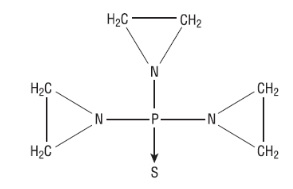
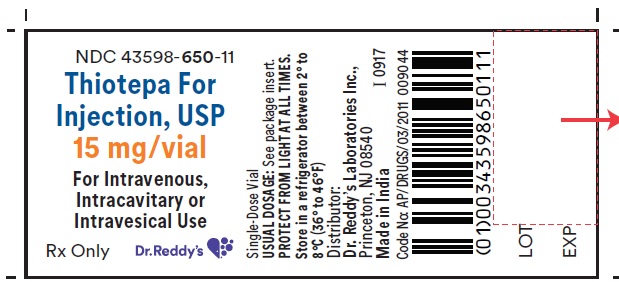
Since absorption from the gastrointestinal tract is variable, thiotepa should not be administered orally.
Dosage must be carefully individualized. A slow response to thiotepa does not necessarily indicate a lack of effect. Therefore, increasing the frequency of dosing may only increase toxicity. After maximum benefit is obtained by initial therapy, it is necessary to continue the patient on maintenance therapy (1 to 4 week intervals). In order to continue optimal effect, maintenance doses should not be administered more frequently than weekly in order to preserve correlation between dose and blood counts.
Preparation and Administration Precautions: Thiotepa is a cytotoxic anticancer drug and as with other potentially toxic compounds, caution should be exercised in handling and preparation of thiotepa. Skin reactions associated with accidental exposure to thiotepa may occur. The use of gloves is recommended. If thiotepa solution contacts the skin, immediately wash the skin thoroughly with soap and water. If thiotepa contacts mucous membranes, the membranes should be flushed thoroughly with water.
Preparation of Solution: Thiotepa for injection should be reconstituted with 1.5 mL of sterile water for injection resulting in a drug concentration of approximately 10 mg/mL. The actual withdrawable quantities and concentration achieved are illustrated in the following table:
| Label Claim (mg/vial) | Actual Content (mg/vial) | Amount of Diluent to be Added (mL) | Approximate Withdrawable Volume (mL) | Approximate Withdrawable Amount (mg/vial) | Approximate Reconstituted Concentration (mg/mL) |
| 15 | 15.6 | 1.5 | 1.4 | 14.7 | 10.4 |
The reconstituted solution is hypotonic and should be further diluted with sodium chloride injection (0. 9% sodium chloride) before use.
When reconstituted with sterile water for injection, solutions of thiotepa should be stored in a refrigerator and used within 8 hours. Reconstituted solutions further diluted with sodium chloride injection should be used immediately.
In order to eliminate haze, filter solutions through a 0.22 micron filter* prior to administration. Filtering does not alter solution potency. Reconstituted solutions should be clear. Solutions that remain opaque or precipitate after filtration should not be used.
*Polysulfone membrane (Gelman’s Sterile AerodiscR, Single Use) or triton-free mixed ester of cellulose/PVC (Millipore’s MILLEXR-GS Filter Unit).
Parenteral drug products should be inspected visually for particulate matter and discoloration prior to administration, whenever solution and container permit.
Initial and Maintenance Doses: Initially the higher dose in the given range is commonly administered. The maintenance dose should be adjusted weekly on the basis of pretreatment control blood counts and subsequent blood counts.
Intravenous Administration: Thiotepa may be given by rapid intravenous administration in doses of 0.3 to 0.4 mg/kg. Doses should be given at 1 to 4 week intervals.
Intracavitary Administration: The dosage recommended is 0.6 to 0.8 mg/kg. Administration is usually effected through the same tubing which is used to remove the fluid from the cavity involved.
Intravesical Administration: Patients with papillary carcinoma of the bladder are dehydrated for 8 to 12 hours prior to treatment. Then 60 mg of thiotepa in 30 to 60 mL of Sodium Chloride Injection is instilled into the bladder by catheter. For maximum effect, the solution should be retained for 2 hours. If the patient finds it impossible to retain 60 mL for 2 hours, the dose may be given in a volume of 30 mL. If desired, the patient may be positioned every 15 minutes for maximum area contact. The usual course of treatment is once a week for 4 weeks. The course may be repeated if necessary, but second and third courses must be given with caution since bone-marrow depression may be increased. Deaths have occurred after intravesical administration, caused by bone-marrow depression from systemically absorbed drug.
Handling and Disposal: Follow safe cytotoxic agent handling procedures. Several guidelines on this subject have been published.1-6 There is no general agreement that all of the procedures recommended in the guidelines are necessary or appropriate.