Ovulation Induction
In a multiple cycle (3), assessor-blind, multinational, multicenter, active comparator study vs. a recombinant FSH comparator, a total of 83 oligo-anovulatory infertile women were randomized and underwent ovulation induction with GONAL-f® RFF. Adverse reactions occurring in at least 2.0% of women receiving GONAL-f® RFF are listed in Table 1.
Table 1: Common Adverse Reactions Reported at a Frequency of ≥ 2% in an Ovulation Induction Study| System Organ Class/Adverse Reactions | GONAL-f® RFF
N=83total number of women treated with GONAL-f® RFF (176 treatment cyclesup to 3 treatment cycles per woman )
nnumber of women with the adverse reaction (%) |
|---|
| Central and Peripheral Nervous System | |
| Headache | 22 (26.5%) |
| Gastrointestinal System |
| Abdominal Pain | 10 (12.0%) |
| Nausea | 3 (3.6%) |
| Flatulence | 3 (3.6%) |
| Diarrhea | 3 (3.6%) |
| Neoplasm |
| Ovarian Cyst | 3 (3.6%) |
| Reproductive, Female |
| Ovarian Hyperstimulation | 6 (7.2%) |
| Application Site |
| Injection Site Pain | 4 (4.8%) |
| Injection Site Inflammation | 2 (2.4%) |
Assisted Reproductive Technology
In a single cycle, assessor-blind, multinational, multicenter, active comparator study vs. a recombinant FSH comparator, a total of 237 normal ovulatory infertile women were randomized and received GONAL-f® RFF as part of an ART [in vitro fertilization (IVF) or intracytoplasmic sperm injection cycle (ICSI)] cycle. All women received pituitary down-regulation with gonadotropin releasing hormone (GnRH) agonist before stimulation. Adverse Reactions occurring in at least 2.0% of women are listed in Table 2.
Table 2: Common Adverse Reactions Reported at a Frequency of ≥ 2% in an Assisted Reproductive Technologies Study| System Organ Class/Adverse Reactions | GONAL-f® RFF
N=237total number of women treated with GONAL-f® RFF
nnumber of women with the adverse reaction (%) |
|---|
| Gastrointestinal System |
| Abdominal Pain | 55 (23.2%) |
| Nausea | 19 (8.0%) |
| Body as a Whole- General |
| Abdomen Enlarged | 33 (13.9%) |
| Central and Peripheral Nervous System | |
| Headache | 44 (18.6%) |
| Application Site Disorders |
| Injection Site Bruising | 23 (9.7%) |
| Injection Site Pain | 13 (5.5%) |
| Injection Site Inflammation | 10 (4.2%) |
| Injection Site Reaction | 10 (4.2%) |
| Application Site Edema | 6 (2.5%) |
| Reproductive, Female |
| Ovarian Hyperstimulation | 11 (4.6%) |
Risk Summary
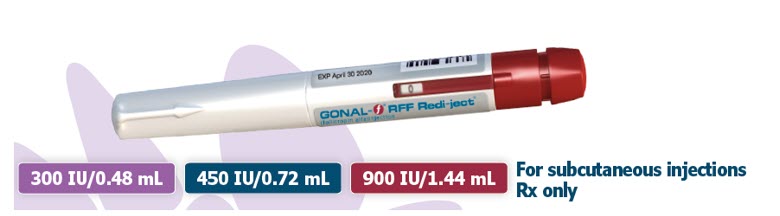
GONAL-f® RFF Redi-ject® is not indicated in pregnant women.
The incidence of congenital malformations after some Assisted Reproductive Technology (ART), procedures, specifically in vitro fertilization (IVF) or intracytoplasmic sperm injection (ICSI)], may be slightly higher than after spontaneous conception. This slightly higher incidence is thought to be related to differences in parental characteristics (e.g., maternal age, maternal and paternal genetic background, sperm characteristics) and to a higher incidence of multi-fetal gestations after IVF or ICSI. There is no human data that the use of gonadotropins (including GONAL-f® RFF Redi-ject®), alone or as part of IVF or ICSI cycles, increases the risk of congenital malformations.
The risk of spontaneous abortion (miscarriage) is increased in women who have used gonadotropins products (including GONAL-f® RFF Redi-ject®) to achieve pregnancy.
In animal studies, the continuous administration of recombinant human FSH during pregnancy resulted in a decrease in the number of viable fetuses and difficult and prolonged delivery. No teratogenic effect has been observed.
In the US general population, the estimated background risk of major birth defects and miscarriage after spontaneous clinically recognized pregnancies, is 2% to 4% and 15% to 20%, respectively.
Data
Human Data
Data on a limited number of exposed pregnancies indicate no adverse reactions of gonadotropins on pregnancy, embryonal or fetal development, parturition or postnatal development following controlled ovarian stimulation.
Animal Data
Embryofetal development studies with recombinant human FSH in rats, where dosing occurred during organogenesis, showed a dose dependent increase in difficult and prolonged parturition in dams, and dose dependent increases in resorptions, pre- and post-implantation losses, and stillborn pups at doses representing 5 and 41 times the lowest clinical dose of 75 IU based on body surface area. Pre-/post-natal development studies with recombinant human FSH in rats, where dosing occurred from mid-gestation through lactation, showed difficult and prolonged parturition in all dams dosed at 41 times the lowest clinical dose of 75 IU based on body surface area, along with maternal death and stillborn pups associated with the difficult and prolonged parturition. This toxicity was not observed in dams and offspring dosed at a level 5 times the lowest clinical dose of 75 IU based on body surface area.
Absorption
The absorption rate of GONAL-f® RFF Redi-ject® following subcutaneous administration is slower than the elimination rate. Hence, the pharmacokinetics of GONAL-f® RFF Redi-ject® are absorption rate-limited.
Distribution
Human tissue or organ distribution of FSH has not been determined for GONAL-f® RFF Redi-ject®.
Metabolism/Excretion
FSH metabolism and excretion following administration of GONAL-f® RFF Redi-ject® have not been studied in humans.
Manufactured by: EMD Serono, Inc., Boston, MA 02210 U.S.A.
U.S. License number: 1773