Other
• Malignancies
Treatment with MAVENCLAD may increase the risk of malignancy. MAVENCLAD is contraindicated in patients with current malignancy. In patients with prior malignancy or with increased risk of malignancy, evaluate the benefits and risks of the use of MAVENCLAD on an individual patient basis. Follow standard cancer screening guidelines in patients treated with MAVENCLAD [see Contraindications (4) and Warnings and Precautions (5.1)].
• Risk of Teratogenicity
MAVENCLAD is contraindicated for use in pregnant women and in women and men of reproductive potential who do not plan to use effective contraception because of the potential for fetal harm. Malformations and embryolethality occurred in animals. Exclude pregnancy before the start of treatment with MAVENCLAD in females of reproductive potential. Advise females and males of reproductive potential to use effective contraception during MAVENCLAD dosing and for 6 months after the last dose in each treatment course. Stop MAVENCLAD if the patient becomes pregnant [see Contraindications (4), Warnings and Precautions (5.2), and Use in Specific Populations (8.1, 8.3)].
Limitations of Use
MAVENCLAD is not recommended for use in patients with clinically isolated syndrome (CIS) because of its safety profile [see Warnings and Precautions (5)].
Cancer Screening
Follow standard cancer screening guidelines because of the risk of malignancies [see Boxed Warning and Warnings and Precautions (5.1)].
Pregnancy
Exclude pregnancy prior to treatment with MAVENCLAD in females of reproductive potential [see Contraindications (4), Warnings and Precautions (5.2), and Use in Specific Populations (8.1, 8.3)].
Complete Blood Count (CBC)
Obtain a CBC with differential including lymphocyte count [see Dosage and Administration (2.5) and Warnings and Precautions (5.3)]. Lymphocytes must be:
- within normal limits before initiating the first treatment course
- at least 800 cells per microliter before initiating the second treatment course
- Exclude HIV infection.
- Perform tuberculosis screening.
- Screen for hepatitis B and C.
- Evaluate for acute infection. Consider a delay in MAVENCLAD treatment until any acute infection is fully controlled.
- Vaccination of patients who are antibody-negative for varicella zoster virus is recommended prior to initiation of MAVENCLAD.
- Administer all immunizations according to immunization guidelines prior to starting MAVENCLAD. Administer live-attenuated or live vaccines at least 4 to 6 weeks prior to starting MAVENCLAD.
- Obtain a baseline (within 3 months) magnetic resonance imaging prior to the first treatment course because of the risk of progressive multifocal leukoencephalopathy (PML).
- First Course/First Cycle: start any time.
- First Course/Second Cycle: administer 23 to 27 days after the last dose of First Course/First Cycle.
- Second Course/First Cycle: administer at least 43 weeks after the last dose of First Course/Second Cycle.
- Second Course/Second Cycle: administer 23 to 27 days after the last dose of Second Course/First Cycle.
- before initiating the first treatment course of MAVENCLAD
- before initiating the second treatment course of MAVENCLAD
- 2 and 6 months after start of treatment in each treatment course; if the lymphocyte count at month 2 is below 200 cells per microliter, monitor monthly until month 6. See Warnings and Precautions (5.3, 5.4) for instructions based on the patient's lymphocyte counts and clinical status (e.g., infections). Hold MAVENCLAD therapy if the lymphocyte count is below 200 cells per microliter
- periodically thereafter and when clinically indicated [see Warnings and Precautions (5.5)]
If necessary, delay the second treatment course for up to 6 months to allow for recovery of lymphocytes to at least 800 cells per microliter. If this recovery takes more than 6 months, the patient should not receive further treatment with MAVENCLAD.
Infections [see Warnings and Precautions (5.4)]
Liver Injury
Obtain serum aminotransferase, alkaline phosphatase, and total bilirubin levels [see Warnings and Precautions (5.7)].
Administration of First Treatment Course
Administration of Second Treatment Course
| Weight Range | Dose in mg (Number of 10 mg Tablets) per Cycle | |
|---|---|---|
| kg | First Cycle | Second Cycle |
| 40 The use of MAVENCLAD in patients weighing less than 40 kg has not been investigated. to less than 50 | 40 mg (4 tablets) | 40 mg (4 tablets) |
| 50 to less than 60 | 50 mg (5 tablets) | 50 mg (5 tablets) |
| 60 to less than 70 | 60 mg (6 tablets) | 60 mg (6 tablets) |
| 70 to less than 80 | 70 mg (7 tablets) | 70 mg (7 tablets) |
| 80 to less than 90 | 80 mg (8 tablets) | 70 mg (7 tablets) |
| 90 to less than 100 | 90 mg (9 tablets) | 80 mg (8 tablets) |
| 100 to less than 110 | 100 mg (10 tablets) | 90 mg (9 tablets) |
| 110 and above | 100 mg (10 tablets) | 100 mg (10 tablets) |
Administer the cycle dosage as 1 or 2 tablets once daily over 4 or 5 consecutive days [see How Supplied/Storage and Handling (16.1)]. Do not administer more than 2 tablets daily.
Following the administration of 2 treatment courses, do not administer additional MAVENCLAD treatment during the next 2 years. Treatment during these 2 years may further increase the risk of malignancy [see Warnings and Precautions (5.1)]. The safety and efficacy of reinitiating MAVENCLAD more than 2 years after completing 2 treatment courses has not been studied.
Cancer Screening
Follow standard cancer screening guidelines in patients treated with MAVENCLAD [see Dosage and Administration (2.1) and Warnings and Precautions (5.1)].
Complete Blood Count
Obtain complete blood count (CBC) with differential including lymphocyte count:
Herpes Prophylaxis
Administer anti-herpes prophylaxis in patients with lymphocyte counts less than 200 cells per microliter [see Warnings and Precautions (5.4)].
Tuberculosis
Three of 1,976 (0.2%) cladribine-treated patients in the clinical program developed tuberculosis. All three cases occurred in regions where tuberculosis is endemic. One case of tuberculosis was fatal, and two cases resolved with treatment.
Perform tuberculosis screening prior to initiation of the first and second treatment course of MAVENCLAD. Latent tuberculosis infections may be activated with use of MAVENCLAD. In patients with tuberculosis infection, delay initiation of MAVENCLAD until the infection has been adequately treated.
Hepatitis
One clinical study patient died from fulminant hepatitis B infection. Perform screening for hepatitis B and C prior to initiation of the first and second treatment course of MAVENCLAD. Latent hepatitis infections may be activated with use of MAVENCLAD. Patients who are carriers of hepatitis B or C virus may be at risk of irreversible liver damage caused by virus reactivation. In patients with hepatitis infection, delay initiation of MAVENCLAD until the infection has been adequately treated.
Herpes Virus Infections
In controlled clinical studies, 6% of MAVENCLAD-treated patients developed a herpes viral infection compared to 2% of placebo patients. The most frequent types of herpes viral infections were herpes zoster infections (2.0% vs. 0.2%) and oral herpes (2.6% vs. 1.2%). Serious herpes zoster infections occurred in 0.2% of MAVENCLAD-treated patients.
Vaccination of patients who are antibody-negative for varicella zoster virus is recommended prior to initiation of MAVENCLAD. Administer live-attenuated or live vaccines at least 4 to 6 weeks prior to starting MAVENCLAD.
The incidence of herpes zoster was higher during the period of absolute lymphocyte count less than 500 cells per microliter, compared to the time when the patients were not experiencing this degree of lymphopenia. Administer anti-herpes prophylaxis in patients with lymphocyte counts less than 200 cells per microliter.
Patients with lymphocyte counts below 500 cells per microliter should be monitored for signs and symptoms suggestive of infections, including herpes infections. If such signs and symptoms occur, initiate treatment as clinically indicated. Consider interruption or delay of MAVENCLAD until resolution of the infection.
Progressive Multifocal Leukoencephalopathy
Progressive multifocal leukoencephalopathy (PML) is an opportunistic viral infection of the brain caused by the JC virus (JCV) that typically only occurs in patients who are immunocompromised, and that usually leads to death or severe disability. Typical symptoms associated with PML are diverse, progress over days to weeks, and include progressive weakness on one side of the body or clumsiness of limbs, disturbance of vision, and changes in thinking, memory, and orientation leading to confusion and personality changes.
No case of PML has been reported in clinical studies of cladribine in patients with multiple sclerosis. In patients treated with parenteral cladribine for oncologic indications, cases of PML have been reported in the postmarketing setting.
Obtain a baseline (within 3 months) magnetic resonance imaging (MRI) before initiating the first treatment course of MAVENCLAD. At the first sign or symptom suggestive of PML, withhold MAVENCLAD and perform an appropriate diagnostic evaluation. MRI findings may be apparent before clinical signs or symptoms.
Vaccinations
Administer all immunizations according to immunization guidelines prior to starting MAVENCLAD. Administer live-attenuated or live vaccines at least 4 to 6 weeks prior to starting MAVENCLAD, because of a risk of active vaccine infection (see Herpes Virus Infections). Avoid vaccination with live-attenuated or live vaccines during and after MAVENCLAD treatment while the patient's white blood cell counts are not within normal limits.
Hypersensitivity
In clinical studies, 11% of MAVENCLAD patients had hypersensitivity adverse reactions, compared to 7% of placebo patients [see Warnings and Precautions (5.8)].
Alopecia
Alopecia occurred in 3% of MAVENCLAD-treated patients compared to 1% of placebo patients.
Myelodysplastic Syndrome
Cases of myelodysplastic syndrome have been reported in patients that had received parenteral cladribine at a higher dosage than that approved for MAVENCLAD. These cases occurred several years after treatment.
Herpes Meningoencephalitis
Fatal herpes meningoencephalitis occurred in one MAVENCLAD-treated patient, at a higher dosage and longer duration of therapy than the approved MAVENCLAD dosage and in combination with interferon beta-1a treatment.
Stevens-Johnson syndrome (SJS) and toxic epidermal necrolysis (TEN)
SJS and TEN are identified risks of parenteral cladribine for the treatment of oncologic indications.
Seizures
In clinical studies, serious events of seizure occurred in 0.3% of MAVENCLAD-treated patients compared to 0 placebo patients. Serious events included generalized tonic-clonic seizures and status epilepticus. It is unknown whether these events were related to the effects of multiple sclerosis alone, to MAVENCLAD, or to a combination of both.
Risk Summary
MAVENCLAD is contraindicated in pregnant women and in females and males of reproductive potential who do not plan to use effective contraception. There are no adequate data on the developmental risk associated with use of MAVENCLAD in pregnant women. Cladribine was embryolethal when administered to pregnant mice and produced malformations in mice and rabbits [see Data]. The observed developmental effects are consistent with the effects of cladribine on DNA [see Contraindications (4) and Warnings and Precautions (5.2)].
In the U.S. general population, the estimated background risk of major birth defects and miscarriage in clinically recognized pregnancies is 2% to 4% and 15% to 20%, respectively. The background risk of major birth defects and miscarriage for the indicated population is unknown.
Data
Animal Data
When cladribine was administered intravenously (0, 0.5, 1.5, or 3 mg/kg/day) to pregnant mice during the period of organogenesis, fetal growth retardation and malformations (including exencephaly and cleft palate) and embryofetal death were observed at the highest dose tested. An increase in skeletal variations was observed at all but the lowest dose tested. There was no evidence of maternal toxicity.
When cladribine was administered intravenously (0, 0.3, 1, and 3 mg/kg/day) to pregnant rabbits during the period of organogenesis, fetal growth retardation and a high incidence of craniofacial and limb malformations were observed at the highest dose tested, in the absence of maternal toxicity.
When cladribine was administered intravenously (0, 0.5, 1.5, or 3.0 mg/kg/day) to mice throughout pregnancy and lactation, skeletal anomalies and embryolethality were observed at all but the lowest dose tested.
Risk Summary
MAVENCLAD is contraindicated in breastfeeding women because of the potential for serious adverse reactions in breastfed infants [see Contraindications (4) and Warnings and Precautions (5)]. Advise women not to breastfeed during dosing with MAVENCLAD and for 10 days after the last dose.
There are no data on the presence of cladribine in human milk, the effects on the breastfed infant, or the effects of the drug on milk production.
Pregnancy Testing
In females of reproductive potential, pregnancy should be excluded before the initiation of each treatment course of MAVENCLAD [see Use in Specific Populations (8.1)].
Contraception
Females
Females of reproductive potential should prevent pregnancy by use of effective contraception during MAVENCLAD dosing and for at least 6 months after the last dose in each treatment course. It is unknown if MAVENCLAD may reduce the effectiveness of the systemically acting hormonal contraceptives. Women using systemically acting hormonal contraceptives should add a barrier method during MAVENCLAD dosing and for at least 4 weeks after the last dose in each treatment course. Women who become pregnant during MAVENCLAD therapy should discontinue treatment [see Warnings and Precautions (5.2) and Drug Interactions (7.7)].
Males
As cladribine interferes with DNA synthesis, adverse effects on human gametogenesis could be expected. Therefore, male patients of reproductive potential should take precautions to prevent pregnancy of their partner during MAVENCLAD dosing and for at least 6 months after the last dose in each treatment course [see Warnings and Precautions (5.2) and Nonclinical Toxicology (13.1)].
Absorption
The bioavailability of cladribine was approximately 40%. Following fasted administration of cladribine, the median time to maximum concentration (Tmax) was 0.5 h (range 0.5 to 1.5 hours).
Effect of Food
Following administration of cladribine with a high fat meal, the geometric mean Cmax decreased by 29% and AUC was unchanged. The Tmax was prolonged to 1.5 hours (range 1 to 3 hours). This difference is not expected to be clinically significant.
Distribution
Cladribine mean apparent volume of distribution ranges from 480 to 490 liters. The plasma protein binding of cladribine is 20% and is independent of concentration, in vitro.
Intracellular concentrations of cladribine and/or its metabolites in human lymphocytes were approximately 30 to 40 times extracellular, in vitro.
Cladribine has the potential to penetrate the blood brain barrier. A cerebrospinal fluid/plasma concentration ratio of approximately 0.25 was observed in cancer patients.
Elimination
Cladribine estimated terminal half-life is approximately 1 day. The intracellular half-life of the cladribine phosphorylated metabolites cladribine monophosphate (Cd-AMP) is 15 hours and Cd-ATP is 10 hours. Cladribine estimated median apparent renal clearance is 22.2 liter per hour and non-renal clearance is 23.4 liter per hour.
Metabolism
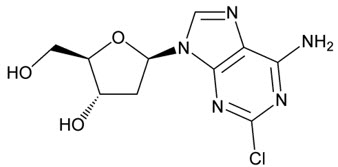
Cladribine is a prodrug that is phosphorylated to Cd-AMP by deoxycytidine kinase (and also by deoxyguanosine kinase in the mitochondria) in lymphocytes. Cd-AMP is further phosphorylated to cladribine diphosphate (Cd-ADP) and the active moiety Cd-ATP. The dephosphorylation and deactivation of Cd-AMP is catalyzed by cytoplasmic 5'-nucleotidase (5'-NTase).
The metabolism of cladribine in whole blood has not been fully characterized. However, extensive whole blood and negligible hepatic enzyme metabolism was observed, in vitro.
Excretion
After administration of 10 mg oral cladribine in MS patients, 28.5 [20] (mean [SD]) percent of the dose was excreted unchanged via the renal route. Renal clearance exceeded the glomerular filtration rate, indicating active renal secretion of cladribine.
Specific Populations
No studies have been conducted to evaluate the pharmacokinetics of cladribine in elderly or in patients with renal or hepatic impairment.
There were no clinically significant differences in the pharmacokinetics of cladribine based on age (range 18 to 65 years) or gender. The effect of hepatic impairment on the pharmacokinetics of cladribine is unknown.
Patients with Renal Impairment
Renal clearance of cladribine was shown to be dependent on creatinine clearance (CLCR). No dedicated studies have been conducted in patients with renal impairment, however patients with mild renal impairment (CLCR of 60 mL to below 90 mL per minute) were included in Study 1. A pooled pharmacokinetic analysis estimated a decrease of 18% in total clearance in a typical subject with a CLCR of 65 mL per minute leading to an increase in cladribine exposure of 25%. Clinical experience in patients with moderate to severe renal impairment (i.e., CLCR below 60 mL per minute) is limited [see Use in Specific Populations (8.6)].
Drug Interaction Studies
Clinical Studies
No clinically significant differences in cladribine pharmacokinetics were observed when used concomitantly with pantoprazole or interferon beta-1a.
In Vitro Studies
It has been reported that lamivudine can inhibit the phosphorylation of cladribine intracellularly. Potential competition for intracellular phosphorylation exists between cladribine and compounds that require intracellular phosphorylation to become active (e.g., lamivudine, zalcitabine, ribavirin, stavudine, and zidovudine).
Cytochrome P450 (CYP) Enzymes: Cladribine is not a substrate of cytochrome P450 enzymes and does not show significant potential to act as inhibitor of CYP1A2, CYP2B6, CYP2C8, CYP2C9, CYP2C19, CYP2D6, CYP2E1 and CYP3A4. Cladribine has no clinically meaningful inductive effect on CYP1A2, CYP2B6 and CYP3A4 enzymes.
Transporter Systems: Cladribine is a substrate of P-glycoprotein (P-gp), breast cancer resistance protein (BCRP), equilibrative nucleoside transporter 1 (ENT1) and concentrative nucleoside transporter 3 (CNT3). Inhibition of BCRP in the gastrointestinal tract may increase the oral bioavailability and systemic exposure of cladribine. Intracellular distribution and renal elimination of cladribine may be altered by potent ENT1, CNT3 transporter inhibitors.
Carcinogenesis
In mice administered cladribine (0, 0.1, 1, or 10 mg/kg) by subcutaneous injection intermittently (7 daily doses followed by 21 days of non-dosing per cycle) for 22 months, an increase in Harderian gland tumors (adenoma) was observed at the highest dose tested.
Mutagenesis
Cladribine was negative for mutagenicity in in vitro (reverse mutation in bacteria, CHO/HGPRT mammalian cell) assays.
Cladribine was positive for clastogenicity in an in vitro mammalian cell assay, in the absence and presence of metabolic activation, and in an in vivo mouse micronucleus assay.
Impairment of Fertility
When cladribine (0, 1, 5, 10, or 30 mg/kg/day) was administered by subcutaneous injection to male mice prior to and during mating to untreated females, no effects on fertility were observed. However, an increase in non-motile sperm was observed at the highest dose tested. In female mice, administration of cladribine (0, 1, 2, 4, or 8 mg/kg/day) by subcutaneous injection prior to and during mating to untreated males and continuing to gestation day 6 caused an increase in embryolethality at the highest dose tested.
In monkeys administered cladribine (0, 0.15, 0.3, or 1.0 mg/kg) by subcutaneous injection intermittently (7 consecutive daily doses followed by 21 days of non-dosing per cycle) for one year, testicular degeneration was observed at the highest dose tested.
Presentations
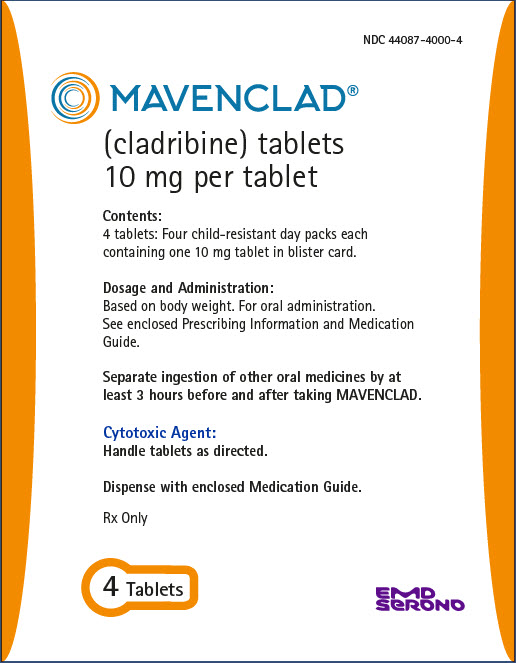
| NDC 44087-4000-4 | Box of 4 tablets: Four day packs each containing one tablet. |
| NDC 44087-4000-5 | Box of 5 tablets: Five day packs each containing one tablet. |
| NDC 44087-4000-6 | Box of 6 tablets: One day pack containing two tablets. Four day packs each containing one tablet. |
| NDC 44087-4000-7 | Box of 7 tablets: Two day packs each containing two tablets. Three day packs each containing one tablet. |
| NDC 44087-4000-8 | Box of 8 tablets: Three day packs each containing two tablets. Two day packs each containing one tablet. |
| NDC 44087-4000-9 | Box of 9 tablets: Four day packs each containing two tablets. One day pack containing one tablet. |
| NDC 44087-4000-0 | Box of 10 tablets: Five day packs each containing two tablets. |
Malignancies
Inform patients that MAVENCLAD may increase their risk of malignancies. Instruct patients to follow standard cancer screening guidelines [see Dosage and Administration (2) and Warnings and Precautions (5.1)].
Risk of Teratogenicity
Inform patients that MAVENCLAD may cause fetal harm. Discuss with women of childbearing age whether they are pregnant, might be pregnant, or are trying to become pregnant. Before initiating each treatment course, inform patients about the potential risk to the fetus, if female patients or partners of male patients get pregnant during MAVENCLAD dosing or within 6 months after the last dose in each treatment course [see Warnings and Precautions (5.2) and Use in Specific Populations (8.1, 8.3)].
Instruct female patients of childbearing potential to use effective contraception during MAVENCLAD dosing and for at least 6 months after the last dose in each treatment course to avoid pregnancy. Advise women using systemically acting hormonal contraceptives to add a barrier method during MAVENCLAD dosing and for at least 4 weeks after the last dose in each treatment course because MAVENCLAD may reduce the effectiveness of the hormonal contraceptive [see Drug Interactions (7.7)].
Instruct male patients to take precautions to prevent pregnancy of their partner during MAVENCLAD dosing and for at least 6 months after the last dose in each treatment course.
Advise patients that female patients or partners of male patients who get pregnant immediately inform their healthcare provider.
Lactation
Inform women that they cannot breastfeed on a MAVENCLAD treatment day and for 10 days after the last dose [see Use in Specific Populations (8.2)].
Lymphopenia and Other Hematologic Toxicity
Inform patients that MAVENCLAD may decrease lymphocyte counts and may also decrease counts of other blood cells. A blood test should be obtained before starting a treatment course, 2 and 6 months after start of treatment in each treatment course, periodically thereafter, and when clinically needed. Advise patients to keep all appointments for lymphocyte monitoring during and after MAVENCLAD treatment [see Dosage and Administration (2.5) and Warnings and Precautions (5.3, 5.5)].
Infections
Inform patients that use of MAVENCLAD may increase the risk of infections. Instruct patients to notify their healthcare provider promptly if fever or other signs of infection such as aching, painful muscles, headache, generally feeling unwell or loss of appetite occur while on therapy or after a course of treatment [see Warnings and Precautions (5.4)].
Advise patients that PML has happened with parenteral cladribine used in oncologic indications. Inform the patient that PML is characterized by a progression of deficits and usually leads to death or severe disability over weeks or months. Instruct the patient of the importance of contacting their doctor if they develop any symptoms suggestive of PML. Inform the patient that typical symptoms associated with PML are diverse, progress over days to weeks, and include progressive weakness on one side of the body or clumsiness of limbs, disturbance of vision, and changes in thinking, memory, and orientation leading to confusion and personality changes [see Warnings and Precautions (5.4)].
Liver Injury
Inform patients that MAVENCLAD may cause liver injury. Instruct patients treated with MAVENCLAD to report promptly any symptoms that may indicate liver injury, including fatigue, anorexia, right upper abdominal discomfort, dark urine, or jaundice. A blood test should be obtained prior to each treatment course with MAVENCLAD and as clinically indicated thereafter [see Warnings and Precautions (5.7)].
Hypersensitivity
Advise patients to seek immediate medical attention if they experience any symptoms of serious or severe hypersensitivity reactions, including skin reactions [see Warnings and Precautions (5.8)].
Cardiac Failure
Advise patients that MAVENCLAD may cause cardiac failure. Instruct patients to seek medical advice if they experience symptoms of cardiac failure (e.g., shortness of breath, rapid or irregular heartbeat, swelling) [see Warnings and Precautions (5.9)].
Treatment Handling and Administration
Instruct patients that MAVENCLAD is a cytotoxic drug and to use care when handling MAVENCLAD tablets, limit direct skin contact with the tablets, and wash exposed areas thoroughly. Advise patients to keep the tablets in the original package until just prior to each scheduled dose and consult their pharmacist on the proper disposal of unused tablets [see Dosage and Administration (2.4) and How Supplied/Storage and Handling (16.2)].
Distributed by:
EMD Serono, Inc.
Rockland, MA 02370
MAVENCLAD is a registered trademark of Merck KGaA, Darmstadt, Germany.