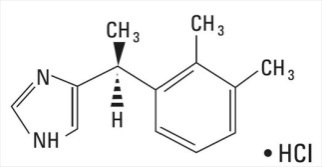
Following intravenous administration, dexmedetomidine exhibited the following pharmacokinetic parameters: a rapid distribution phase with a distribution half-life (t1/2) of approximately 6 minutes; a terminal elimination half-life (t1/2) of approximately 2 hours; and steady-state volume of distribution (Vss) of approximately 118 liters. Clearance was estimated to be approximately 39 L/hour. The mean body weight associated with this clearance estimate was 72 kg.
Dexmedetomidine exhibits linear pharmacokinetics in the dosage range of 0.2 to 0.7 mcg/kg/hr when administered by intravenous infusion for up to 24 hours. Table 8 shows the main pharmacokinetic parameters when dexmedetomidine HCl was infused (after appropriate loading doses) at maintenance infusion rates of 0.17 mcg/kg/hr (target plasma concentration of 0.3 ng/mL) for 12 and 24 hours, 0.33 mcg/kg/hr (target plasma concentration of 0.6 ng/mL) for 24 hours, and 0.70 mcg/kg/hr (target plasma concentration of 1.25 ng/mL) for 24 hours.
Table 8: Mean ± SD Pharmacokinetic Parameters
Parameter | Loading Infusion (min)/Total Infusion Duration (hrs) |
10 min/12 hrs | 10 min/24 hrs | 10 min/24 hrs | 35 min/24 hrs |
Dexmedetomidine HCL Target Plasma Concentration (ng/mL) and Dose (mcg/kg/hr) |
0.3/0.17 | 0.3/0.17 | 0.6/0.33 | 1.25/0.70 |
t1/2*, hour | 1.78 ± 0.30 | 2.22 ± 0.59 | 2.23 ± 0.21 | 2.50 ± 0.61 |
CL, liter/hour | 46.3 ± 8.3 | 43.1 ± 6.5 | 35.3 ± 6.8 | 36.5 ± 7.5 |
Vss, liter | 88.7 ± 22.9 | 102.4 ± 20.3 | 93.6 ± 17.0 | 99.6 ± 17.8 |
Avg Css #, ng/mL | 0.27 ± 0.05 | 0.27 ± 0.05 | 0.67 ± 0.10 | 1.37 ± 0.20 |
* Presented as harmonic mean and pseudo standard deviation. # Mean Css = Average steady-state concentration of dexmedetomidine HCl. The mean Css was calculated based on post-dose sampling from 2.5 to 9 hours samples for 12 hour infusion and post-dose sampling from 2.5 to 18 hours for 24 hour infusions. The loading doses for each of the above indicated groups were 0.5, 0.5, 1 and 2.2 mcg/kg, respectively. |
Dexmedetomidine pharmacokinetic parameters after dexmedetomidine HCl maintenance doses of 0.2 to 1.4 mcg/kg/hr for >24 hours were similar to the PK parameters after dexmedetomidine HCL maintenance dosing for < 24 hours in other studies. The values for clearance (CL), volume of distribution (V), and t1/2 were 39.4 L/hr, 152 L, and 2.67 hours, respectively.
Distribution
The steady-state volume of distribution (Vss) of dexmedetomidine was approximately 118 liters. Dexmedetomidine protein binding was assessed in the plasma of normal healthy male and female subjects. The average protein binding was 94% and was constant across the different plasma concentrations tested.
Elimination
The distribution half-life (t1/2) of dexmedetomidine is approximately 6 minutes, the terminal elimination half-life (t1/2) is approximately 2 hours, and clearance is estimated to be approximately 39 L/hour.
Metabolism: Dexmedetomidine undergoes almost complete biotransformation with very little unchanged dexmedetomidine excreted in urine and feces. Biotransformation involves both direct glucuronidation as well as cytochrome P450 mediated metabolism. The major metabolic pathways of dexmedetomidine are: direct N-glucuronidation to inactive metabolites; aliphatic hydroxylation (mediated primarily by CYP2A6) of dexmedetomidine to generate 3-hydroxy-dexmedetomidine, the glucuronide of 3-hydroxy-dexmedetomidine, and 3-carboxy-dexmedetomidine; and N-methylation of dexmedetomidine to generate 3-hydroxy N-methyl-dexmedetomidine, 3-carboxy N-methyl-dexmedetomidine, and dexmedetomidine-N-methyl O-glucuronide.
Excretion: A mass balance study demonstrated that after nine days an average of 95% of the radioactivity, following intravenous administration of radiolabeled dexmedetomidine, was recovered in the urine and 4% in the feces. No unchanged dexmedetomidine was detected in the urine. Approximately 85% of the radioactivity recovered in the urine was excreted within 24 hours after the infusion. Fractionation of the radioactivity excreted in urine demonstrated that products of N-glucuronidation accounted for approximately 34% of the cumulative urinary excretion. In addition, aliphatic hydroxylation of parent drug to form 3-hydroxy-dexmedetomidine, the glucuronide of 3-hydroxy-dexmedetomidine, and 3-carboxylic acid-dexmedetomidine together represented approximately 14% of the dose in urine. N-methylation of dexmedetomidine to form 3-hydroxy N-methyl dexmedetomidine, 3-carboxy N-methyl dexmedetomidine, and N-methyl O-glucuronide dexmedetomidine accounted for approximately 18% of the dose in urine. The N-Methyl metabolite itself was a minor circulating component and was undetected in urine. Approximately 28% of the urinary metabolites have not been identified.
Specific Populations
Age: Geriatric Population: The pharmacokinetic profile of dexmedetomidine HCl was not altered by age. There were no differences in the pharmacokinetics of dexmedetomidine HCl in young (18 to 40 years), middle age (41 to 65 years), and elderly (greater than 65 years) subjects.
Sex: There was no observed difference in dexmedetomidine HCl pharmacokinetics in male and female subjects. Protein binding was similar in males and females.
Hepatic Impairment: In subjects with varying degrees of hepatic impairment (Child-Pugh Class A, B, or C), clearance values for dexmedetomidine HCl were lower than in healthy subjects. The mean clearance values for patients with mild, moderate, and severe hepatic impairment were 74%, 64% and 53% of those observed in the normal healthy subjects, respectively. Mean clearances for free drug were 59%, 51% and 32% of those observed in the normal healthy subjects, respectively [see Dosage and Administration (2.4) and Use in Specific Populations (8.6)].
The fraction of dexmedetomidine HCl that was bound to plasma proteins was significantly decreased in subjects with hepatic impairment compared to subjects with normal hepatic function.
Renal Impairment: Dexmedetomidine HCl pharmacokinetics (Cmax, Tmax, AUC, t1/2, CL, and Vss) were not significantly different in subjects with severe renal impairment (creatinine clearance: less than 30 mL/minute) compared to subjects with normal renal function.
Drug Interaction Studies
In Vitro Studies:In vitro studies in human liver microsomes demonstrated no evidence of cytochrome P450 mediated drug interactions that are likely to be of clinical relevance.
No pharmacokinetic interactions between dexmedetomidine HCl and isoflurane, propofol, alfentanil and midazolam have been demonstrated [see Drug Interactions (7.1)].
Drugs Highly Bound to Plasma Proteins: Dexmedetomidine is highly bound to plasma proteins. The potential for protein binding displacement of dexmedetomidine by other drugs highly bound to proteins (i.e., fentanyl, ketorolac, theophylline, digoxin and lidocaine) was explored in vitro, and negligible changes in the plasma protein binding of dexmedetomidine were observed. The potential for protein binding displacement of other drugs highly bound to proteins (i.e., phenytoin, warfarin, ibuprofen, propranolol, theophylline and digoxin) by dexmedetomidine was explored in vitro and none of these compounds appeared to be significantly displaced by dexmedetomidine.