Brimonidine Gel
Product Images NDC 45802-078

View Photos of Packaging, Regulatory Labels, and Product Appearance

Product Visual Gallery

This gallery contains 13 technical images submitted to the FDA as part of the official labeling for Brimonidine (NDC 45802-078). Unlike standard consumer photos, these assets often include clinical data figures, molecular chemical structures, and official manufacturer packaging layouts.

As provided by Padagis Israel Pharmaceuticals Ltd, these visuals offer a comprehensive scientific overview of the product's physical and chemical identity, aiding pharmacists and researchers in product verification and study.

FDA Label Image

Carton (Carton Rev06 22)

Carton (Carton Rev06 22)
Brimonidine Topical Gel 0.33% pump label for a 30 g package by Padagis Israel Pharmaceuticals Ltd. The label includes directions for use, storage instructions, active and inactive ingredients, and a barcode. It specifies the product is for topical use only and not for oral, ophthalmic, or intravaginal use.*
FDA Label Image

Figure A (Figure A)

Figure A (Figure A)
An instructional illustration showing a hand removing a sticker from a capped topical gel tube. The image highlights the cap and sticker removal process for the BRIMONIDINE topical gel tube packaging.*
FDA Label Image

Figure B (Figure B)

Figure B (Figure B)
An instructional illustration showing a hand preparing a topical gel applicator for use. The image focuses on the fingers gripping a tube and removing or twisting off the cap, demonstrating how to open the product before application.*
FDA Label Image

Figure C (Figure C)

Figure C (Figure C)
An instructional illustration showing a person using their thumb to press the pump dispenser of a topical gel bottle with the other hand positioned below to receive the medication. The image includes the label 'Pump' to guide proper usage.*
FDA Label Image

Figure D (Figure D)

Figure D (Figure D)
An instructional illustration showing a hand using the thumb and forefinger to twist or unscrew the cap of a small container or tube, likely demonstrating how to open the product packaging.*
FDA Label Image

Brimonidine Structure.jpg (Image 01)

Brimonidine Structure.jpg (Image 01)
Chemical structure diagram showing the molecular structures of brimonidine (featuring a brominated bicyclic imidazoline and pyridine ring system) and a second molecule consistent with tartaric acid. The image illustrates the chemical makeup related to brimonidine topical gel 5 mg/g by Padagis Israel Pharmaceuticals Ltd.*
FDA Label Image

Figure 1 Day 1.jpg (Image 02)

Figure 1 Day 1.jpg (Image 02)
A line graph comparing composite success percentages over 12 hours on Day 1 between Brimonidine Topical Gel and Vehicle Gel. The y-axis shows composite success (%) and the x-axis shows time in hours. Brimonidine Topical Gel exhibits a higher percentage of composite success, peaking around 6 hours, whereas Vehicle Gel remains low throughout.*
FDA Label Image

Figure 1 Day 15.jpg (Image 03)

Figure 1 Day 15.jpg (Image 03)
A line graph titled 'Day 15' showing composite success percentages on the vertical axis and time in hours on the horizontal axis. The graph features two lines: one with circular markers rising to 28% at 6 hours then decreasing, and a second dashed line with triangular markers peaking at about 7% around 6 hours before declining.*
FDA Label Image

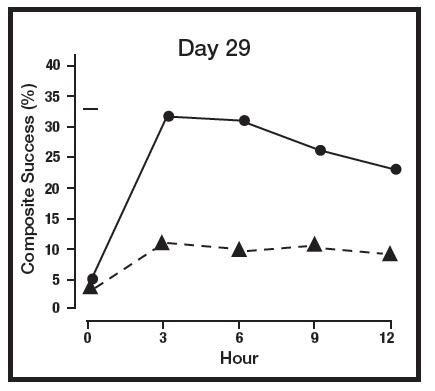
Figure 1 Day 29.jpg (Image 04)

Figure 1 Day 29.jpg (Image 04)
A line graph titled 'Day 29' displaying composite success percentage over a 12-hour period. The x-axis represents hours (0, 3, 6, 9, 12), and the y-axis shows composite success percentage ranging from 0 to 40%. Two lines are shown: one with circles peaking near 32% at hour 3, then gradually declining to about 23% at hour 12; a second line with triangles remains around 10% throughout the period.*
FDA Label Image

Figure 2 Day 1.jpg (Image 05)

Figure 2 Day 1.jpg (Image 05)
Line chart titled 'Day 1' comparing composite success percentages over 12 hours between Brimonidine Topical Gel and Vehicle Gel. The x-axis represents time in hours (0 to 12), and the y-axis shows composite success in percentage (0 to 40%). Brimonidine Topical Gel shows a peak in success near 6 hours, while Vehicle Gel remains near 0% throughout.*
FDA Label Image

Figure 2 Day 15.jpg (Image 06)

Figure 2 Day 15.jpg (Image 06)
A line graph titled 'Day 15' showing Composite Success (%) on the vertical axis and Hour on the horizontal axis. The graph compares two data series over 12 hours, with one series showing higher success rates peaking around 6 hours, then declining, and the other series showing a gradual increase over time.*
FDA Label Image

Figure 2 Day 29.jpg (Image 07)

Figure 2 Day 29.jpg (Image 07)
A line graph titled 'Day 29' showing composite success percentage over a 12-hour period. The x-axis represents hours (0, 3, 6, 9, 12), and the y-axis represents percent composite success ranging from 0 to 40%. Two data series are plotted: one with solid circles showing an increase from near 0% to above 25% at 3 hours, maintaining around 25% through 6 hours, then decreasing to below 20% at 9 hours and rising to about 22% at 12 hours; the second with solid triangles showing a steady trend hovering around 7-11% composite success throughout the 12 hours.*
FDA Label Image

Serialization (Image 13)

Serialization (Image 13)
A label panel showing placeholders for product identification information including serial number (S/N), lot number, and expiration date (Exp) for BRIMONIDINE topical gel 5 mg/g by Padagis Israel Pharmaceuticals Ltd. The label is designed to be completed with specific product batch details.*

* About these descriptions: Image descriptions on this page are generated by automated AI analysis of the product label images from the manufacturer's FDA label submission (SPL). They are provided for reference only and may contain errors or omissions. Always rely on the printed label itself and the official FDA labeling, and consult a pharmacist or healthcare professional with any questions about this product.