1 Indications And Usage
Mometasone furoate ointment is indicated for the relief of the inflammatory and pruritic manifestations of corticosteroid-responsive dermatoses in adults and pediatric patients 2 years of age or older.
The following Structured Product Label (SPL) was submitted to the FDA by Padagis Israel Pharmaceuticals Ltd for the product Mometasone Furoate (NDC 45802-119). This document serves as the official prescribing information, containing essential scientific data and clinical materials required for healthcare providers and patients.
This specific version of the label includes detailed information regarding 1 indications and usage, 2 dosage and administration, 3 dosage forms and strengths, 4 contraindications, 5.1 endocrine system adverse reactions, 5.2 ophthalmic adverse reactions, 5.3 allergic contact dermatitis, 5.4 concomitant skin infections, and other regulatory disclosures. Use the navigation below to review specific sections of the FDA submission.
Mometasone furoate ointment is indicated for the relief of the inflammatory and pruritic manifestations of corticosteroid-responsive dermatoses in adults and pediatric patients 2 years of age or older.
Ointment, 0.1%. Each gram of Mometasone Furoate Ointment USP, 0.1% contains 1 mg of mometasone furoate in a white to off-white uniform ointment base.
Mometasone furoate ointment is contraindicated in patients with a history of hypersensitivity to mometasone furoate or any of the excipients in mometasone furoate ointment.
Hypothalamic-Pituitary-Adrenal (HPA) Axis Suppression
Systemic absorption of topical corticosteroids, including mometasone furoate ointment, can cause reversible hypothalamic-pituitary-adrenal (HPA) axis suppression with the potential for glucocorticosteroid insufficiency. This may occur during treatment or after withdrawal of treatment. Factors that predispose a patient using a topical corticosteroid to HPA axis suppression include the use of high-potency corticosteroids, large treatment surface areas, prolonged use, use of occlusive dressings, altered skin barrier, liver failure, and young age.
Because of the potential for systemic absorption, consider periodically evaluating patients who are at risk of HPA axis suppression for evidence of HPA axis suppression. This may be done by using the adrenocorticotropic hormone (ACTH) stimulation test.
In a trial evaluating the effects of mometasone furoate ointment on the HPA axis, 15 grams were applied twice daily for 7 days to 6 adult subjects with psoriasis or atopic dermatitis. In this trial, mometasone furoate ointment caused a slight lowering of adrenal corticosteroid secretion [see Clinical Pharmacology (12.2)].
If HPA axis suppression occurs, gradually withdraw mometasone furoate ointment, reduce the frequency of application or consider use of a less potent corticosteroid. If signs and symptoms of glucocorticosteroid insufficiency occur, supplemental systemic corticosteroids may be required.
Cushing’s Syndrome, Hyperglycemia, and Glucosuria
Systemic effects of topical corticosteroids, including mometasone furoate ointment, may also manifest as Cushing’s syndrome, hyperglycemia, and glucosuria.
Additional Considerations
Concomitant use of mometasone furoate ointment with other corticosteroid-containing products may increase total systemic corticosteroid exposure, and result in increased risk for adverse reactions.
Pediatric patients may be more susceptible to systemic toxicity from equivalent doses due to their larger skin surface to body mass ratios [see Use in Specific Populations (8.4)].
Minimize the risk of adverse reactions by using mometasone furoate ointment as recommended [see Dosage and Administration (2)].
Use of topical corticosteroids, including mometasone furoate ointment, may increase the risk of posterior subcapsular cataracts and glaucoma. Cataracts and glaucoma have been reported in postmarketing experience with the use of topical corticosteroid products, including topical mometasone products [see Adverse Reactions (6.2)].
Avoid contact of mometasone furoate ointment with eyes. Advise patients to report any visual symptoms and consider referral to an ophthalmologist for evaluation.
Use of topical corticosteroids, including mometasone furoate ointment, can cause allergic contact dermatitis. Allergic contact dermatitis with corticosteroids is usually diagnosed by observing failure to heal rather than noting a clinical exacerbation. Corroborate such an observation with appropriate diagnostic patch testing. If irritation develops, discontinue mometasone furoate ointment and institute appropriate therapy.
Use of topical corticosteroids, including mometasone furoate ointment, may delay healing or worsen concomitant skin infections. If concomitant skin infections are present or develop, use an appropriate antimicrobial agent. If a favorable response does not occur promptly, gradually withdraw mometasone furoate ointment and discontinue use until the infection has been adequately controlled
The following serious adverse reactions are discussed in more detail in other sections of the labeling:
Because clinical trials are conducted under widely varying conditions, adverse reaction rates observed in the clinical trials of a drug cannot be directly compared to rates in the clinical trials of another drug and may not reflect the rates observed in clinical practice.
In controlled clinical trials the incidence of adverse reactions associated with the use of mometasone furoate ointment was 4.8%. Reported reactions included burning, pruritus, skin atrophy, tingling/stinging, and furunculosis. Cases of rosacea associated with the use of mometasone furoate ointment have been reported.
The following adverse reactions have been identified during postapproval use of topical corticosteroids. Because adverse reactions are reported voluntarily from a population of uncertain size, it is not always possible to reliably estimate their frequency or establish a causal relationship to drug exposure.
Risk Summary
There are no adequate and well-controlled studies in pregnant women. Available data from postmarketing reports and published observational studies over decades of use with mometasone furoate use during pregnancy have not identified a drug-associated risk of major birth defects, miscarriage, or adverse maternal outcomes. Maternal use of potent or very potent topical corticosteroids may be associated with an increased risk of low birth weight infants (see Data). Advise pregnant women to use mometasone furoate ointment on the smallest area of skin and for the shortest duration possible.
When administered subcutaneously, orally, or topically to pregnant rats, rabbits, and mice, mometasone furoate increased fetal malformations. The doses that produced malformations also decreased fetal growth, as measured by lower fetal weights and/or delayed ossification. Mometasone furoate also caused dystocia and related complications when administered to rats during the end of pregnancy (see Data). The available data do not allow the calculation of relevant comparisons between the systemic exposure of mometasone furoate observed in animal studies to the systemic exposure that would be expected in humans after topical use of mometasone furoate ointment.
The background risk of major birth defects and miscarriage for the indicated population is unknown. All pregnancies have a background risk of birth defect, loss, or other adverse outcomes. In the U.S. general population, the estimated risk of major birth defects and miscarriage in clinically recognized pregnancies is 2 to 4% and 15 to 20%, respectively.
Data
Human Data
Published data from one observational study that included 60,497 pregnancies exposed to topical corticosteroids, including 10,056 pregnancies exposed to topical mometasone, did not identify an increased risk of low birth weight infants. However, data from other observational studies demonstrate that maternal use of potent to very potent topical corticosteroids was associated with an increased risk of low birth weight infants, especially when the cumulative dosage throughout pregnancy was greater than 300 grams. Available studies have limitations including confounding by disease severity, imprecision in birth weight outcomes, and data reliance on filled prescriptions rather than actual use.
Animal Data
In mice, mometasone furoate caused cleft palate at subcutaneous doses of 60 mcg/kg and above. Fetal survival was reduced at 180 mcg/kg. No toxicity was observed at 20 mcg/kg.
In rats, mometasone furoate produced umbilical hernias at topical doses of 600 mcg/kg and above. Mometasone furoate produced delays in ossification, but no malformations at 300 mcg/kg.
In rabbits, mometasone furoate caused multiple malformations (e.g., flexed front paws, gallbladder agenesis, umbilical hernia, hydrocephaly) at topical doses of 150 mcg/kg and above. In an oral study, mometasone furoate increased resorptions and caused cleft palate and/or head malformations (hydrocephaly and domed head) at 700 mcg/kg. At 2800 mcg/kg most litters were aborted or resorbed. No toxicity was observed at 140 mcg/kg.
When rats received subcutaneous doses of mometasone furoate throughout pregnancy or during the later stages of pregnancy, prolonged and difficult labor and reduced number of live births, birth weight, and early pup survival were observed at 15 mcg/kg. Similar effects were not observed at 7.5 mcg/kg.
Risk Summary
There are no data on the presence of mometasone furoate following topical administration in animal or human milk, the effects on the breastfed infant, or the effects on milk production. It is not known whether topical administration of corticosteroids could result in sufficient systemic absorption to produce detectable quantities in breast milk. To minimize potential exposure to the breastfed infant via breast milk, use mometasone furoate ointment on the smallest area of skin and for the shortest duration possible while breastfeeding. Advise breastfeeding women not to apply mometasone furoate ointment directly to the nipple and areola to avoid direct infant exposure [see Warnings and Precautions (5.1) and Use in Specific Populations (8.4)]. The developmental and health benefits of breastfeeding should be considered along with the mother’s clinical need for mometasone furoate ointment and any potential adverse effects on the breastfed infant from mometasone furoate ointment or from the underlying maternal condition
The safety and effectiveness of mometasone furoate ointment for the relief of the inflammatory and pruritic manifestations of corticosteroid-responsive dermatoses have been established in pediatric patients 2 years of age or older [see Adverse Reactions (6.1)].
The safety and efficacy of mometasone furoate ointment have not been established in pediatric patients younger than 2 years of age. The safety and efficacy of mometasone furoate ointment use for longer than three weeks have not been established in pediatric patients 2 years of age and older.
The following adverse reactions were reported to be possibly or probably related to treatment with mometasone furoate ointment during a clinical study in 5% of 63 pediatric subjects 6 months to 2 years of age: decreased glucocorticoid levels, 1; an unspecified skin disorder, 1; and a bacterial skin infection, 1. The following signs of skin atrophy were also observed among 63 subjects treated with mometasone furoate ointment in a clinical trial: shininess, 4; telangiectasia, 1; loss of elasticity, 4; loss of normal skin markings, 4; and thinness, 1.
Endocrine Adverse Reactions
Sixty-three pediatric subjects ages 6 to 23 months, with atopic dermatitis, were enrolled in an open-label HPA axis safety trial. Mometasone furoate ointment caused HPA axis suppression in approximately 27% of pediatric subjects ages 6 to 23 months, who showed normal adrenal function by Cortrosyn test before starting treatment, and applied mometasone furoate over a mean body surface area of 39% (range 15%-99%). The criteria for suppression were: basal cortisol level of ≤5 mcg/dL, 30-minute post-stimulation level of ≤18 mcg/dL, or an increase of <7 mcg/dL. Follow-up testing 2 to 4 weeks after stopping treatment, available for 8 of the subjects, demonstrated suppressed HPA axis function in 3 subjects, using these same criteria. Mometasone furoate ointment is not indicated for use in pediatric patients younger than 2 years of age [see Clinical Pharmacology (12.2)].
Because of a higher ratio of skin surface area to body mass, pediatric patients are at a greater risk than adults of HPA axis suppression and Cushing’s syndrome when they are treated with topical corticosteroids. They are, therefore, also at greater risk of glucocorticosteroid insufficiency during and/or after withdrawal of treatment. Pediatric patients may be more susceptible than adults to skin atrophy, including striae, when they are treated with topical corticosteroids.
HPA axis suppression, Cushing’s syndrome, linear growth retardation, delayed weight gain, and intracranial hypertension have been reported in pediatric patients receiving topical corticosteroids. Manifestations of adrenal suppression in pediatrics include low plasma cortisol levels and absence of response to ACTH stimulation. Manifestations of intracranial hypertension include bulging fontanelles, headaches, and bilateral papilledema. Do not use mometasone furoate ointment in the treatment of diaper dermatitis.
Clinical trials of mometasone furoate ointment included 310 subjects who were 65 years of age and over and 57 subjects who were 75 years of age and over. No overall differences in safety or effectiveness were observed between these subjects and younger subjects, and other reported clinical experience has not identified differences in responses between the elderly and younger subjects, but greater sensitivity of some older individuals cannot be ruled out.
Mometasone Furoate Ointment USP, 0.1% contains 1 mg mometasone furoate per gram in a white to off-white uniform ointment base for topical use. Mometasone furoate is a synthetic corticosteroid with anti-inflammatory activity.
Chemically, mometasone furoate is 9α,21-dichloro-11β,17-dihydroxy-16α-methylpregna-1,4-diene-3,20-dione 17-(2-furoate), with the empirical formula C27H30Cl2O6, a molecular weight of 521.4 and the following structural formula:

Chemical Structure (Image 01)
Mometasone furoate is a white to off-white powder practically insoluble in water, slightly soluble in octanol, and moderately soluble in ethyl alcohol.
Mometasone furoate ointment contains the following inactive ingredients: hexylene glycol, phosphoric acid, propylene glycol stearate (55% monoester), purified water, white wax, and white petrolatum.
Corticosteroids play a role in cellular signaling, immune function, inflammation, and protein regulation; however, the precise mechanism of action in dermatoses is unknown.
Studies performed with mometasone furoate ointment indicate that it is in the medium range of potency as compared with other topical corticosteroids.
Hypothalamic-Pituitary-Adrenal (HPA) Axis Suppression
In a study evaluating the effects of mometasone furoate ointment on the HPA axis, 15 grams were applied twice daily for 7 days to 6 adult subjects with psoriasis or atopic dermatitis. The ointment was applied without occlusion to at least 30% of the body surface. The results showed that the drug caused a slight lowering of adrenal corticosteroid secretion [see Warnings and Precautions (5.1)].
Sixty-three pediatric subjects ages 6 to 23 months, with atopic dermatitis, were enrolled in an open-label HPA axis safety study. Mometasone furoate ointment was applied once daily over a mean body surface area of 39% (range 15%-99%). In approximately 27% of subjects who showed normal adrenal function by Cortrosyn test before starting treatment, adrenal suppression was observed at the end of treatment with mometasone furoate ointment. The criteria for suppression were: basal cortisol level of ≤5 mcg/dL, 30-minute post-stimulation level of ≤18 mcg/dL, or an increase of <7 mcg/dL. Follow-up testing 2 to 4 weeks after stopping treatment, available for 8 of the subjects, demonstrated suppressed HPA axis function in 3 subjects, using these same criteria [see Use in Specific Populations (8.4)].
The extent of percutaneous absorption of topical corticosteroids is determined by many factors including the vehicle and the integrity of the epidermal barrier. Studies in humans indicate that approximately 0.7% of the applied dose of mometasone furoate ointment enters the circulation after 8 hours of contact on normal skin without occlusion. Inflammation and/or other disease processes in the skin may increase percutaneous absorption.
Long-term animal studies have not been performed to evaluate the carcinogenic potential of mometasone furoate ointment. Long-term carcinogenicity studies of mometasone furoate were conducted by the inhalation route in rats and mice. In a 2-year carcinogenicity study in Sprague Dawley rats, mometasone furoate demonstrated no statistically significant increase of tumors at inhalation doses up to 67 mcg/kg. In a 19-month carcinogenicity study in Swiss CD-1 mice, mometasone furoate demonstrated no statistically significant increase in the incidence of tumors at inhalation doses up to 160 mcg/kg.
Mometasone furoate increased chromosomal aberrations in an in vitro Chinese hamster ovary cell assay, but did not increase chromosomal aberrations in an in vitro Chinese hamster lung cell assay. Mometasone furoate was not mutagenic in the Ames test or mouse lymphoma assay, and was not clastogenic in an in vivo mouse micronucleus assay, a rat bone marrow chromosomal aberration assay, or a mouse male germ-cell chromosomal aberration assay. Mometasone furoate also did not induce unscheduled DNA synthesis in vivo in rat hepatocytes.
In reproductive studies in rats, mometasone furoate did not cause impairment of fertility in male or female rats at subcutaneous doses up to 15 mcg/kg.
The safety and efficacy of mometasone furoate ointment, 0.1% for the treatment of corticosteroid-responsive dermatoses was demonstrated in two vehicle-controlled trials, one in subjects with psoriasis and one in subjects with atopic dermatitis. These trials included a total of 218 subjects with 109 subjects applying mometasone furoate ointment and 109 subjects applying vehicle ointment once daily for 21 days.
How Supplied
Mometasone Furoate Ointment USP, 0.1% is a white to off-white uniform ointment and supplied in 15-gram (NDC 45802-119-37) and 45-gram (NDC 45802-119-42) tubes; boxes of one.
Storage and Handling
Store at 20° to 25°C (68° to 77°F) [see USP Controlled Room Temperature].
Advise the patient to read the FDA-approved patient labeling (Patient Information).
Important Administration Instructions
Inform patients of the following [see Dosage and Administration (2)]:
Endocrine System Adverse Reactions
Ophthalmic Adverse Reactions
Allergic Contact Dermatitis
Pregnancy and Lactation
Manufactured by Padagis®
Yeruham, Israel
www.padagis.com
Rev 08-26
1M600 RC PH7
PADAGIS is a registered trademark of Padagis US LLC.
Mometasone Furoate (moe-MET-a-sone fur-o-ate) Ointment USP, 0.1%
Important information: Mometasone furoate ointment is for use on skin only (topical). Do not use mometasone furoate ointment in your eyes, mouth, or vagina.
What is mometasone furoate ointment?
Do not use mometasone furoate ointment if you:
Before using mometasone furoate ointment, tell your healthcare provider about all your medical conditions, including if you:
Tell your healthcare provider about all the medicines you take, including prescription and over-the-counter medicines, vitamins, and herbal supplements.
Especially tell your healthcare provider if you take other corticosteroid medicines by mouth or use other products on your skin or scalp that contain corticosteroids. Do not use other products containing a corticosteroid medicine while using mometasone propionate ointment without talking to your healthcare provider first.
How should I use mometasone furoate ointment?
What are the possible side effects of mometasone furoate ointment?
Mometasone furoate ointment may cause serious side effects, including:
The most common side effects of mometasone furoate ointment include burning, itching, thinning of the skin (atrophy), tingling, stinging, and boils.
These are not all the possible side effects of mometasone furoate ointment.
Call your doctor for medical advice about side effects. You may report side effects to FDA at 1-800-FDA-1088.
How should I store mometasone furoate ointment?
General information about the safe and effective use of mometasone furoate ointment.
Medicines are sometimes prescribed for purposes other than those listed in a Patient Information leaflet. Do not use mometasone furoate ointment for a condition for which it was not prescribed. Do not give mometasone furoate ointment to other people, even if they have the same symptoms that you have. It may harm them. You can ask your pharmacist or healthcare provider for information about mometasone furoate ointment that is written for health professionals.
What are the ingredients in mometasone furoate ointment?
Active ingredient: mometasone furoate
Inactive ingredients: hexylene glycol, phosphoric acid, propylene glycol stearate (55% monoester), purified water, white wax, and white petrolatum
Manufactured by Padagis®
Yeruham, Israel
www.padagis.com
Rev 08-26
1M600 RC PH7
This Patient Information has been approved by the U.S. Food and Drug Administration.
NDC 45802-119-37
Rx Only
Mometasone Furoate Ointment USP, 0.1%
For Dermatologic Use Only. Not for Ophthalmic Use.
15 g
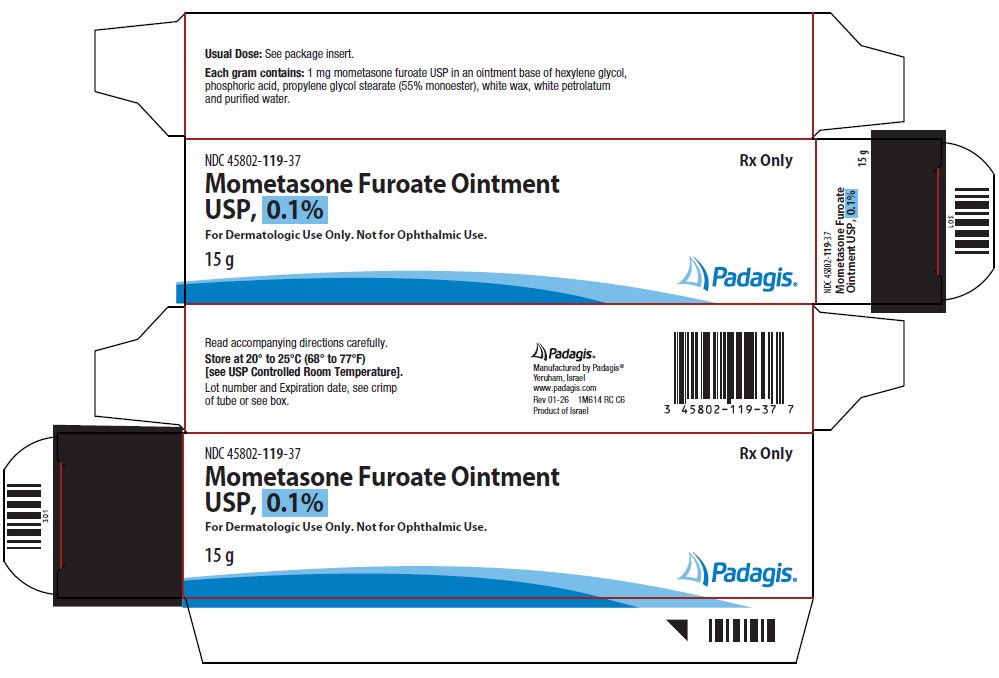
Carton Image (15g)
NDC 45802-119-42
Rx Only
Mometasone Furoate Ointment USP, 0.1%
For Dermatologic Use Only. Not for Ophthalmic Use.
45 g
* Please review the disclaimer below.
