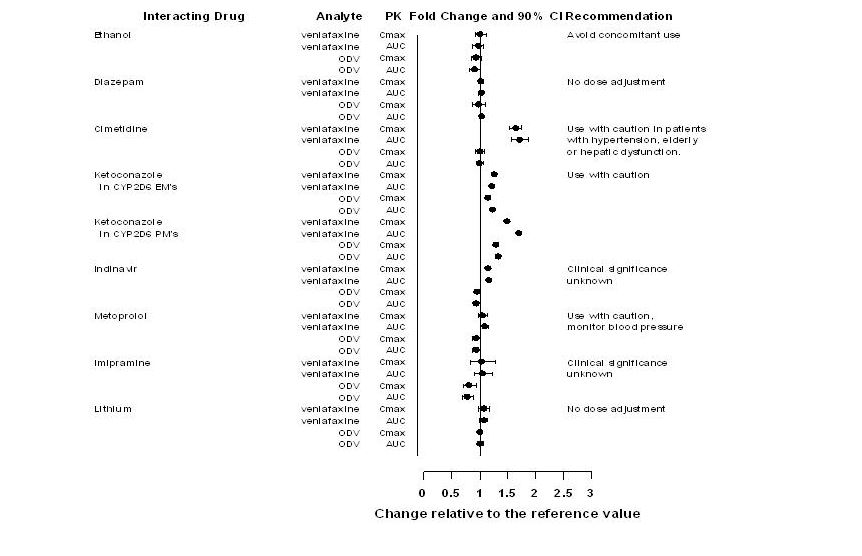
Patients with Hepatic Impairment
The total daily dose should be reduced by 50% in patients with mild (Child-Pugh=5–6) to moderate (Child-Pugh=7–9) hepatic impairment. In patients with severe hepatic impairment (Child-Pugh=10–15) or hepatic cirrhosis, it may be necessary to reduce the dose by 50% or more [
See
Use in Specific Populations (8.7)].
Patients with Renal Impairment
The total daily dose should be reduced by 25% to 50% in patients with mild (CLcr= 60–89 mL/min) or moderate (CLcr= 30–59 mL/min) renal impairment. In patients undergoing hemodialysis or with severe renal impairment (CLcr < 30 mL/min), the total daily dose should be reduced by 50% or more. Because there was much individual variability in clearance between patients with renal impairment, individualization of dosage may be desirable in some patients [
see
Use in Specific Populations (8.7)].
Use of Venlafaxine hydrochloride Extended-Release with other MAOIs such as Linezolid or Intravenous Methylene Blue
Do not start venlafaxine hydrochloride extended-release in a patient who is being treated with linezolid or intravenous methylene blue, because there is an increased risk of serotonin syndrome. In a patient who requires more urgent treatment of a psychiatric condition, other interventions, including hospitalization should be considered [
see
Contraindications (4.2)].
In some cases, a patient already receiving venlafaxine hydrochloride extended-release therapy may require urgent treatment with linezolid or intravenous methylene blue. If acceptable alternatives to linezolid or intravenous methylene blue are not available and the potential benefits of linezolid or intravenous methylene blue treatment are judged to outweigh the risks of serotonin syndrome in a particular patient, venlafaxine hydrochloride extended-release should be stopped promptly, and linezolid or intravenous methylene blue can be administered. Monitor the patient for symptoms of serotonin syndrome for 7 days or until 24 hours after the last dose of linezolid or intravenous methylene blue, whichever comes first. Therapy with venlafaxine hydrochloride extended-release can be resumed 24 hours after the last dose of linezolid or intravenous methylene blue [
see
Warnings and Precautions (5.2)].
The risk of administering methylene blue by non-intravenous routes (such as oral tablets or by local injection) or in intravenous doses much lower than 1 mg/kg concomitantly with venlafaxine hydrochloride extended-release is unclear. The clinician should, nevertheless, be aware of the possibility of emergent symptoms of serotonin syndrome with such use [
see
Warnings and Precautions (5.2)]
.
Screening Patients for Bipolar Disorder
A major depressive episode may be the initial presentation of bipolar disorder. It is generally believed (though not established in controlled studies) that treating such an episode with an antidepressant alone may increase the likelihood of precipitation of a mixed/manic episode in patients at risk for bipolar disorder. Whether any of the symptoms described above represent such a conversion is unknown. However, prior to initiating treatment with an antidepressant, patients with depressive symptoms should be adequately screened to determine if they are at risk for bipolar disorder; such screening should include a detailed psychiatric history, including a family history of suicide, bipolar disorder, and depression. It should be noted that venlafaxine hydrochloride extended-release is not approved for use in treating bipolar depression.
Weight Changes
The average change in body weight and incidence of weight loss (percentage of patients who lost 3.5% or more) in the placebo-controlled pediatric studies in MDD, GAD, and SAD are shown in Tables 3 and 4.
Table 3: Average Change in Body Weight (kg) From Beginning of Treatment in Pediatric Patients in Double-blind, Placebo-controlled Studies of Venlafaxine hydrochloride Extended-ReleaseIndication
(Duration)
| Venlafaxine hydrochloride Extended-Release | Placebo |
|---|
MDD and GAD
(4 pooled studies, 8 weeks)
| -0.45 (n = 333) | +0.77 (n = 333) |
SAD
(16 weeks)
| -0.75 (n = 137) | +0.76 (n = 148) |
Table 4: Incidence (%) of Pediatric Patients Experiencing Weight Loss (3.5% or more) in Double-blind, Placebo-controlled Studies of Venlafaxine hydrochloride Extended-ReleaseIndication
(Duration)
| Venlafaxine hydrochloride Extended-Release | Placebo |
|---|
MDD and GAD
(4 pooled studies, 8 weeks)
| 18
p < 0.001 versus placebo (n = 333)
| 3.6 (n = 333) |
SAD
(16 weeks)
| 47
(n = 137)
| 14 (n = 148) |
Weight loss was not limited to patients with treatment-emergent anorexia [
see
Warnings and Precautions (5.11)].
The risks associated with longer term venlafaxine hydrochloride extended-release use were assessed in an open-label MDD study of children and adolescents who received venlafaxine hydrochloride extended-release for up to six months. The children and adolescents in the study had increases in weight that were less than expected, based on data from age- and sex-matched peers. The difference between observed weight gain and expected weight gain was larger for children (< 12 years old) than for adolescents (≥ 12 years old).
Height Changes
Table 5 shows the average height increase in pediatric patients in the short-term, placebo-controlled MDD, GAD, and SAD studies. The differences in height increases in GAD and MDD studies were most notable in patients younger than twelve.
Table 5: Average Height Increases (cm) in Pediatric Patients in Placebo-controlled Studies of Venlafaxine hydrochloride Extended-ReleaseIndication
(Duration)
| Venlafaxine hydrochloride Extended-Release | Placebo |
|---|
| MDD | | |
| (8 weeks) | 0.8 (n = 146) | 0.7 (n = 147) |
| GAD | | |
| (8 weeks) | 0.3
p = 0.041 (n = 122)
| 1.0 (n = 132) |
| SAD | | |
| (16 weeks) | 1.0 (n = 109) | 1.0 (n = 112) |
In the six-month, open-label MDD study, children and adolescents had height increases that were less than expected, based on data from age- and sex-matched peers. The difference between observed and expected growth rates was larger for children (< 12 years old) than for adolescents (≥ 12 years old).
Most Common Adverse Reactions
The most commonly observed adverse reactions in the clinical study database in venlafaxine hydrochloride extended-release treated patients in MDD, GAD, SAD, and PD (incidence ≥ 5% and at least twice the rate of placebo) were: nausea (30.0%), somnolence (15.3%), dry mouth (14.8%), sweating (11.4%), abnormal ejaculation (9.9%), anorexia (9.8%), constipation (9.3%), impotence (5.3%) and decreased libido (5.1%).
Adverse Reactions Reported as Reasons for Discontinuation of Treatment
Combined across short-term, placebo-controlled premarketing studies for all indications, 12% of the 3,558 patients who received venlafaxine hydrochloride extended-release (37.5–225 mg) discontinued treatment due to an adverse experience, compared with 4% of the 2,197 placebo-treated patients in those studies.
The most common adverse reactions leading to discontinuation in ≥ 1% of the venlafaxine hydrochloride extended-release treated patients in the short-term studies (up to 12 weeks) across indications are shown in Table 7.
Table 7: Incidence (%) of Patients Reporting Adverse Reactions Leading to Discontinuation in Placebo-controlled Clinical Studies (up to 12 Weeks Duration)Body System
Adverse Reaction
| Venlafaxine hydrochloride Extended-Release
n = 3,558
| Placebo
n = 2,197
|
|---|
| Body as a whole | | |
| Asthenia | 1.7 | 0.5 |
| Headache | 1.5 | 0.8 |
| Digestive system | | |
| Nausea | 4.3 | 0.4 |
| Nervous system | | |
| Dizziness | 2.2 | 0.8 |
| Insomnia | 2.1 | 0.6 |
| Somnolence | 1.7 | 0.3 |
| Skin and appendages | 1.5 | 0.6 |
| Sweating | 1.0 | 0.2 |
Common Adverse Reactions in Placebo-controlled Studies
The number of patients receiving multiple doses of venlafaxine hydrochloride extended-release during the premarketing assessment for each approved indication is shown in Table 8. The conditions and duration of exposure to venlafaxine in all development programs varied greatly, and included (in overlapping categories) open and double-blind studies, uncontrolled and controlled studies, inpatient (venlafaxine hydrochloride immediate-release only) and outpatient studies, fixed-dose, and titration studies.
Table 8: Patients Receiving Venlafaxine hydrochloride Extended-Release in Premarketing Clinical Studies| Indication | Venlafaxine hydrochloride Extended-Release |
|---|
| MDD | 705
In addition, in the premarketing assessment of venlafaxine hydrochloride immediate-release, multiple doses were administered to 2,897 patients in studies for MDD. |
| GAD | 1,381 |
| SAD | 819 |
| PD | 1,314 |
The incidences of common adverse reactions (those that occurred in ≥ 2% of venlafaxine hydrochloride extended-release treated patients [357 MDD patients, 1,381 GAD patients, 819 SAD patients, and 1,001 PD patients] and more frequently than placebo) in venlafaxine hydrochloride extended-release treated patients in short-term, placebo-controlled, fixed- and flexible-dose clinical studies (doses 37.5 to 225 mg per day) are shown in Table 9.
The adverse reaction profile did not differ substantially between the different patient populations.
Table 9: Common Adverse Reactions: Percentage of Patients Reporting Adverse Reactions (≥ 2% and > placebo) in Placebo-controlled Studies (up to 12 Weeks Duration) across All IndicationsBody System
Adverse Reaction
| Venlafaxine hydrochloride Extended-Release
n = 3,558
| Placebo
n = 2,197
|
|---|
| Body as a whole | | |
| Asthenia | 12.6 | 7.8 |
| Cardiovascular system | | |
| Hypertension | 3.4 | 2.6 |
| Palpitation | 2.2 | 2.0 |
| Vasodilatation | 3.7 | 1.9 |
| Digestive system | | |
| Anorexia | 9.8 | 2.6 |
| Constipation | 9.3 | 3.4 |
| Diarrhea | 7.7 | 7.2 |
| Dry mouth | 14.8 | 5.3 |
| Nausea | 30.0 | 11.8 |
| Vomiting | 4.3 | 2.7 |
| Nervous system | | |
| Abnormal dreams | 2.9 | 1.4 |
| Dizziness | 15.8 | 9.5 |
| Insomnia | 17.8 | 9.5 |
| Libido decreased | 5.1 | 1.6 |
| Nervousness | 7.1 | 5.0 |
| Paresthesia | 2.4 | 1.4 |
| Somnolence | 15.3 | 7.5 |
| Tremor | 4.7 | 1.6 |
| Respiratory system | | |
| Yawn | 3.7 | 0.2 |
| Skin and appendages | | |
| Sweating (including night sweats) | 11.4 | 2.9 |
| Special senses | | |
| Abnormal vision | 4.2 | 1.6 |
| Urogenital system | | |
| Abnormal ejaculation/orgasm (men)
Percentages based on the number of men (venlafaxine hydrochloride extended-release, n = 1,440; placebo, n = 923) | 9.9 | 0.5 |
| Anorgasmia (men)
| 3.6 | 0.1 |
| Anorgasmia (women)
Percentages based on the number of women (venlafaxine hydrochloride extended-release, n = 2,118; placebo, n = 1,274) | 2.0 | 0.2 |
| Impotence (men)
| 5.3 | 1.0 |
Other Adverse Reactions Observed in Clinical Studies
Body as a whole – Photosensitivity reaction, chills
Cardiovascular system – Postural hypotension, syncope, hypotension, tachycardia
Digestive system – Gastrointestinal hemorrhage [
see
Warnings and Precautions (5.4)], bruxism
Hemic/Lymphatic system – Ecchymosis [
see
Warnings and Precautions (5.4)]
Metabolic/Nutritional – Hypercholesterolemia, weight gain [
see
Warnings and Precautions (5.10)], weight loss [
see
Warnings and Precautions (5.10)]
Nervous system – Seizures [
see
Warnings and Precautions (5.8)], manic reaction [
see
Warnings and Precautions (5.6)], agitation, confusion, akathisia, hallucinations, hypertonia, myoclonus, depersonalization, apathy
Skin and appendages – Urticaria, pruritus, rash, alopecia
Special senses – Mydriasis, abnormality of accommodation, tinnitus, taste perversion
Urogenital system – Urinary retention, urination impaired, urinary incontinence, urinary frequency increased, menstrual disorders associated with increased bleeding or increased irregular bleeding (e.g., menorrhagia, metrorrhagia)
Serum Cholesterol
Venlafaxine hydrochloride extended-release was associated with mean final increases in serum cholesterol concentrations compared with mean final decreases for placebo in premarketing MDD, GAD, SAD and PD clinical studies (Table 13).
Table 13: Mean Final On-therapy Changes in Cholesterol Concentrations (mg/dL) in Venlafaxine hydrochloride Extended-Release Premarketing StudiesIndication
(Duration)
| Venlafaxine hydrochloride Extended-Release | Placebo |
|---|
| MDD | | |
| (12 weeks) | +1.5 | -7.4 |
| GAD | | |
| (8 weeks) | +1.0 | -4.9 |
| (6 months) | +2.3 | -7.7 |
| SAD | | |
| (12 weeks) | +7.9 | -2.9 |
| (6 months) | +5.6 | -4.2 |
| PD | | |
| (12 weeks) | 5.8 | -3.7 |
Venlafaxine hydrochloride extended-release capsules treatment for up to 12 weeks in premarketing placebo-controlled trials for major depressive disorder was associated with a mean final on-therapy increase in serum cholesterol concentration of approximately 1.5 mg/dL compared with a mean final decrease of 7.4 mg/dL for placebo. Venlafaxine hydrochloride extended-release treatment for up to 8 weeks and up to 6 months in premarketing placebo-controlled GAD trials was associated with mean final on-therapy increases in serum cholesterol concentration of approximately 1.0 mg/dL and 2.3 mg/dL, respectively while placebo subjects experienced mean final decreases of 4.9 mg/dL and 7.7 mg/dL, respectively. Venlafaxine hydrochloride extended-release treatment for up to 12 weeks and up to 6 months in premarketing placebo-controlled Social Anxiety Disorder trials was associated with mean final on-therapy increases in serum cholesterol concentration of approximately 7.9 mg/dL and 5.6 mg/dL, respectively, compared with mean final decreases of 2.9 and 4.2 mg/dL, respectively, for placebo. Venlafaxine hydrochloride extended-release treatment for up to 12 weeks in premarketing placebo-controlled panic disorder trials was associated with mean final on-therapy increases in serum cholesterol concentration of approximately 5.8 mg/dL compared with a mean final decrease of 3.7 mg/dL for placebo.
Patients treated with venlafaxine hydrochloride immediate-release for at least 3 months in placebo-controlled 12-month extension trials had a mean final on-therapy increase in total cholesterol of 9.1 mg/dL compared with a decrease of 7.1 mg/dL among placebo-treated patients. This increase was duration dependent over the study period and tended to be greater with higher doses. Clinically relevant increases in serum cholesterol, defined as 1) a final on-therapy increase in serum cholesterol ≥50 mg/dL from baseline and to a value ≥261 mg/dL, or 2) an average on-therapy increase in serum cholesterol ≥50 mg/dL from baseline and to a value ≥261 mg/dL, were recorded in 5.3% of venlafaxine-treated patients and 0.0% of placebo-treated patients.
Serum Triglycerides
Venlafaxine hydrochloride extended-release was associated with mean final on-therapy increases in fasting serum triglycerides compared with placebo in premarketing clinical studies of SAD and PD up to 12 weeks (pooled data) and 6 months duration (Table 14).
Table 14: Mean Final On-therapy Increases in Triglyceride Concentrations (mg/dL) in Venlafaxine hydrochloride Extended-Release Premarketing StudiesIndication
(Duration)
| Venlafaxine hydrochloride Extended-Release | Placebo |
|---|
| SAD | 8.2 | 0.4 |
| (12 weeks) | | |
| SAD | 11.8 | 1.8 |
| (6 months) | | |
| PD | 5.9 | 0.9 |
| (12 weeks) | | |
| PD | 9.3 | 0.3 |
| (6 months) | | |
Absorption and Distribution
Venlafaxine is well absorbed and extensively metabolized in the liver. ODV is the major active metabolite. On the basis of mass balance studies, at least 92% of a single oral dose of venlafaxine is absorbed. The absolute bioavailability of venlafaxine is approximately 45%.
Administration of venlafaxine hydrochloride extended-release (150 mg once daily) generally resulted in lower C
max and later T
max values than for venlafaxine hydrochloride immediate-release administered twice daily (Table 16). When equal daily doses of venlafaxine were administered as either an immediate-release tablet or the extended-release capsule, the exposure to both venlafaxine and ODV was similar for the two treatments, and the fluctuation in plasma concentrations was slightly lower with the venlafaxine hydrochloride extended-release capsule. Therefore, venlafaxine hydrochloride extended-release provides a slower rate of absorption, but the same extent of absorption compared with the immediate-release tablet.
Table 16: Comparison of C
max and T
max Values for Venlafaxine and ODV Following Oral Administration of Venlafaxine hydrochloride Extended-Release and Venlafaxine hydrochloride Immediate-Release)
| Venlafaxine | ODV |
|---|
| C
max
(ng/mL)
| T
max
(h)
| C
max
(ng/mL)
| T
max
(h)
|
|---|
| Venlafaxine hydrochloride Extended-Release (150 mg once daily) | 150 | 5.5 | 260 | 9 |
| Venlafaxine hydrochloride Immediate-Release (75 mg twice daily) | 225 | 2 | 290 | 3 |
Food did not affect the bioavailability of venlafaxine or its active metabolite, ODV. Time of administration (AM versus PM) did not affect the pharmacokinetics of venlafaxine and ODV from the 75 mg venlafaxine hydrochloride extended-release capsule.
Venlafaxine is not highly bound to plasma proteins; therefore, administration of venlafaxine hydrochloride extended-release to a patient taking another drug that is highly protein-bound should not cause increased free concentrations of the other drug.
Metabolism and Elimination
Following absorption, venlafaxine undergoes extensive presystemic metabolism in the liver, primarily to ODV, but also to N-desmethylvenlafaxine, N,O-didesmethylvenlafaxine, and other minor metabolites.
In vitro studies indicate that the formation of ODV is catalyzed by CYP2D6; this has been confirmed in a clinical study showing that patients with low CYP2D6 levels (poor metabolizers) had increased levels of venlafaxine and reduced levels of ODV compared to people with normal CYP2D6 levels (extensive metabolizers) [
see
Use in Specific Populations (8.7)].
Approximately 87% of a venlafaxine dose is recovered in the urine within 48 hours as unchanged venlafaxine (5%), unconjugated ODV (29%), conjugated ODV (26%), or other minor inactive metabolites (27%). Renal elimination of venlafaxine and its metabolites is thus the primary route of excretion.
Carcinogenesis
Tumors were not increased by venlafaxine treatment in mice or rats. Venlafaxine was given by oral gavage to mice for 18 months at doses up to 120 mg/kg per day, which was 1.7 times the maximum recommended human dose on a mg/m
2 basis. Venlafaxine was also given to rats by oral gavage for 24 months at doses up to 120 mg/kg per day. In rats receiving the 120 mg/kg dose, plasma concentrations of venlafaxine at necropsy were 1 times (male rats) and 6 times (female rats) the plasma concentrations of patients receiving the maximum recommended human dose. Plasma levels of the O-desmethyl metabolite (ODV) were lower in rats than in patients receiving the maximum recommended dose. O-desmethylvenlafaxine (ODV), the major human metabolite of venlafaxine, administered by oral gavage to mice and rats for 2 years did not increase the incidence of tumors in either study. Mice received ODV at dosages up to 500/300 mg/kg/day (dosage lowered after 45 weeks of dosing). The exposure at the 300 mg/kg/day dose is 9 times that of a human dose of 225 mg/day. Rats received ODV at dosages up to 300 mg/kg/day (males) or 500 mg/kg/day (females). The exposure at the highest dose is approximately 8 (males) or 11 (females) times that of a human dose of 225 mg/day.
Mutagenesis
Venlafaxine and the major human metabolite, ODV, were not mutagenic in the Ames reverse mutation assay in
Salmonella bacteria or the Chinese hamster ovary/HGPRT mammalian cell forward gene mutation assay. Venlafaxine was also not mutagenic or clastogenic in the
in vitro BALB/c-3T3 mouse cell transformation assay, the sister chromatid exchange assay in cultured Chinese hamster ovary cells, or in the
in vivo chromosomal aberration assay in rat bone marrow. ODV was not clastogenic in the
in vitro Chinese hamster ovary cell chromosomal aberration assay or in the
in vivo chromosomal aberration assay in rats.
Impairment of Fertility
Reproduction and fertility studies of venlafaxine in rats showed no adverse effects of venlafaxine on male or female fertility at oral doses of up to 2 times the maximum recommended human dose of 225 mg/day on a mg/m
2 basis. However, reduced fertility was observed in a study in which male and female rats were treated with O-desmethylvenlafaxine (ODV), the major human metabolite of venlafaxine, prior to and during mating and gestation. This occurred at an ODV exposure (AUC) approximately 2 to 3 times that associated with a human venlafaxine dose of 225 mg/day.
Suicidal Thoughts and Behaviors
Advise patients, their families and caregivers to look for the emergence of suicidality, worsening of depression, and other psychiatric symptoms (anxiety, agitation, panic attacks, insomnia, irritability, hostility, aggressiveness, impulsivity, akathisia, psychomotor restlessness, hypomania, mania, other unusual changes in behavior), especially early during treatment and when the dose is adjusted up or down. Such symptoms should be reported to the patient's prescriber or health professional, especially if they are severe, abrupt in onset, or were not part of the patient's presenting symptoms. Symptoms such as these may be associated with an increased risk for suicidal thinking and behavior and indicate a need for very close monitoring [
see
Boxed Warning and
Warnings and Precautions (5.1)].
Concomitant Medication
Advise patients taking venlafaxine hydrochloride extended-release not to use concomitantly other products containing venlafaxine or desvenlafaxine. Healthcare professionals should instruct patients not to take venlafaxine hydrochloride extended-release with an MAOI or within 14 days of stopping an MAOI and to allow 7 days after stopping venlafaxine hydrochloride extended-release before starting an MAOI [
see
Contraindications (4.2)].
Serotonin Syndrome
Patients should be cautioned about the risk of serotonin syndrome, with the concomitant use of venlafaxine hydrochloride extended-release and triptans, tramadol, tryptophan supplements, with antipsychotics or other dopamine antagonists, or other serotonergic agents [s
ee
Warnings and Precautions (5.2) and
Drug Interactions (7.3)].
Elevated Blood Pressure
Advise patients that they should have regular monitoring of blood pressure when taking venlafaxine hydrochloride extended-release [
see
Warnings and Precautions (5.3)].
Abnormal Bleeding
Patients should be cautioned about the concomitant use of venlafaxine hydrochloride extended-release and NSAIDs, aspirin, warfarin, or other drugs that affect coagulation since combined use of psychotropic drugs that interfere with serotonin reuptake and these agents has been associated with an increased risk of bleeding [
see
Warnings and Precautions (5.4)].
Angle Closure Glaucoma
Patients should be advised that taking venlafaxine hydrochloride extended-release can cause mild pupillary dilation, which in susceptible individuals, can lead to an episode of angle closure glaucoma. Pre-existing glaucoma is almost always open-angle glaucoma because angle closure glaucoma, when diagnosed, can be treated definitively with iridectomy. Open-angle glaucoma is not a risk factor for angle closure glaucoma. Patients may wish to be examined to determine whether they are susceptible to angle closure, and have a prophylactic procedure (e.g., iridectomy), if they are susceptible [
see
Warnings and Precautions (5.5)].
Activation of Mania/Hypomania
Advise patients, their families and caregivers to observe for signs of activation of mania/hypomania [
see
Warnings and Precautions (5.6)].
Cardiovascular/Cerebrovascular Disease
Caution is advised in administering venlafaxine hydrochloride extended-release to patients with cardiovascular, cerebrovascular, or lipid metabolism disorders [
see
Adverse Reactions (6.1)].
Serum Cholesterol and Triglyceride Elevation
Advise patients that elevations in total cholesterol, LDL and triglycerides may occur and that measurement of serum lipids may be considered [
see
Warnings and Precautions (6.3)].
Discontinuation [Symptoms]
Advise patients not to stop taking venlafaxine hydrochloride extended-release without talking first with their healthcare professional. Patients should be aware that discontinuation effects may occur when stopping venlafaxine hydrochloride extended-release [
see
Warnings and Precautions (5.7) and
Adverse Reactions (6.1)].
Interference with Cognitive and Motor Performance
Caution patients about operating hazardous machinery, including automobiles, until they are reasonably certain that venlafaxine hydrochloride extended-release therapy does not adversely affect their ability to engage in such activities.
Alcohol
Advise patients to avoid alcohol while taking venlafaxine hydrochloride extended-release [
see
Drug Interactions (7.6)].
Allergic Reactions
Advise patients to notify their physician if they develop allergic phenomena such as rash, hives, swelling, or difficulty breathing.
Pregnancy
Advise patients to notify their physician if they become pregnant or intend to become pregnant during therapy [
see
Use in Specific Populations (8.1)].
Nursing
Advise patients to notify their physician if they are breast-feeding an infant [
see
Use in Specific Populations (8.3)].
Residual Spheroids
Venlafaxine hydrochloride extended-release contains spheroids, which release the drug slowly into the digestive tract. The insoluble portion of these spheroids is eliminated, and patients may notice spheroids passing in the stool or via colostomy. Patients should be informed that the active medication has already been absorbed by the time the patient sees the spheroids.
Distributed by:
Apotex Corp.
Weston, Florida 33326
LAB-0501-16.0