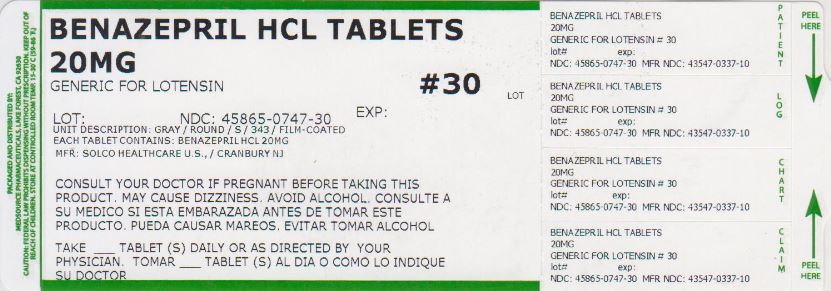
Other
Rx only
Prescribing Information
Hypertension
Head and Neck Angioedema: Angioedema of the face, extremities, lips, tongue, glottis, and larynx has been reported in patients treated with angiotensin-converting enzyme inhibitors. In U.S. clinical trials, symptoms consistent with angioedema were seen in none of the subjects who received placebo and in about 0.5% of the subjects who received benazepril hydrochloride tablets. Angioedema associated with laryngeal edema can be fatal. If laryngeal stridor or angioedema of the face, tongue, or glottis occurs, treatment with benazepril hydrochloride tablets should be discontinued and appropriate therapy instituted immediately. Where there is involvement of the tongue, glottis, or larynx, likely to cause airway obstruction, appropriate therapy, e.g., subcutaneous epinephrine injection 1:1000 (0.3 mL to 0.5 mL) should be promptly administered (see ADVERSE REACTIONS).
Black patients receiving ACE inhibitors have been reported to have a higher incidence of angioedema compared to nonblacks.
Intestinal Angioedema: Intestinal angioedema has been reported in patients treated with ACE inhibitors. These patients presented with abdominal pain (with or without nausea or vomiting); in some cases there was no prior history of facial angioedema and C-1 esterase levels were normal. The angioedema was diagnosed by procedures including abdominal CT scan or ultrasound, or at surgery, and symptoms resolved after stopping the ACE inhibitor. Intestinal angioedema should be included in the differential diagnosis of patients on ACE inhibitors presenting with abdominal pain.
Anaphylactoid Reactions During Desensitization: Two patients undergoing desensitizing treatment with hymenoptera venom while receiving ACE inhibitors sustained life-threatening anaphylactoid reactions. In the same patients, these reactions were avoided when ACE inhibitors were temporarily withheld, but they reappeared upon inadvertent rechallenge.
Anaphylactoid Reactions During Membrane Exposure: Anaphylactoid reactions have been reported in patients dialyzed with high-flux membranes and treated concomitantly with an ACE inhibitor. Anaphylactoid reactions have also been reported in patients undergoing low-density lipoprotein apheresis with dextran sulfate absorption (a procedure dependent upon devices not approved in the United States).
Impaired Renal Function: As a consequence of inhibiting the renin-angiotensin-aldosterone system, changes in renal function may be anticipated in susceptible individuals. In patients with severe congestive heart failure whose renal function may depend on the activity of the renin-angiotensin-aldosterone system, treatment with angiotensin-converting enzyme inhibitors, including benazepril, may be associated with oliguria and/or progressive azotemia and (rarely) with acute renal failure and/or death. In a small study of hypertensive patients with renal artery stenosis in a solitary kidney or bilateral renal artery stenosis, treatment with benazepril hydrochloride tablets was associated with increases in blood urea nitrogen and serum creatinine; these increases were reversible upon discontinuation of benazepril hydrochloride tablets or diuretic therapy, or both. When such patients are treated with ACE inhibitors, renal function should be monitored during the first few weeks of therapy. Some hypertensive patients with no apparent preexisting renal vascular disease have developed increases in blood urea nitrogen and serum creatinine, usually minor and transient, especially when benazepril hydrochloride tablets has been given concomitantly with a diuretic. This is more likely to occur in patients with preexisting renal impairment. Dosage reduction of benazepril hydrochloride tablets and/or discontinuation of the diuretic may be required. Evaluation of the hypertensive patient should always include assessment of renal function (see DOSAGE AND ADMINISTRATION).
Hyperkalemia: In clinical trials, hyperkalemia (serum potassium at least 0.5 mEq/L greater than the upper limit of normal) occurred in approximately 1% of hypertensive patients receiving benazepril hydrochloride tablets. In most cases, these were isolated values which resolved despite continued therapy. Risk factors for the development of hyperkalemia include renal insufficiency, diabetes mellitus, and the concomitant use of potassium-sparing diuretics, potassium supplements, and/or potassium-containing salt substitutes, which should be used cautiously, if at all, with benazepril hydrochloride tablets (see Drug Interactions).
Cough: Presumably due to the inhibition of the degradation of endogenous bradykinin, persistent nonproductive cough has been reported with all ACE inhibitors, always resolving after discontinuation of therapy. ACE inhibitor-induced cough should be considered in the differential diagnosis of cough.
Surgery/Anesthesia: In patients undergoing surgery or during anesthesia with agents that produce hypotension, benazepril will block the angiotensin II formation that could otherwise occur secondary to compensatory renin release. Hypotension that occurs as a result of this mechanism can be corrected by volume expansion.
Pregnancy: Female patients of childbearing age should be told about the consequences of exposure to benazepril hydrochloride during pregnancy. Discuss treatment options with women planning to become pregnant. Patients should be asked to report pregnancies to their physicians as soon as possible.
Angioedema: Angioedema, including laryngeal edema, can occur at any time with treatment with ACE inhibitors. Patients should be so advised and told to report immediately any signs or symptoms suggesting angioedema (swelling of face, eyes, lips, or tongue, or difficulty in breathing) and to take no more drug until they have consulted with the prescribing physician.
Symptomatic Hypotension: Patients should be cautioned that lightheadedness can occur, especially during the first days of therapy, and it should be reported to the prescribing physician. Patients should be told that if syncope occurs, benazepril hydrochloride tablets should be discontinued until the prescribing physician has been consulted.
All patients should be cautioned that inadequate fluid intake or excessive perspiration, diarrhea, or vomiting can lead to an excessive fall in blood pressure, with the same consequences of lightheadedness and possible syncope.
Hyperkalemia: Patients should be told not to use potassium supplements or salt substitutes containing potassium without consulting the prescribing physician.
Neutropenia: Patients should be told to promptly report any indication of infection (e.g., sore throat, fever), which could be a sign of neutropenia.
Diuretics: Patients on diuretics, especially those in whom diuretic therapy was recently instituted, may occasionally experience an excessive reduction of blood pressure after initiation of therapy with benazepril hydrochloride tablets. The possibility of hypotensive effects with benazepril hydrochloride tablets can be minimized by either discontinuing the diuretic or increasing the salt intake prior to initiation of treatment with benazepril hydrochloride tablets. If this is not possible, the starting dose should be reduced (see DOSAGE AND ADMINISTRATION).
Potassium Supplements and Potassium-Sparing Diuretics: Concomitant use with benazepril hydrochloride tablets may effect potassium levels. Monitor potassium periodically.
Oral Anticoagulants: Interaction studies with warfarin and acenocoumarol failed to identify any clinically important effects on the serum concentrations or clinical effects of these anticoagulants.
Lithium: Increased serum lithium levels and symptoms of lithium toxicity have been reported in patients receiving ACE inhibitors (including benazepril) during therapy with lithium. Monitor lithium levels when used concomitantly with benazepril hydrochloride tablets.
Gold: Nitritoid reactions (symptoms include facial flushing, nausea, vomiting and hypotension) have been reported rarely in patients on therapy with injectable gold (sodium aurothiomalate) and concomitant ACE inhibitor therapy.
Anti-diabetics: In rare cases, diabetic patients receiving an ACE inhibitor (including benazepril) concomitantly with insulin or oral anti-diabetics may develop hypoglycemia. Such patients should therefore be advised about the possibility of hypoglycemic reactions and should be monitored accordingly.
Non-Steroidal Anti-Inflammatory Drugs (NSAIDs) including Selective Cyclooxygenase-2 Inhibitors (COX-2 Inhibitors): In patients who are elderly, volume-depleted (including those on diuretic therapy), or with compromised renal function, co-administration of NSAIDs, including selective COX-2 inhibitors, with ACE inhibitors, including benazepril, may result in deterioration of renal function, including possible acute renal failure. These effects are usually reversible. Monitor renal function periodically in patients receiving benazepril and NSAID therapy.
The antihypertensive effect of ACE inhibitors, including benazepril, may be attenuated by NSAIDs.
Dual Blockade of the Renin-Angiotensin System (RAS): Dual Blockade of the RAS with angiotensin receptor blockers, ACE inhibitors, or aliskiren is associated with increased risks of hypertension, hyperkalemia, and changes in renal function (including acute renal failure) compared to monotherapy. Most patients receiving the combination of two RAS inhibitors do not obtain any additional benefit compared to monotherapy. In general, avoid combined use of RAS inhibitors. Closely monitor blood pressure, renal function and electrolytes in patients on benazepril hydrochloride and other agents that affect the RAS.
Do not co-administer aliskiren with benazepril hydrochloride in patients with diabetes. Avoid use of aliskiren with benazepril hydrochloride in patients with renal impairment (GFR <60 ml/min).
Other: Benazepril hydrochloride tablets have been used concomitantly with beta-adrenergic-blocking agents, calcium-channel-blocking agents, diuretics, digoxin, and hydralazine, without evidence of clinically important adverse interactions. Benazepril, like other ACE inhibitors, has had less than additive effects with beta-adrenergic blockers, presumably because both drugs lower blood pressure by inhibiting parts of the renin-angiotensin system.
The pharmacokinetics of benazepril are not affected by the following drugs: hydrochlorothiazide, furosemide, chlorthalidone, digoxin, propranolol, atenolol, nifedipine, amlodipine, naproxen, acetylsalicylic acid, or cimetidine. Likewise the administration of benazepril does not substantially affect the pharmacokinetics of these medications (cimetidine kinetics were not studied).
Dermatologic: Stevens-Johnson syndrome, pemphigus, apparent hypersensitivity reactions (manifested by dermatitis, pruritus, or rash), photosensitivity, and flushing.
Gastrointestinal: Nausea, pancreatitis, constipation, gastritis, vomiting, and melena.
Hematologic: Thrombocytopenia and hemolytic anemia.
Neurologic and Psychiatric: Anxiety, decreased libido, hypertonia, insomnia, nervousness, and paresthesia.
Other: Fatigue, asthma, bronchitis, dyspnea, sinusitis, urinary tract infection, frequent urination, infection, arthritis, impotence, alopecia, arthralgia, myalgia, asthenia, sweating.
Another potentially important adverse experience, eosinophilic pneumonitis, has been attributed to other ACE inhibitors.
Pediatric Patients: The adverse experience profile for pediatric patients appears to be similar to that seen in adult patients.
Hemoglobin: Decreases in hemoglobin (a low value and a decrease of 5 g/dL) were rare, occurring in only 1 of 2,014 patients receiving benazepril hydrochloride tablets alone and in 1 of 1,357 patients receiving benazepril hydrochloride tablets plus a diuretic. No U.S. patients discontinued treatment because of decreases in hemoglobin.
Other (causal relationships unknown): Elevations of uric acid, blood glucose, serum bilirubin, and liver enzymes (see WARNINGS) have been reported, as have scattered incidents of hyponatremia, electrocardiographic changes, eosinophilia, and proteinuria.