Other
Cardiovascular Risk
- Nonsteroidal anti-inflammatory drugs (NSAIDs) may cause an increased risk of serious cardiovascular thrombotic events, myocardial infarction, and stroke, which can be fatal. This risk may increase with duration of use. Patients with cardiovascular disease or risk factors for cardiovascular disease may be at greater risk [see Warnings and Precautions (5.1)].
- Diclofenac sodium topical solution is contraindicated in the perioperative setting of coronary artery bypass graft (CABG) surgery [see Contraindications (4)] .
- NSAIDs cause an increased risk of serious gastrointestinal adverse events including bleeding, ulceration, and perforation of the stomach or intestines, which can be fatal. These events can occur at any time during use and without warning symptoms. Elderly patients are at greater risk for serious gastrointestinal events [see Warnings and Precautions (5.2)].
Gastrointestinal Risk
Application site reactions:
In controlled trials, the most common treatment related adverse events in patients receiving diclofenac sodium topical solution were application site skin reactions. Application site reactions were characterized by one or more of the following: dryness, erythema, induration, vesicles, paresthesia, pruritus, vasodilation, acne, and urticaria. The most frequent of these reactions were dry skin (32%), contact dermatitis characterized by skin erythema and induration (9%), contact dermatitis with vesicles (2%) and pruritus (4%). In one controlled trial, a higher rate of contact dermatitis with vesicles (4%) was observed after treatment of 152 subjects with the combination of diclofenac sodium topical solution and oral diclofenac. In the open label uncontrolled long-term safety study, contact dermatitis occurred in 13% and contact dermatitis with vesicles in 10% of patients, generally within the first 6 months of exposure, leading to a withdrawal rate for an application site event of 14%.
Adverse events common to the NSAID class:
In controlled trials, subjects treated with diclofenac sodium topical solution experienced some adverse events associated with the NSAID class more frequently than subjects using placebo (constipation, diarrhea, dyspepsia, nausea, flatulence, abdominal pain, edema; see Table 1). The combination of diclofenac sodium topical solution and oral diclofenac, compared to oral diclofenac alone, resulted in a higher rate of rectal hemorrhage (3% vs. less than 1%), and more frequent abnormal creatinine (12% vs. 7%), urea (20% vs. 12%), and hemoglobin (13% vs. 9%), but no difference in elevation of liver transaminases.
Table 1: lists all adverse reactions occurring in ≥1% of patients receiving diclofenac sodium topical solution, where the rate in the diclofenac sodium topical solution group exceeded placebo, from seven controlled studies conducted in patients with osteoarthritis. Since these trials were of different durations, these percentages do not capture cumulative rates of occurrence.
| Treatment Group: | Diclofenac Sodium Topical Solution
N=911 | Topical Placebo
N=332 |
|---|---|---|
| Adverse Reaction
Preferred Term according to COSTART | N (%) | N (%) |
| Dry Skin (Application Site) | 292 (32) | 17 (5) |
| Contact Dermatitis (Application Site) | 83 (9) | 6 (2) |
| Dyspepsia | 72 (8) | 13 (4) |
| Abdominal Pain | 54 (6) | 10 (3) |
| Flatulence | 35 (4) | 1 (<1) |
| Pruritus (Application Site) | 34 (4) | 7 (2) |
| Diarrhea | 33 (4) | 7 (2) |
| Nausea | 33 (4) | 3 (1) |
| Pharyngitis | 40 (4) | 13 (4) |
| Constipation | 29 (3) | 1 (<1) |
| Edema | 26 (3) | 0 |
| Rash (Non-Application Site) | 25 (3) | 5 (2) |
| Infection | 25 (3) | 8 (2) |
| Ecchymosis | 19 (2) | 1 (<1) |
| Dry Skin (Non-Application Site) | 19 (2) | 1 (<1) |
| Contact Dermatitis, vesicles (Application Site) | 18 (2) | 0 |
| Paresthesia (Non-Application Site) | 14 (2) | 3 (<1) |
| Accidental Injury | 22 (2) | 7 (2) |
| Pruritus (Non-Application Site) | 15 (2) | 2 (<1) |
| Sinusitis | 10 (1) | 2 (<1) |
| Halitosis | 11 (1) | 1 (<1) |
| Application Site Reaction (not otherwise specified) | 11 (1) | 3 (<1) |
Absorption
Diclofenac systemic exposure from diclofenac sodium topical solution application (4 times daily for 1 week) was approximately 1/3 of the diclofenac systemic exposure from the Solaraze (diclofenac topical gel) application (twice daily for 4 weeks).
Distribution
Diclofenac is more than 99% bound to human serum proteins, primarily to albumin.
Diclofenac diffuses into and out of the synovial fluid. Diffusion into the joint occurs when plasma levels are higher than those in the synovial fluid, after which the process reverses and synovial fluid levels are higher than plasma levels. It is not known whether diffusion into the joint plays a role in the effectiveness of diclofenac.
Metabolism
Five diclofenac metabolites have been identified in human plasma and urine. The metabolites include 4'- hydroxy-, 5-hydroxy-, 3'-hydroxy-, 4', 5-dihydroxy- and 3'-hydroxy-4'-methoxy diclofenac. The major diclofenac metabolite, 4'-hydroxy-diclofenac, has very weak pharmacologic activity. The formation of 4'-hydroxy diclofenac is primarily mediated by CPY2C9. Both diclofenac and its oxidative metabolites undergo glucuronidation or sulfation followed by biliary excretion. Acylglucuronidation mediated by UGT2B7 and oxidation mediated by CPY2C8 may also play a role in diclofenac metabolism. CYP3A4 is responsible for the formation of minor metabolites, 5-hydroxy and 3'-hydroxy-diclofenac.
Excretion
Diclofenac is eliminated through metabolism and subsequent urinary and biliary excretion of the glucuronide and the sulfate conjugates of the metabolites.
Little or no free unchanged diclofenac is excreted in the urine.
Special Populations
Pediatric: The pharmacokinetics of diclofenac sodium topical solution has not been investigated in pediatric patients.
Race: Pharmacokinetic differences due to race have not been studied.
Mutagenesis: Diclofenac was not mutagenic or clastogenic in a battery of genotoxicity tests that included the bacterial reverse mutation assay, in vitro mouse lymphoma point mutation assay, chromosomal aberration studies in Chinese hamster ovarian cells in vitro, and in vivo rat chromosomal aberration assay of bone marrow cells.
Impairment of Fertility: Fertility studies have not been conducted with diclofenac sodium topical solution. Diclofenac sodium administered to male and female rats at doses up to 4 mg/kg/day (1.4-fold of the MRHD of diclofenac sodium topical solution based on apparent bioavailability and body surface area comparison) did not affect fertility. Studies have not been conducted to determine the safety of DMSO on fertility.
Ocular Effects
No adverse effects were observed using indirect ophthalmoscopy after multiple-daily dermal application to rats for 26 weeks and minipigs for 52 weeks of DMSO at twice the concentration found in diclofenac sodium topical solution. Published studies of dermal or oral administration of DMSO to rabbits, dogs and pigs described refractive changes of lens curvature and cortical fibers indicative of myopic changes and/or incidences of lens opacity or discoloration when evaluated using slit-lamp biomicroscopy examination, although no ocular abnormalities were observed in rhesus monkeys during daily oral or dermal treatment with DMSO for 9 to18 months.
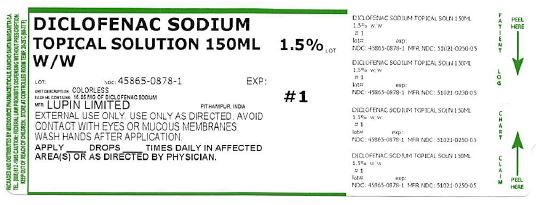
NDC Number & Size
150 mL bottle NDC # 51021-250-05