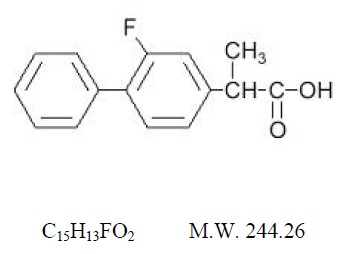
General pharmacokinetic characteristics
The pharmacokinetics of flurbiprofen have been characterized in healthy subjects, special populations and patients (see Table 2). The pharmacokinetics of flurbiprofen are linear, and there is little accumulation of flurbiprofen following multiple doses of flurbiprofen.
Table 2: Mean (SD) R-,S-Flurbiprofen Pharmacokinetic Parameters Normalized to a 100 mg Dose of Flurbiprofen TabletsPharmacokinetic Parameter | Normal Healthy Adults 100 mg single-dose
(18 to 40 years)
N = 15
| Geriatric Arthritis Patients Steady-state evaluation of 100 mg every 12 hours
(65 to 83 years)
N = 13
| End Stage Renal Disease Patients
(23 to 42 years)
N = 8
| Alcoholic Cirrhosis Patients 200 mg single-dose (31 to 61 years) N = 8 |
Peak Concentration (mcg/mL) | 14 (4) | 16 (5) | 9
Calculated from mean parameter values of both flurbiprofen enantiomers | 9
|
Time to Reach Peak Concentration (h) | 1.9 (1.5) | 2.2 (3) | 2.3
| 1.2
|
Urinary Recovery of Unchanged Flurbiprofen (% of Dose) | 2.9 (1.3) | 0.6 (0.6) | 0.02 (0.02) | NA
Not available |
Area Under the Curve (AUC)
(mcg•h/mL)
AUC from 0 to infinity for single doses and from 0 to the end of the dosing interval for multiple-doses | 83 (20) | 77 (24) | 44
| 50
|
Apparent Volume of Distribution (Vz/F, L) | 14 (3) | 12 (5) | 10
| 14
|
Terminal Elimination Half-life
(t
½, h)
| 7.5 (0.8) | 5.8 (1.9) | 3.3
Value for S-flurbiprofen | 5.4
|
Absorption
The mean oral bioavailability of flurbiprofen from flurbiprofen tablets 100 mg is 96% relative to an oral solution. Flurbiprofen is rapidly and non-stereoselectively absorbed from flurbiprofen, with peak plasma concentrations occurring at approximately 2 hours (see Table 2).
Administration of flurbiprofen with either food or antacids may alter the rate but not the extent of flurbiprofen absorption. Ranitidine has been shown to have no effect on either the rate or extent of flurbiprofen absorption from flurbiprofen.
Distribution
The apparent volume of distribution (Vz/F) of both R- and S-flurbiprofen is approximately 0.12 L/kg. Both flurbiprofen enantiomers are more than 99% bound to plasma proteins, primarily albumin. Plasma protein binding is relatively constant for the typical average steady-state concentrations (≤ 10 mcg/mL) achieved with recommended doses. Flurbiprofen is poorly excreted into human milk. The nursing infant dose is predicted to be approximately 0.1 mg/day in the established milk of a woman taking flurbiprofen 200 mg/day.
Metabolism
Several flurbiprofen metabolites have been identified in human plasma and urine. These metabolites include 4’-hydroxy-flurbiprofen, 3’, 4’-dihydroxy-flurbiprofen, 3’-hydroxy-4’-methoxy-flurbiprofen, their conjugates, and conjugated flurbiprofen. Unlike other arylpropionic acid derivatives (e.g., ibuprofen), metabolism of R-flurbiprofen to S-flurbiprofen is minimal.
In vitro studies have demonstrated that cytochrome CYP2C9 plays an important role in the metabolism of flurbiprofen to its major metabolite 4’-hydroxy-flurbiprofen. The 4’-hydroxy-flurbiprofen metabolite showed little anti-inflammatory activity in animal models of inflammation.
In vitro studies also demonstrated glucuronidation of both enantiomers of flurbiprofen and 4’-hydroxy-flurbiprofen. UGT2B7 is the predominant UGT isozyme responsible for the glucuronidation. Flurbiprofen does not induce enzymes that alter its metabolism.
Excretion
Following dosing with flurbiprofen, less than 3% of flurbiprofen is excreted unchanged in the urine, with about 70% of the dose eliminated in the urine as flurbiprofen, 4’-hydroxy-flurbiprofen, and their acylglucuronide conjugates. Because renal elimination is a significant pathway of elimination of flurbiprofen metabolites, dosing adjustment in patients with moderate or severe renal dysfunction may be necessary to avoid accumulation of flurbiprofen metabolites.
The mean terminal elimination half-lives (t
½) of R- and S-flurbiprofen are similar, about 4.7 and 5.7 hours, respectively.
Specific Populations
Pediatric: The pharmacokinetics of flurbiprofen have not been investigated in pediatric patients.
Race: No pharmacokinetic differences due to race have been identified.
Geriatric: Flurbiprofen pharmacokinetics were similar in geriatric arthritis patients, younger arthritis patients, and young healthy volunteers receiving flurbiprofen 100 mg as either single or multiple doses.
Hepatic Impairment: Hepatic metabolism may account for > 90% of flurbiprofen elimination, so patients with hepatic disease may require reduced doses of flurbiprofen compared to patients with normal hepatic function. The pharmacokinetics of R- and S-flurbiprofen were similar, however, in alcoholic cirrhosis patients (N = 8) and young healthy volunteers (N = 8) following administration of a single 200 mg dose of flurbiprofen. Flurbiprofen plasma protein binding may be decreased in patients with liver disease and serum albumin concentrations below 3.1 g/dL.
Renal Impairment: Renal clearance is an important route of elimination for flurbiprofen metabolites, but a minor route of elimination for unchanged flurbiprofen (≤ 3% of total clearance). The unbound clearances of R- and S-flurbiprofen did not differ significantly between normal healthy volunteers (N = 6, 50 mg single dose) and patients with renal impairment (N = 8, inulin clearances ranging from 11 to 43 mL/min, 50 mg multiple doses). Flurbiprofen plasma protein binding may be decreased in patients with renal impairment and serum albumin concentrations below 3.9 g/dL. Elimination of flurbiprofen metabolites may be reduced in patients with renal impairment.
Flurbiprofen is not significantly removed from the blood into dialysate in patients undergoing continuous ambulatory peritoneal dialysis.
Drug Interaction Studies
Antacids:
Administration of flurbiprofen to volunteers under fasting conditions or with antacid suspension yielded similar serum flurbiprofen-time profiles in young adult subjects (n = 12). In geriatric subjects (n = 7), there was a reduction in the rate but not the extent of flurbiprofen absorption.
Aspirin:
Concurrent administration of flurbiprofen and aspirin resulted in 50% lower serum flurbiprofen concentrations. This effect of aspirin (which is also seen with other NSAIDs) has been demonstrated in patients with rheumatoid arthritis (n = 15) and in healthy volunteers (n = 16) [
see Drug Interactions (
7)
].
Beta-adrenergic Blocking Agents:
The effect of flurbiprofen on blood pressure response to propranolol and atenolol was evaluated in men with mild uncomplicated hypertension (n = 10). Flurbiprofen pretreatment attenuated the hypotensive effect of a single dose of propranolol but not atenolol. Flurbiprofen did not appear to affect the beta-blocker-mediated reduction in heart rate. Flurbiprofen did not affect the pharmacokinetic profile of either drug [
see Drug Interactions (
7)
].
Cimetidine, Ranitidine:
In normal volunteers (n = 9), pretreatment with cimetidine or ranitidine did not affect flurbiprofen pharmacokinetics, except for a small (13%) but statistically significant increase in the area under the serum concentration curve of flurbiprofen in subjects who received cimetidine.
Digoxin:
In studies of healthy males (n = 14), concomitant administration of flurbiprofen and digoxin did not change the steady state serum levels of either drug [
see Drug Interactions (
7)
].
Diuretics:
Studies in healthy volunteers have shown that, like other NSAIDs, flurbiprofen can interfere with the effects of furosemide. Although results have varied from study to study, effects have been shown on furosemide-stimulated diuresis, natriuresis, and kaliuresis [
see Drug Interactions (
7)
].
Lithium:
In a study of 11 women with bipolar disorder receiving lithium carbonate at a dosage of 600 to 1200 mg/day, administration of 100 mg flurbiprofen every 12 hours increased plasma lithium concentrations by 19%. Four of 11 patients experienced a clinically important increase (> 25% or > 0.2 mmol/L) [
see Drug Interactions (
7)
].
Methotrexate:
In a study of six adult arthritis patients, coadministration of methotrexate (10 to 25 mg/dose) and flurbiprofen (300 mg/day) resulted in no observable interaction between these two drugs [
see Drug Interactions (
7)
].
Oral Hypoglycemic Agents:
In a clinical study, flurbiprofen was administered to adult diabetics who were already receiving glyburide (n = 4), metformin (n = 2), chlorpropamide with phenformin (n=3), or glyburide with phenformin (n = 6). Although there was a slight reduction in blood sugar concentrations during concomitant administration of flurbiprofen and hypoglycemic agents, there were no signs or symptoms of hypoglycemia.
Poor Metabolizers of CYP2C9 Substrates:
In patients who are known or suspected to be poor CYP2C9 metabolizers based on genotype or previous history/experience with other CYP2C9 substrates (such as warfarin and phenytoin), reduce the dose of flurbiprofen to avoid abnormally high plasma levels due to reduced metabolic clearance.