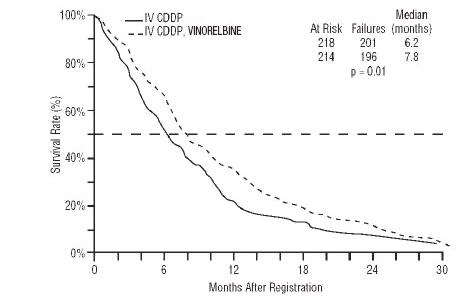
Because clinical trials are conducted under varying designs and in different patient populations, the adverse reaction rates reported in one clinical trial may not be easily compared to those rates reported in another clinical trial and may not reflect the rates actually observed in clinical practice.
Single Agent
The data below reflect exposure to vinorelbine as a single agent administered at a dose of 30 mg/m2 on a weekly basis to 365 patients enrolled in 3 controlled studies for metastatic NSCLC and advanced breast cancer. The population included 143 patients with previously untreated metastatic NSCLC (Study 3) who received a median of 8 doses of vinorelbine. The patients were aged 32 to 79 (median 61 years), 71% were male, 91% White, 48% had adenocarcinoma histology. The data also reflect exposure to vinorelbine in 222 patients with previously treated advanced breast cancer who received a median of 10 doses of vinorelbine. Vinorelbine is not indicated for the treatment of breast cancer.
Selected adverse reactions reported in these studies are provided in Tables 1 and 2. The most common adverse reactions (greater than or equal to 20%) of single agent vinorelbine were leukopenia, neutropenia, anemia, increased aspartate aminotransferase (AST), nausea, vomiting, constipation, asthenia, injection site reaction and peripheral neuropathy. The most common (greater than or equal to 5%) Grade 3 or 4 adverse reactions were neutropenia, leukopenia, anemia, increased total bilirubin, increased AST, injection site reaction and asthenia.
Approximately 49% of patients with NSCLC who were treated with vinorelbine experienced at least one dose reduction due to an adverse reaction.
Thirteen percent of patients discontinued vinorelbine due to adverse reactions. The most frequent adverse reactions leading to vinorelbine discontinuation were asthenia, dyspnea, nausea, constipation, anorexia, myasthenia and fever.
Table 1: Hematologic Adverse Reactions Experienced in Greater Than 5% of Patients Receiving Vinorelbine *†:| | All Patients | NSCLC |
| | (N=365)
(%) | (N= 143)
(%) |
| *Grade based on modified criteria from the National Cancer Institute version 1. |
| †Patients with NSCLC had not received prior chemotherapy. The majority of the remaining patients had received prior chemotherapy. |
| Laboratory | | | |
| Hematologic | | | |
| | | | |
| Neutropenia | < 2,000 cells/mm3 | 90 | 80 |
| | < 500 cells/mm3 | 36 | 29 |
| Leukopenia | < 4,000 cells/mm3 | 92 | 81 |
| | < 1,000 cells/mm3 | 15 | 12 |
| Thrombocytopenia | < 100,000 cells/mm3 | 5 | 4 |
| Anemia | < 11 g/dl | 83 | 77 |
| | < 8 g/dl | 9 | 1 |
| Hospitalizations due to neutropenic complications | 9 | 8 |
Table 2: Non-hematologic Adverse Reactions Experienced in Greater Than or Equal to 5% of Patients Receiving Vinorelbine *†:| | All Grades | Grades 3 to 4 |
| | All Patients
(%) | NSCLC
(%) | All Patients
(%) | NSCLC
(%) |
| *Grade based on modified criteria from the National Cancer Institute version 1. |
| ‡ Incidence of paresthesia plus hypesthesia. |
| †Patients with NSCLC had not received prior chemotherapy. The majority of the remaining patients had received prior chemotherapy. |
| Laboratory | | | | |
| Hepatic | | | | |
| AST increased (N=346) | 67 | 54 | 6 | 3 |
| Bilirubin increased | 13 | 9 | 7 | 5 |
| (N=351) | | | | |
| | | | | |
| Clinical | | | | |
| Nausea | 44 | 34 | 2 | 1 |
| Asthenia | 36 | 27 | 7 | 5 |
| Constipation | 35 | 29 | 3 | 2 |
| Injection site reaction | 28 | 38 | 2 | 5 |
| Injection site pain | 16 | 13 | 2 | 1 |
| Neuropathy peripheral‡ | 25 | 20 | <2 | 1 |
| Vomiting | 20 | 15 | 2 | 1 |
| Diarrhea | 17 | 13 | 1 | 1 |
| Alopecia | 12 | 12 | ≤1 | 1 |
| Phlebitis | 7 | 10 | <1 | 1 |
| Dyspnea | 7 | 3 | 3 | 2 |
Myelosuppression: In clinical trials, Grade 3 to 4 neutropenia, anemia and thrombocytopenia occurred in 69%, 9% and 1%, respectively of patients receiving single agent vinorelbine. Neutropenia is the major dose-limiting toxicity.
Neurotoxicity: Neurotoxicity was most commonly manifested as constipation, paresthesia, hyperesthesia and hyporeflexia. Grade 3 and 4 neuropathy was observed in 1% of the patients receiving single agent vinorelbine.
Injection Site Reactions: Injection site reactions, including erythema, pain at injection site and vein discoloration, occurred in approximately one third of patients; 5% were severe. Phlebitis (chemical phlebitis) along the vein proximal to the site of injection was reported in 10% of patients.
Cardiovascular Toxicity: Chest pain occurred in 5% of patients; myocardial infarction occurred in less than 0.1% of patients.
Pulmonary Toxicity and Respiratory Failure: Dyspnea (shortness of breath) was reported in 3% of patients; it was severe in 2%. Interstitial pulmonary changes were documented.
Other: Hemorrhagic cystitis and the syndrome of inappropriate ADH secretion were each reported in less than 1% of patients.
In Combination with Cisplatin
Table 3 presents the incidence of selected adverse reactions, occurring in greater than or equal to 10% of vinorelbine treated patients reported in a randomized trial comparing the combination of vinorelbine 25 mg/m2 administered every week of each 28-day cycle and cisplatin 100 mg/m2 administered on day 1 of each 28-day cycle versus cisplatin alone at the same dose and schedule in patients with previously untreated NSCLC (Study 1).
Patients randomized to vinorelbine plus cisplatin received a median of 3 cycles of treatment and those randomized to cisplatin alone received a median of 2 cycles of treatment. The incidence of Grade 3 and 4 neutropenia was significantly higher in the vinorelbine plus cisplatin arm (82%) compared to the cisplatin alone arm (5%).
Thirty-five percent of the eligible patients in the combination arm required treatment discontinuation due to an adverse reaction compared to 19% in the cisplatin alone arm.
Four patients in the vinorelbine plus cisplatin arm died of neutropenic sepsis. Seven additional deaths were reported in the combination arm: 2 from cardiac ischemia, 1 cerebrovascular accident, 1 multisystem failure due to an overdose of vinorelbine, and 3 from febrile neutropenia.
Table 3: Adverse Reactions Experienced by Greater Than or Equal to 10% of Patients on Vinorelbine plus Cisplatin versus Single-Agent Cisplatin*| | Vinorelbine 25mg/m2 plus | Cisplatin 100 mg/m2 (N=210) |
| | Cisplatin 100 mg/m2 (N=212) | |
| | All Grades
(%) | Grades 3 to 4
(%) | All Grades
(%) | Grades 3 to 4
(%) |
| *Graded according to the standard SWOG criteria version 1. |
| †Categorical toxicity grade not specified |
| Laboratory | | | | |
| Hematologic | | | | |
| Neutropenia | 89 | 82 | 26 | 5 |
| Anemia | 89 | 24 | 72 | <8 |
| Leukopenia | 88 | 58 | 31 | <1 |
| Thrombocytopenia | 29 | 5 | 21 | <2 |
| Febrile neutropenia† | N/A | 11 | N/A | 0 |
| Renal | | | | |
| Blood creatinine increased | 37 | 4 | 28 | <5 |
| Clinical | | | | |
| Malaise/Fatigue/Lethargy | 67 | 12 | 49 | 8 |
| Vomiting | 60 | 13 | 60 | 14 |
| Nausea | 58 | 14 | 57 | 12 |
| Decreased appetite | 46 | 0 | 37 | 0 |
| Constipation | 35 | 3 | 16 | 1 |
| Alopecia | 34 | 0 | 14 | 0 |
| Weight decreased | 34 | 1 | 21 | <1 |
| Fever without infection | 20 | 2 | 4 | 0 |
| Hearing impaired | 18 | 4 | 18 | <4 |
| Injection site reaction | 17 | <1 | 1 | 0 |
| Diarrhea | 17 | <3 | 11 | <2 |
| Paraesthesia | 17 | <1 | 10 | <1 |
| Taste alterations | 17 | 0 | 15 | 0 |
| Peripheral numbness | 11 | 2 | 7 | <1 |
| Myalgia/Arthralgia | 12 | <1 | 3 | <1 |
| Phlebitis/Thrombosis/Embolism | 10 | 3 | <1 | <1 |
| Weakness | 12 | <3 | 7 | 2 |
| Infection | 11 | <6 | <1 | <1 |
| Respiratory tract infection | 10 | <5 | 3 | 3 |
Table 4 presents the incidence of selected adverse reactions, occurring in greater than or equal to 10% of vinorelbine treated patients reported in a randomized trial of vinorelbine plus cisplatin, vindesine plus cisplatin and vinorelbine as a single agent in patients with stage III or IV NSCLC who had not received prior chemotherapy. A total of 604 patients received either vinorelbine 30 mg/m2 every week plus cisplatin 120 mg/m2 on Day 1 and Day 29, then every 6 weeks thereafter (N=207), vindesine 3 mg/m2 for 6 weeks, then every other week thereafter plus cisplatin 120 mg/m2 on Days 1 and Day 29, then every 6 weeks thereafter (N=193) or vinorelbine 30 mg/m2 every week (N=204).
Patients randomized to vinorelbine plus cisplatin received a median of 15 weeks of treatment, vindesine plus cisplatin 12 weeks and vinorelbine received 13 weeks. Grade 3 and 4 neutropenia was significantly greater in the vinorelbine plus cisplatin arm (78%) compared to vindesine plus cisplatin (48%) and vinorelbine as a single agent (53%). Neurotoxicity, including peripheral neuropathy and constipation, was reported in 44% (Grades 3 to 4, 7%) of the patients receiving vinorelbine plus cisplatin, 58% (Grades 3 to 4, 17%) of the patients receiving vindesine and cisplatin and 44% (Grades 3 to 4, 8.5%) of the patients receiving vinorelbine as a single agent.
Study discontinuation due to an adverse reaction was required in 27, 22 and 10% of the patients randomized to vinorelbine plus cisplatin, vindesine plus cisplatin and cisplatin alone arms, respectively.
Table 4: Adverse Reactions Experienced by Greater Than or Equal to 10 % of Patients from a Comparative Trial of Vinorelbine Plus Cisplatin versus Vindesine Plus Cisplatin versus Single-Agent Vinorelbine*| | Vinorelbine/Cisplatin† | Vindesine/Cisplatin‡ | Vinorelbine§ |
| | All Grades
(%) | Grades 3 to 4
(%) | All Grades
(%) | Grades 3 to 4
(%) | All Grades
(%) | Grades 3 to 4
(%) |
| *Grade based on criteria from the World Health Organization (WHO). |
| †N=194 to 207; all patients receiving vinorelbine/cisplatin with laboratory and non-laboratory data. |
| ‡N=173 to 192; all patients receiving vindesine/cisplatin with laboratory and non-laboratory data. |
| §N=165 to 201; all patients receiving vinorelbine with laboratory and non-laboratory data. |
| ¦Categorical toxicity grade not specified. |
| ¶Neurotoxicity includes peripheral neuropathy and constipation. |
| Laboratory | | | | | | |
| Hematologic | | | | | | |
| Neutropenia | 95 | 78 | 79 | 48 | 85 | 53 |
| Leukopenia | 94 | 57 | 82 | 27 | 83 | 32 |
| Thrombocytopenia | 15 | 4 | 10 | 3.5 | 3 | 0 |
| Renal | | | | | | |
| Blood creatinine | 46 | N/A | 37 | N/A | 13 | N/A |
| increased ¦ | | | | | | |
| Clinical | | | | | | |
| Nausea/Vomiting | 74 | 30 | 72 | 25 | 31 | 2 |
| Alopecia | 51 | 7.5 | 56 | 14 | 30 | 2 |
| Neurotoxicity ¶ | 44 | 7 | 58 | 17 | 44 | 8.5 |
| Diarrhea | 25 | 1.5 | 24 | 1 | 12 | 0.5 |
| Injection site | 17 | 2.5 | 7 | 0 | 22 | 2 |
| reaction | | | | | | |
| Ototoxicity | 10 | 2 | 14 | 1 | 1 | 0 |