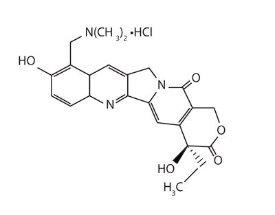
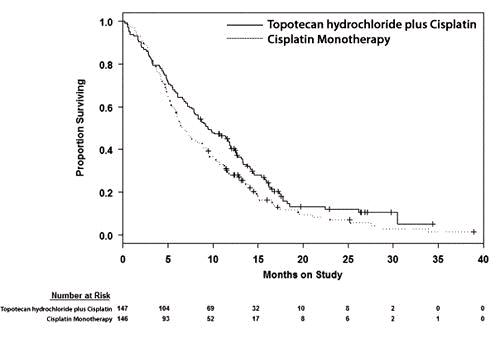
Following administration of Topotecan Hydrochloride for Injection at doses of 0.5 to 1.5 mg/m2 administered as a 30-minute infusion to cancer patients, topotecan exhibited multiexponential pharmacokinetics with a terminal half-life of 2 to 3 hours. Total exposure (AUC) is approximately dose-proportional.
Distribution
Binding of topotecan to plasma proteins is approximately 35%.
Metabolism
Topotecan undergoes a reversible pH-dependent hydrolysis of its lactone moiety; it is the lactone form that is pharmacologically active. At pH less than or equal to 4, the lactone is exclusively present, whereas the ring-opened hydroxy-acid form predominates at physiologic pH. In vitro studies in human liver microsomes indicate topotecan is metabolized to an N-demethylated metabolite. The mean metabolite:parent AUC ratio was about 3% for total topotecan and topotecan lactone following intravenous administration.
Excretion
Renal clearance is the primary route of topotecan elimination.
In a mass balance/excretion trial in 4 patients with solid tumors, the overall recovery of total topotecan and its N-desmethyl metabolite in urine and feces over 9 days averaged 73.4% ± 2.3% of the administered intravenous dose. Mean values of 50.8% ± 2.9% as total topotecan and 3.1% ± 1.0% as N-desmethyl topotecan were excreted in the urine following intravenous administration. Fecal elimination of total topotecan accounted for 17.9% ± 3.6% while fecal elimination of N-desmethyl topotecan was 1.7% ± 0.6%. An O-glucuronidation metabolite of topotecan and N-desmethyl topotecan has been identified in the urine.
Specific Populations
Gender: Plasma clearance of topotecan lactone in male patients was approximately 24% higher than that in female patients, largely reflecting difference in body size.
Age: Population pharmacokinetic analysis in female patients did not identify age as a significant factor. Decreased renal clearance, which is common in the elderly, is a more important determinant of topotecan clearance [see Dosage and Administration (2.4), Use in Specific Populations (8.5)].
Renal Impairment: In patients with mild renal impairment (Clcr = 40 to 60 mL/min), plasma clearance of topotecan lactone was decreased by 33% compared with patients with normal renal function (Clcr greater than 60 mL/min). In patients with moderate renal impairment (Clcr = 20 to 39 mL/min), plasma clearance of topotecan lactone was reduced by 65% compared with patients with normal renal function. Dosage adjustment is recommended for patients with moderate renal impairment. No dosage adjustment is required in patients with mild renal impairment [see Dosage and Administration (2.4), Use in Specific Populations (8.6)].
Hepatic Impairment: Plasma clearance of topotecan lactone in patients with hepatic impairment serum bilirubin levels between 1.7 and 15.0 mg/dL) was decreased by 33% compared with patients with normal hepatic function (serum bilirubin levels less than 1.7 mg/dL).
Drug Interactions
Effects of Topotecan on Drug-Metabolizing Enzymes: In vitro inhibition studies using marker substrates for human P450 CYP1A2, CYP2A6, CYP2C8/9, CYP2C19, CYP2D6, CYP2E, CYP3A, or CYP4A or dihydropyrimidine dehydrogenase indicate that the activities of these enzymes were not altered by topotecan.
Cisplatin: Administration of cisplatin (60 or 75 mg/m2 on Day 1) before topotecan (0.75 mg/m2/day on Days 1 to 5) in 9 patients with ovarian cancer had no significant effect on the Cmax and AUC of total topotecan.
Topotecan (0.3 mg/m2 intravenous daily on Days 2 to 6) had no effect on the pharmacokinetics of free platinum in 15 patients with ovarian cancer who were administered cisplatin 50 mg/m2 (n = 9) or 75 mg/m2 (n = 6) on Day 2 after paclitaxel 110 mg/m2 on Day 1. Topotecan (0.75 mg/m2 intravenous daily on Days 1 to 5) had no effect on dose-normalized (60 mg/m2) Cmax values of free platinum in 13 patients with ovarian cancer who were administered 60 mg/m2 (n = 10) or 75 mg/m2 (n = 3) cisplatin on Day 1.