Falling Asleep During Activities of Daily Living and Somnolence
Advise patients about the potential for sedating effects associated with carbidopa, levodopa and entacapone tablets including somnolence and the possibility of falling asleep while engaged in activities of daily living. Because somnolence can be a frequent adverse reaction with potentially serious consequences, patients should not drive a motor vehicle, operate heavy machinery or engage in other potentially dangerous activities until they have gained sufficient experience with carbidopa, levodopa and entacapone tablets to determine whether or not it affects their mental and/or motor performance adversely [see Warnings and Precautions (5.1)]. Advise patients that if increased somnolence or episodes of falling asleep during activities of daily living (e.g., conversations, eating, driving a motor vehicle, etc.) are experienced at any time during treatment, they should not drive or participate in potentially dangerous activities until they have contacted their physician.
Advise patients to speak with their health care prescriber before taking alcohol, sedating medications, or other CNS depressants (e.g., benzodiazepines, antipsychotics, antidepressants, etc.) because of the possible additive effects in combination with carbidopa, levodopa and entacapone tablets.
Hypotension, Orthostatic Hypotension and Syncope
Advise patients that they may develop symptomatic (or asymptomatic) postural (orthostatic) hypotension or non-orthostatic hypotension while taking carbidopa, levodopa and entacapone tablets. Hypotension/orthostatic hypotension may occur more frequently during initial therapy. Patients should not rise rapidly after sitting or lying down, especially if they have been doing so for prolonged periods and especially at the initiation of treatment with carbidopa, levodopa and entacapone tablets.
Advise patients about the potential for syncope in patients using dopamine agonists. For this reason, inform patients about the possibility of syncope while taking carbidopa, levodopa and entacapone tablets [see Warnings and Precautions (5.2)].
Dyskinesias
Inform patients that carbidopa, levodopa and entacapone tablets may cause and/or exacerbate pre-existing dyskinesias [see Warnings and Precautions (5.3)].
Hallucinations and/or Psychotic-Like Behavior
Inform patients that hallucinations and other psychotic-like behavior can occur while taking carbidopa, levodopa and entacapone tablets[see Warnings and Precautions (5.5)].
Impulse Control and/or Compulsive Behaviors
Advise patients that they may experience impulse control and/or compulsive behaviors while taking one or more of the medications used for the treatment of Parkinson’s disease, including carbidopa, levodopa and entacapone tablets. Ask patients about the development of new or increased gambling urges, sexual urges, urges for uncontrolled spending, or other intense urges while being treated with carbidopa, levodopa and entacapone tablets. Advise patients to inform their physician or health care provider if they experience new or increased gambling urges, increased sexual urges or other intense urges while taking carbidopa, levodopa and entacapone tablets. Physicians should consider dose reduction or stopping the medication if a patient develops such urges while taking carbidopa, levodopa and entacapone tablets[see Warnings and Precautions (5.6)].
Withdrawal-Emergent Hyperpyrexia and Confusion
Advise patients that they may develop fever and confusion as part of a syndrome resembling NMS and possibly with other clinical features (e.g., muscle rigidity, autonomic dysfunction, hyper- or hypotension, etc.). This fever and confusion syndrome may particularly occur with dose reductions or withdrawal of carbidopa, levodopa and entacapone tablets but may also develop after initiation of treatment. Advise patients to contact their healthcare provider if they wish to discontinue or decrease the dose of carbidopa, levodopa and entacapone tablets and to contact a health care provider if they develop fever and confusion [see Warnings and Precautions (5.7)].
Diarrhea and Colitis
Inform the patients that diarrhea may occur with carbidopa, levodopa and entacapone tablets and it may have a delayed onset. Sometimes prolonged diarrhea may be caused by colitis (inflammation of the large intestine). Patients with diarrhea should drink fluids to maintain adequate hydration and monitor for weight loss. If diarrhea associated with carbidopa, levodopa and entacapone tablets is prolonged, discontinuing the drug is expected to lead to resolution. If diarrhea continues after stopping carbidopa, levodopa and entacapone tablets, further diagnostic investigations may be needed. In some cases, diarrhea may be associated with colitis [see Warnings and Precautions (5.8)].
Rhabdomyolysis
Advise patients that they may develop rhabdomyolysis and myalgia if they experience prolonged motor activity including dyskinesia. This event may also be associated with fever and confusion [see Warnings and Precautions (5.9)].
Nausea and Vomiting
Inform patients that carbidopa, levodopa and entacapone tablets may cause nausea and vomiting may occur more frequently during initial therapy and may require dose adjustment.
Instructions for Use
Instruct patients to take carbidopa, levodopa and entacapone tablets only as prescribed. Instruct patients to only take a single tablet of carbidopa, levodopa and entacapone tablets at each dosing interval. Instruct patients not to take multiple tablets or additional portions of tablets to achieve a higher dose of levodopa. Advise patients not to split, crush, or chew carbidopa, levodopa and entacapone tablet.
Inform the patient that carbidopa, levodopa and entacapone tablet is a formulation of carbidopa/levodopa combined with entacapone that is designed to begin release of ingredients within 30 minutes after ingestion. It is important that carbidopa, levodopa and entacapone tablets be taken at regular intervals according to the schedule outlined by the physician. Caution the patient not to change the prescribed dosage regimen and not to add any additional antiparkinsonian medications, including other carbidopa/levodopa preparations, without first consulting the physician.
Advise patients that “off” episodes (“wearing-off” of drug effect) occur at the end of the dosing interval but unpredictable “off” episodes may occur at any time. Advise the patient to notify a health care provider for possible treatment adjustments if such response poses a problem to the patient’s everyday life.
Advise patients that dark coloration (red, brown, or black) may appear in saliva, urine, or sweat after taking carbidopa, levodopa and entacapone tablets. Although the color appears to be clinically insignificant, garments may become discolored.
Advise patients that a change in diet to foods that are high in protein may delay the absorption of levodopa. Excessive acidity also delays stomach emptying, thus delaying the absorption of levodopa. Iron salts (such as in multi-vitamin tablets) may also reduce the effectiveness of carbidopa, levodopa and entacapone tablets.
Pregnancy
Instruct patients to notify their healthcare provider if they become pregnant or intend to become pregnant during therapy [see Use in Specific Populations (8.1)].
Lactation
Instruct patients to notify their healthcare provider if they intend to breastfeed or are breastfeeding an infant [see Use in Specific Populations (8.2)].
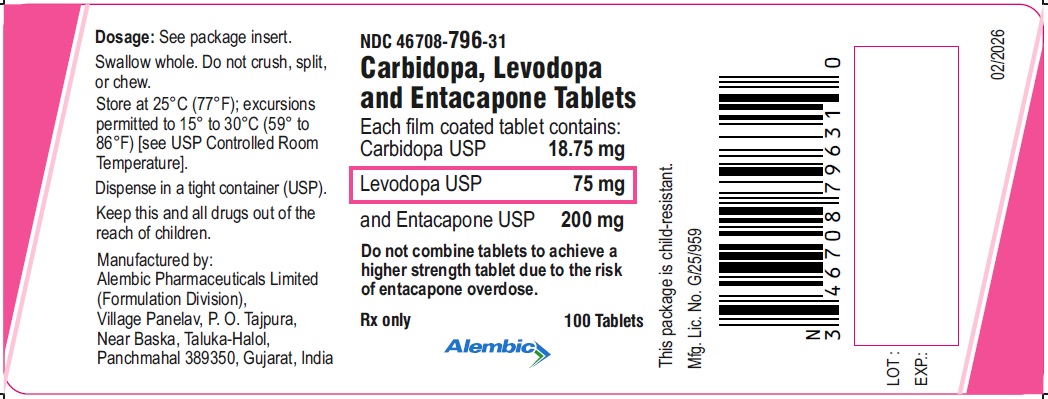
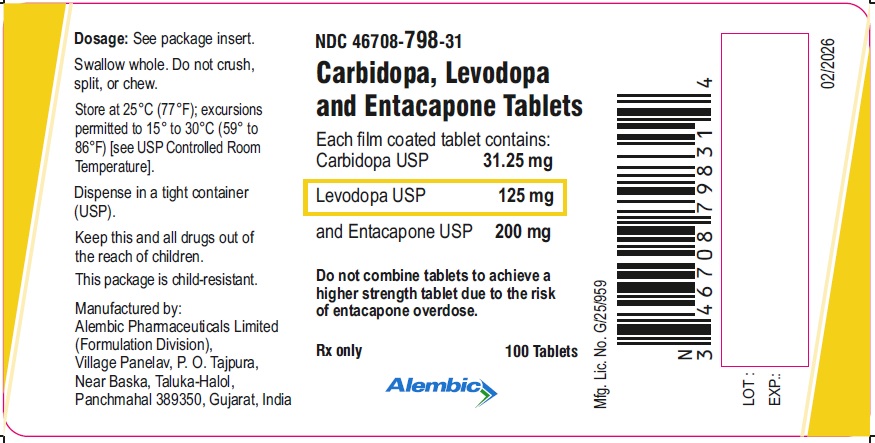
Manufactured by:
Alembic Pharmaceuticals Limited
(Formulation Division),
Village Panelav, P. O. Tajpura,
Near Baska, Taluka-Halol,
Panchmahal 389350, Gujarat, India.
Revised: 02/2026