WHO Functional Class III-IV
Two randomized, double-blind, multi-center, placebo-controlled trials were conducted in 32 and 213 patients. The larger study (BREATHE-1) compared 2 doses (125 mg twice daily and 250 mg twice daily) of bosentan with placebo. The smaller study (Study 351) compared 125 mg twice daily with placebo. Patients had severe (WHO functional Class III–IV) PAH: idiopathic or heritable PAH (72%) or PAH associated with scleroderma or other connective tissue diseases (21%), or to autoimmune diseases (7%). There were no patients with PAH associated with other conditions such as HIV disease or recurrent pulmonary emboli.
In both studies, bosentan or placebo was added to patients’ current therapy, which could have included a combination of digoxin, anticoagulants, diuretics, and vasodilators (e.g., calcium channel blockers, ACE inhibitors), but not epoprostenol. Bosentan was given at a dose of 62.5 mg twice daily for 4 weeks and then at 125 mg twice daily or 250 mg twice daily for either 12 (BREATHE-1) or 8 (Study 351) additional weeks. The primary study endpoint was 6-minute walk distance. In addition, symptoms and functional status were assessed. Hemodynamic measurements were made at 12 weeks in Study 351.
The mean age was about 49 years. About 80% of patients were female, and about 80% were Caucasian. Patients had been diagnosed with pulmonary hypertension for a mean of 2.4 years.
Submaximal Exercise Ability
Results of the 6-minute walk distance at 3 months (Study 351) or 4 months (BREATHE-1) are shown in Table 4.
Table 4. Effects of bosentan on 6-minute walk distance
|
BREATHE-1 |
Study 351 |
|
Bosentan125 mg twice daily
(n = 74)
|
Bosentan 250 mg twice daily
(n = 70)
|
Placebo (n = 69)
|
Bosentan125 mg twice daily
(n = 21)
|
Placebo (n = 11)
|
Baseline |
326 ± 73 |
333 ± 75 |
344 ± 76 |
360 ± 86 |
355 ± 82 |
End point |
353 ± 115 |
379 ± 101 |
336 ± 129 |
431 ± 66 |
350 ± 147 |
Change from baseline |
27 ± 75 |
46 ± 62 |
-8 ± 96 |
70 ± 56 |
-6 ± 121 |
Placebo – subtracted |
35 (a) |
54 (b) |
|
76 (c) |
|
Distance in meters: mean ± standard deviation. Changes are to week 16 for BREATHE-1 and to week 12 for Study 351. (a)p=0.01; by Wilcoxon; (b)p=0.0001; by Wilcoxon; (c)p=0.02; by Student’s t-test.
|
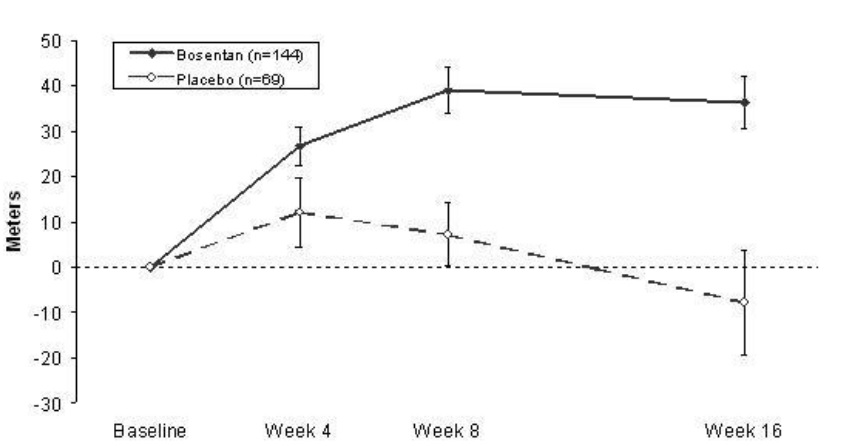
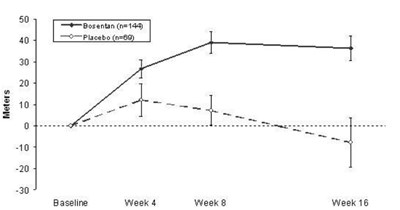
In both trials, treatment with bosentan resulted in a significant increase in exercise ability. The improvement in walk distance was apparent after 1 month of treatment (with 62.5 mg twice daily) and fully developed by about 2 months of treatment (Figure 5). It was maintained for up to 7 months of double-blind treatment. Walking distance was somewhat greater with 250 mg twice daily, but the potential for increased hepatotoxicity causes this dose not to be recommended [see Dosage and Administration (2.1)]. There were no apparent differences in treatment effects on walk distance among subgroups analyzed by demographic factors, baseline disease severity, or disease etiology, but the studies had little power to detect such differences.
Figure 5. Mean Change in 6-min Walk Distance (BREATHE-1)
Spl-bosentan-figure-5 (Spl Bosentan Figure 5)
Change from baseline in 6-minute walking distance from start of therapy to week 16 in the placebo and combined bosentan (125 mg twice daily and 250 mg twice daily) groups. Values are expressed as mean ± standard error of the mean.
Hemodynamic Changes
Invasive hemodynamic parameters were assessed in Study 351. Treatment with bosentan led to a significant increase in cardiac index (CI) associated with a significant reduction in pulmonary artery pressure (PAP), pulmonary vascular resistance (PVR), and mean right atrial pressure (RAP) (Table 5).
The relationship between hemodynamic effects and improvements in 6-minute walk distance is unknown.
Table 5: Change from Baseline to Week 12: Hemodynamic Parameters
|
Bosentan
125 mg twice daily |
|
Placebo |
CI (L/min/m2) |
n=20 |
|
n=10 |
Baseline |
2.35±0.73
|
|
2.48±1.03 |
Absolute Change |
0.50±0.46 |
|
-0.52±0.48 |
Treatment Effect |
|
1.02(a) |
|
Mean PAP (mmHg) |
n=20 |
|
n=10 |
Baseline |
53.7±13.4 |
|
55.7±10.5 |
Absolute Change |
-1.6±5.1 |
|
5.1±8.8 |
Treatment Effect |
|
-6.7(b) |
|
PVR (dyn•sec•cm-5) |
n=19 |
|
n=10 |
Baseline |
896±425 |
|
942±430 |
Absolute Change |
-223±245 |
|
191±235 |
Treatment Effect |
|
-415(a) |
|
Mean RAP (mmHg) |
n=19 |
|
n=10 |
Baseline |
9.7±5.6 |
|
9.9±4.1 |
Absolute Change |
-1.3±4.1 |
|
4.9±4.6 |
Treatment Effect |
|
-6.2(a) |
|
Values shown are means ± SD
(a)p≤0.001; (b)p<0.02
Symptoms and Functional Status
Symptoms of PAH were assessed by Borg dyspnea score, WHO functional class, and rate of
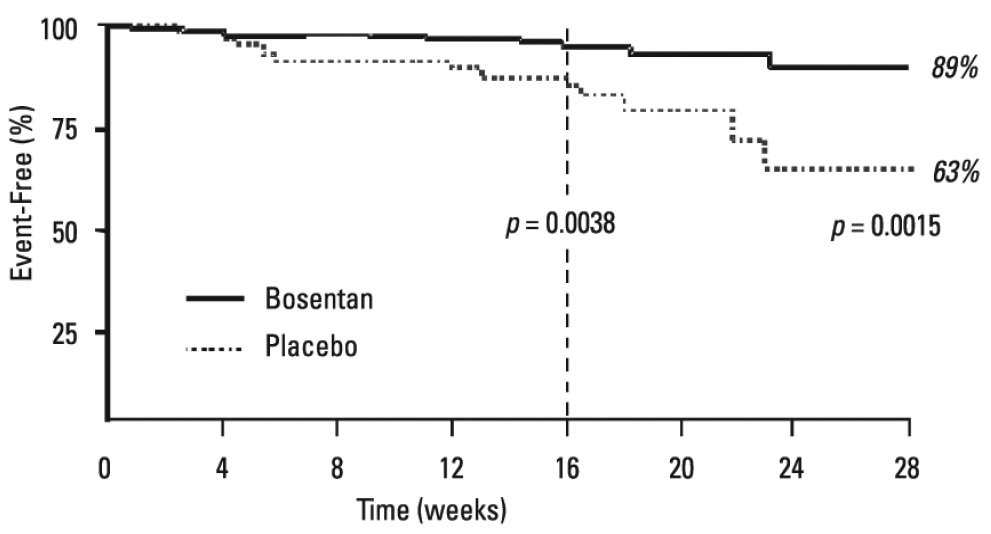
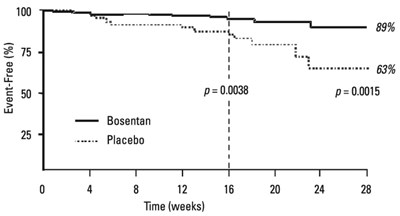
“clinical worsening.” Clinical worsening was assessed as the sum of death, hospitalizations for PAH, discontinuation of therapy because of PAH, and need for epoprostenol. There was a significant reduction in dyspnea during walk tests (Borg dyspnea score), and significant improvement in WHO functional class in bosentan -treated patients. There was a significant reduction in the rate of clinical worsening (Table 6 and Figure 6). Figure 6 shows the log-rank test reflecting clinical worsening over 28 weeks.
Table 6. Incidence of Clinical Worsening, Intent To Treat Population
|
BREATHE-1 |
Study 351 |
|
Bosentan 125/250 mg twice daily (n = 144)
|
Placebo(n = 69)
|
Bosentan
125 mg twice daily
(n = 21) |
Placebo(n = 11)
|
Patients with clinical worsening [n (%)]
|
9 (6%)(a) |
14 (20%)
|
0 (0%)(b) |
3 (27%)
|
Death |
1 (1%) |
2 (3%) |
0 (0%) |
0 (0%) |
Hospitalization for PAH |
6 (4%) |
9 (13%) |
0 (0%) |
3 (27%) |
Discontinuation due to worsening of PAH |
5 (3%) |
6 (9%) |
0 (0%) |
3 (27%) |
Receipt of epoprostenol(c) |
4 (3%) |
3 (4%) |
0 (0%) |
3 (27%) |
Note: Patients may have had more than one reason for clinical worsening.
(a) p = 0.0015 vs. placebo by log-rank test. There was no relevant difference between the 125 mg and 250 mg twice daily groups.
(b) p = 0.033 vs. placebo by Fisher’s exact test.
(c)Receipt of epoprostenol was always a consequence of clinical worsening.
Figure 6. Time to Clinical Worsening (BREATHE-1)
Spl-bosentan-figure-6 (Spl Bosentan Figure 6)
Time from randomization to clinical worsening with Kaplan-Meier estimate of the proportions of failures in BREATHE-1. All patients (n=144 in the bosentan group and n=69 in the placebo group) participated in the first 16 weeks of the study. A subset of this population (n=35 in the bosentan group and 13 in the placebo group) continued double-blind therapy for up to 28 weeks.
WHO Functional Class II
In a randomized, double-blind, multicenter, placebo-controlled trial, 185 mildly symptomatic PAH patients with WHO Functional Class II (mean baseline 6-minute walk distance of 443 meters) received bosentan 62.5 mg twice daily for 4 weeks followed by 125 mg twice daily (n = 93), or placebo (n = 92) for 6 months. Enrolled patients were treatment-naïve (n = 156) or on a stable dose of sildenafil (n = 29). The coprimary endpoints were change from baseline to month 6 in PVR and 6-minute walk distance. Time to clinical worsening (assessed as the sum of death, hospitalization due to PAH complications, or symptomatic progression of PAH), Borg dyspnea index, change in WHO functional class and hemodynamics were assessed as secondary endpoints.
Compared with placebo, bosentan treatment was associated with a reduced incidence of worsening of at least one functional class (3% bosentan vs. 13% placebo, p = 0.03), and improvement in hemodynamic variables (PVR, mPAP, TPR, cardiac index, and SVO2; p < 0.05). The +19 m mean (+14 m median) increase in 6-minute walk distance with bosentan vs.placebo was not significant (p = 0.08). There was a significant delay in time to clinical worsening (first seen primarily as symptomatic progression of PAH) with bosentan compared with placebo (hazard ratio 0.2, p = 0.01). Findings were consistent in strata with or without treatment with sildenafil at baseline.
Long-term Treatment of PAH
Long-term follow-up of patients with Class III and IV PAH who were treated with bosentan in open-label extensions of trials (N=235) showed that 93% and 84% of patients were still alive at 1 and 2 years, respectively, after the start of treatment. These uncontrolled observations do not allow comparison with a group not given bosentan and cannot be used to determine the long-term effect of bosentan on mortality.
Pulmonary Arterial Hypertension in Adults related to Congenital Heart Disease with Left-to-Right Shunts
A small study (N=54) and its open-label extension (N=37) of up to 40 weeks in adult patients with Eisenmenger physiology demonstrated effects of bosentan on exercise and safety that were similar to those seen in other trials in patients with PAH (WHO Group 1).