Hydrocodone bitartrate extended-release tablets contain hydrocodone, a substance with a high potential for abuse similar to other opioids, including fentanyl, hydromorphone, methadone, morphine, oxycodone, oxymorphone, and tapentadol. Hydrocodone bitartrate extended-release tablets can be abused and is subject to misuse, addiction, and criminal diversion [see Warnings and Precautions (5.1)].
The high drug content in the extended-release formulation adds to the risk of adverse outcomes from abuse and misuse.
All patients treated with opioids require careful monitoring for signs of abuse and addiction because use of opioid analgesic products carries the risk of addiction even under appropriate medical use.
Prescription drug abuse is the intentional non-therapeutic use of a prescription drug, even once, for its rewarding psychological or physiological effects. Drug addiction is a cluster of behavioral, cognitive, and physiological phenomena that develop after repeated substance use and includes: a strong desire to take the drug, difficulties in controlling its use, persisting in its use despite harmful consequences, a higher priority given to drug use than to other activities and obligations, increased tolerance, and sometimes a physical withdrawal.
"Drug-seeking" behavior is very common in persons with substance use disorders. Drug seeking tactics include emergency calls or visits near the end of office hours, refusal to undergo appropriate examination, testing, or referral, repeated “loss” of prescriptions, tampering with prescriptions, and reluctance to provide prior medical records or contact information for other treating healthcare provider(s). “Doctor shopping” (visiting multiple prescribers to obtain additional prescriptions) is common among drug abusers and people with untreated addiction. Preoccupation with achieving adequate pain relief can be appropriate behavior in a patient with poor pain control.
Abuse and addiction are separate and distinct from physical dependence and tolerance. Healthcare providers should be aware that addiction may not be accompanied by concurrent tolerance and symptoms of physical dependence in all addicts. In addition, abuse of opioids can occur in the absence of true addiction.
Hydrocodone bitartrate extended-release tablets, like other opioids, can be diverted for non-medical use into illicit channels of distribution. Careful record-keeping of prescribing information, including quantity, frequency, and renewal requests, as required by state and federal law, is strongly advised.
Proper assessment of the patient, proper prescribing practices, periodic re-evaluation of therapy, and proper dispensing and storage are appropriate measures that help to limit abuse of opioid drugs.
Risks Specific to Abuse of Hydrocodone Bitartrate Extended-Release Tablets
Hydrocodone bitartrate extended-release tablets is for oral use only. Abuse of hydrocodone bitartrate extended-release tablets poses a risk of overdose and death. Abuse may occur by taking intact tablets in quantities greater than prescribed or without legitimate purpose, by crushing and chewing or snorting the crushed formulation, or by injecting a solution made from the crushed formulation. The risk is increased with concurrent use of hydrocodone bitartrate extended-release tablets with alcohol or other central nervous system depressants. Taking cut, broken, chewed, crushed, or dissolved hydrocodone bitartrate extended-release tablets increases the risk of overdose and death.
With parenteral abuse, the inactive ingredients in hydrocodone bitartrate extended-release tablets can result in local tissue necrosis, infection, pulmonary granulomas, increased risk of endocarditis and valvular heart injury, embolism, and death. Parenteral drug abuse is commonly associated with transmission of infectious diseases, such as hepatitis and HIV.
Abuse Deterrence Studies
Hydrocodone bitartrate extended-release tablets are formulated with physicochemical properties intended to make the tablet more difficult to manipulate for misuse and abuse, and maintains some extended release characteristics even if the tablet is physically compromised. To evaluate the ability of these physicochemical properties to reduce the potential for abuse of hydrocodone bitartrate extended-release tablets, a series of in vitro laboratory studies, pharmacokinetic studies and clinical abuse potential studies was conducted. A summary is provided at the end of this section.
In Vitro Testing
In vitro physical and chemical tablet manipulation studies were performed to evaluate the success of different extraction methods in defeating the extended-release formulation. Results support that hydrocodone bitartrate extended-release tablets resists crushing, breaking, and dissolution using a variety of tools and solvents and retains some extended-release properties despite manipulation. When subjected to an aqueous environment, hydrocodone bitartrate extended-release tablets gradually forms a viscous hydrogel (i.e., a gelatinous mass) that resists passage through a hypodermic needle.
Clinical Abuse Potential Studies
Studies in Non-dependent Opioid Abusers:
Two randomized, double-blind, placebo and active-comparator studies in non-dependent opioid abusers were conducted to characterize the abuse potential of hydrocodone bitartrate extended-release tablets following physical manipulation and administration via the intranasal and oral routes. For both studies, drug liking was measured on a bipolar drug liking scale of 0 to 100 where 50 represents a neutral response of neither liking nor disliking, 0 represents maximum disliking, and 100 represents maximum liking. Response to whether the subject would take the study drug again was measured on a unipolar scale of 0 to 100 where 0 represents the strongest negative response (“definitely would not take drug again”) and 100 represents the strongest positive response (“definitely would take drug again”).
Intranasal Abuse Potential Study:
In the intranasal abuse potential study, 31 subjects were dosed and 25 subjects completed the study. Treatments studied included intranasally administered tampered 60 mg hydrocodone bitartrate extended-release tablets, powdered hydrocodone bitartrate 60 mg, and placebo. Incomplete dosing due to granules falling from the subjects’ nostrils occurred in 82% (n = 23) of subjects receiving tampered hydrocodone bitartrate extended-release tablets compared to no subjects with powdered hydrocodone or placebo.
The intranasal administration of tampered hydrocodone bitartrate extended-release tablets was associated with statistically significantly lower mean and median scores for drug liking and take drug again (P<0.001 for both), compared with powdered hydrocodone as summarized in Table 4.
Table 4. Summary of Maximum Scores (Emax) on Drug Liking and Take Drug Again VAS Following intranasal Administration of Hydrocodone Bitartrate Extended-Release Tablets and Hydrocodone Powder in Non-dependent Opioid Abusers
| VAS Scale (100 point) | Hydrocodone Bitartrate
Extended-Release Tablets |
Hydrocodone |
| Intranasal (n=25) | Manipulated | Powder |
| Drug Liking Bipolar scale (0=maximum negative response, 50=neutral response, 100=maximum positive response) |
| Mean (SE) | 65.4 (3.7) | 90.4 (2.6) |
| Median (Range) | 56 (50–100) | 100 (51–100) |
| Take Drug Again Unipolar scale (0=maximum negative response, 100=maximum positive response) |
| Mean (SE) | 36.4 (8.2) | 85.2 (5.0) |
| Median (Range) | 14 (0-100) | 100 (1-100) |
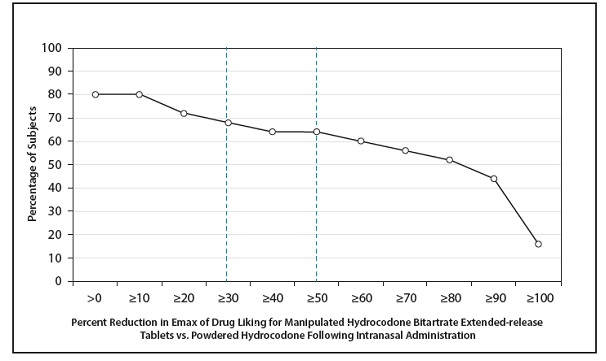
Figure 1 demonstrates a comparison of peak drug liking scores for tampered hydrocodone bitartrate extended-release tablets compared with powdered hydrocodone in subjects (n = 25) who received both treatments intranasally. The Y-axis represents the percent of subjects attaining a percent reduction in peak drug liking scores for tampered hydrocodone bitartrate extended-release tablets vs. hydrocodone powder greater than or equal to the value on the X-axis.
Approximately 80% (n = 20) of subjects had some reduction in drug liking with tampered hydrocodone bitartrate extended-release tablets relative to hydrocodone powder. Sixty-eight percent (n = 17) of subjects had a reduction of at least 30% in drug liking with tampered hydrocodone bitartrate extended-release tablets compared with hydrocodone powder, and approximately 64% (n = 16) of subjects had a reduction of at least 50% in drug liking with tampered hydrocodone bitartrate extended-release tablets compared with hydrocodone powder. Approximately 20% (n = 5) of subjects had no reduction in liking with tampered hydrocodone bitartrate extended-release tablets relative to hydrocodone powder.
Figure 1: Percent Reduction Profiles for Emax of Drug Liking VAS for Manipulated Hydrocodone Bitartrate Extended-Release Tablets vs. Hydrocodone Powder, N = 25 Following Intranasal Administration
Oral Abuse Potential Study:
In the oral abuse potential study, 40 subjects were dosed and 35 subjects completed the study. Treatments studied included oral administrations of chewed 60 mg hydrocodone bitartrate extended-release tablets, intact 60 mg hydrocodone bitartrate extended-release tablets, 60 mg aqueous hydrocodone bitartrate solution, and placebo.
The oral administration of chewed and intact hydrocodone bitartrate extended-release tablets was associated with statistically lower mean and median scores on scales that measure drug liking and desire to take drug again (P<0.001), compared to hydrocodone solution as summarized in Table 5.
Table 5. Summary of Maximum Scores (Emax) on Drug Liking and Take Drug Again VAS Following Oral Administration of Hydrocodone Bitartrate Extended-Release Tablets and Hydrocodone Solution in Non-dependent Recreational Opioid Users
| VAS Scale (100 point) | Hydrocodone Bitartrate Extended-Release Tablets | Hydrocodone |
| Oral (n=35) | Intact | Chewed | Solution |
| Drug Liking Bipolar scale (0=maximum negative response, 50=neutral response, 100=maximum positive response) |
| Mean (SE) | 63.3 (2.7) | 69.0 (3.0) | 94.0 (1.7) |
| Median (Range) | 58 (50–100) | 66 (50–100) | 100 (51–100) |
| Take Drug Again Unipolar scale (0=maximum negative response, 100=maximum positive response) |
| Mean (SE) | 34.3 (6.1) | 44.3 (6.9) | 89.7 (3.6) |
| Median (Range) | 24 (0-100) | 55 (0-100) | 100 (1-100) |
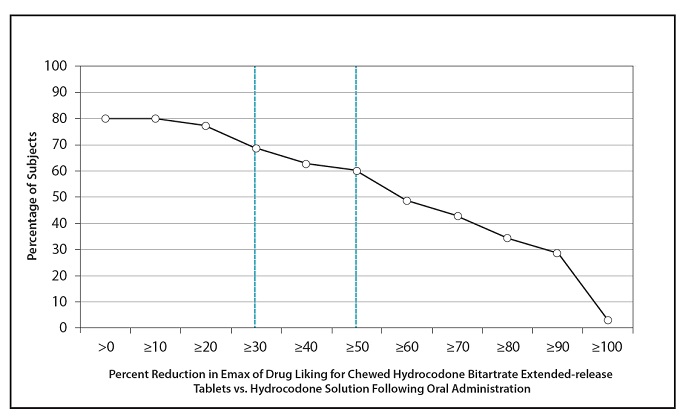
Figure 2 demonstrates a comparison of peak drug liking scores for chewed hydrocodone bitartrate extended-release tablets compared with hydrocodone solution in subjects who received both treatments orally. The Y-axis represents the percent of subjects attaining a percent reduction in peak drug liking scores for chewed hydrocodone bitartrate extended-release tablets vs. hydrocodone solution greater than or equal to the value on the X-axis.
Approximately 80% (n = 28) of subjects had some reduction in drug liking with chewed hydrocodone bitartrate extended-release tablets relative to hydrocodone solution. Approximately 69% (n = 24) of subjects had a reduction of at least 30% in drug liking with chewed hydrocodone bitartrate extended-release tablets compared with hydrocodone solution, and approximately 60% (n = 21) of subjects had a reduction of at least 50% in drug liking with chewed hydrocodone bitartrate extended-release tablets compared with hydrocodone solution. Approximately 20% (n = 7) of subjects had no reduction in drug liking with chewed hydrocodone bitartrate extended-release tablets relative to hydrocodone solution.
Figure 2. Percent Reduction Profiles for Emax of Drug Liking VAS for Chewed Hydrocodone Bitartrate Extended-Release Tablets vs. Hydrocodone Solution, N = 35 Following Oral Administration
The results of a similar analysis of drug liking for intact hydrocodone bitartrate extended-release tablets relative to hydrocodone solution were comparable to the results of chewed hydrocodone bitartrate extended-release tablets relative to hydrocodone solution. Approximately 83% (n = 29) of subjects had some reduction in drug liking with intact hydrocodone bitartrate extended-release tablets relative to hydrocodone solution. Eighty-three percent (n = 29) of subjects had a reduction of at least 30% in peak drug liking scores with intact hydrocodone bitartrate extended-release tablets compared to hydrocodone solution, and approximately 74% (n = 26) of subjects had a reduction of at least 50% in peak drug liking scores with intact hydrocodone bitartrate extended-release tablets compared with hydrocodone solution. Approximately 17% (n = 6) had no reduction in drug liking with intact hydrocodone bitartrate extended-release tablets relative to hydrocodone solution.
Summary
The in vitro data demonstrate that hydrocodone bitartrate extended-release tablets has physical and chemical properties that are expected to deter intranasal and intravenous abuse. The data from the clinical abuse potential studies, along with support from the in vitro data, also indicate that hydrocodone bitartrate extended-release tablets has physicochemical properties that are expected to reduce intranasal abuse and oral abuse when chewed. However, abuse of hydrocodone bitartrate extended-release tablets by the intravenous, intranasal, and oral routes is still possible.
Additional data, including epidemiological data, when available, may provide further information on the impact of hydrocodone bitartrate extended-release tablets on the abuse liability of the drug. Accordingly, this section may be updated in the future as appropriate.