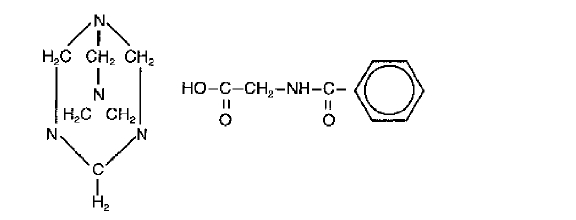
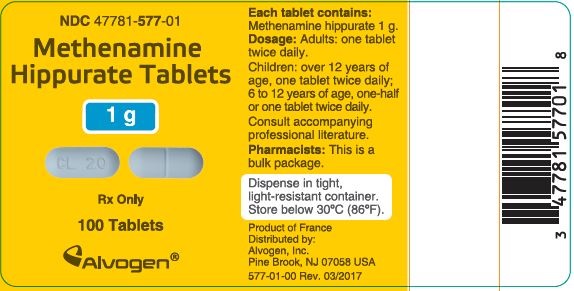
Methenamine hippurate is readily absorbed from the GI tract.Methenamine distributes widely into body fluids, but very little is hydrolyzed prior to excretion in the kidney and thus has minimal systemic toxic potential.
Within one-half hour after a single 1g dose of a Methenamine Hippurate Tablet, antibacterial activity is demonstrable in the urine. Urine shows continuous antibacterial activity when Methenamine Hippurate Tablets are administered at the recommended dosage schedule of 1 g twice daily. Over 90% of the methenamine moiety is excreted in the urine within twenty-four hours after administration of a single 1 g dose. Similarly, the hippurate moiety is rapidly absorbed and excreted, and it reaches the urine by both tubular secretion and glomerular filtration. This may be of importance in older patients or those with some degree of renal impairment.
Methenamine is placentally transferred to the fetus during pregnancy.
Microbiology: Methenamine hippurate exerts its activity because the methenamine component is hydrolyzed to formaldehyde in acid urine. Hippuric acid, the other component, acts to keep the urine acid. The minimal inhibitory concentrations are significantly lower in more acidic media; therefore, the efficacy of Methenamine Hippurate Tablets can be increased by acidification of urine (see DOSAGE AND ADMINISTRATION).
Microorganisms do not develop resistance to formaldehyde; however urea-splitting microorganisms (e.g. Proteus species) tend to raise pH of the urine thus inhibiting the release of formaldehyde. When the urine pH is 6 and the daily urine volume is 1000 -1500 mL a 2 g dose of Methenamine Hippurate Tablets daily will yield a urinary concentration of 18 to 60 μg/mL of formaldehyde, this being more than the minimal inhibitory concentration for most urinary pathogens.