Ctc-310
FDA Label NDC 48142-200

Full FDA labeling including Indications, Dosage, Usage, and Precautions

Structured Product Label

The following Structured Product Label (SPL) was submitted to the FDA by Celtic Biotech Iowa, Inc. for the product Ctc-310 (NDC 48142-200). This document serves as the official prescribing information, containing essential scientific data and clinical materials required for healthcare providers and patients.

This specific version of the label includes detailed information regarding description, indications, pharmacologic category, pharmacology, pharmacodynamics, contraindications, pregnancy, nursing mothers, and other regulatory disclosures. Use the navigation below to review specific sections of the FDA submission.

Description

CTC-310 is a liquid for injection formula comprising a 1:1 combination of Crotoxin and Cardiotoxin

Crotoxin preparations are made from the venom of the South American rattlesnake, Crotalus durissus.

Cardiotoxin preparations are made from the venom of the Asian cobra Naja naja.

They are homeopathic formulations that include sterile injectables for intravenous and subcutaneous use.

Indications

According to the FDA reference text “Clarkes’ Materia Medica 1900”;

Crotalus venom preparations are indicated as homeopathic medications for numerous conditions but especially; Cancers. Tongue, inflammation of ; cancer of. Clinical experience shows that Crotoxin also provide relief from some forms of pain.

Cobra venom preparations are indicated as homeopathic medications for several conditions but especially for; angina faucium, angina pectoris, asthma, dysmenia (painful menses), grief (depression), headache (migraine), pain in ovaries (ovarian cysts), spinal irritation (back pain) and sore throat. Cardiotoxin is the principal active analgesic component.

Pharmacologic Category

Anti-cancer.

Pharmacology

The principal active components in both venoms are cytotoxins. Crotoxin (CT) is a pre-synaptic bi-partite beta-neurotoxin with phospholipase A2 (PLA2) activity. Evaluation by the Developmental Therapeutics Program of the National Cancer Institute (NSC 624244) for cytotoxicity in vitro against a panel of human tumour cell lines showed enhanced cytotoxicity towards melanoma, CNS and non-small cell lung cancer lines. Toxin-phospholipid interaction and subsequent accumulation of products of phospholipid hydrolysis in the membrane may alter membrane packing, disrupt lipid domains and affect protein conformation resulting in effects like inhibition of type II Ca2+ channels or alteration of transmembrane signaling pathways. Current thought suggests that CT binds to the upregulated Crocalbin that is upregulated in malignant cells. The Nicotinic Acetylcholine receptor is also upregulated in tumor cell lines and have been clearly identified as having a role in proliferation especially in lung cancer and CNS tumors – tumor populations with high sensitivity to CT. The released PLA2 produces arachidonic acid at the membrane surface that activates protein kinase C (PKC) and possibly other tyrosine kinases. PKC in turn phosphorylates endogenous caspases and the activated caspases initiate the process of programmed cell death.

The main pharmacological target for Cardiotoxin has not been clearly identified though it has been shown to target heparin sulphate-glyco proteins. Cardiotoxins (CD) have a number of pharmacological properties in intact tissues including hemolysis, cytolysis, contractures of muscle, membrane depolarization and activation of tissue phospholipase C and, to a far lesser extent, an arachidonic acid-associated phospholipase A2. The toxins have also been demonstrated to open the Ca2+ release channel (ryanodine receptor) and alter the activity of the Ca2++Mg2+-ATPase in isolated sarcoplasmic reticulum preparations derived from cardiac or skeletal muscle. However, a relationship of these actions in isolated organelles to contracture induction has not yet been established. The toxins also bind to and, in some cases, alter the function of a number of other proteins in disrupted tissues. The most difficult tasks in understanding the mechanism of action of these toxins have been dissociating the primary from secondary effects and distinguishing between effects that only occur in disrupted tissues and those that occur in intact tissue.

Pharmacodynamics

Both actives exert potent cytolytic activities in-vitro. Tissue culture studies were performed using murine and human tumour cell lines. The responses are summarized in Table 1.

Table 1: Comparison of cytotoxicity of CT, CD, and VRCTC-310
PanelLC50 mg/mlTheoretical Additive LC50Potent. (factor)
CTCDCTC-310
Leukemia43.66.37.211.0(1.5)
Non Small Cell Lung12.73.95.06.0(1.2)
Small Cell Lung30.11.153.92.2
Colon74.922.436.434.5
Central Nervous System7.52.22.13.4(1.6)
Melanoma7.61.862.83.0
Ovaria21.05.47.38.6(1.2)
Renal10.13.25.44.9

Prior data showed that CT-induced cytotoxic effects appeared to be highly selective toward cell lines expressing an upregulated density of Epidermal-like Growth Factor receptors, though CT appeared to unexpectedly promote EGFR phosphorylation. Enhanced EGFR activity in cancer cells and tumors is associated with increased growth, survival and angiogenesis of tumors. CT stimulated phosphorylation of the EGFR is a cellular response to the induction of apoptosis.

CD has poor anti-tumor effect in-vivo but it has recently been discovered the CD can block this rescue mechanism thereby enhancing the cytocidal activity. CD induces apoptosis in adeno-carcinoma A549 cells, as indicated by an increase in the sub-G(1) population, phosphatidyl-serine externalization, loss of mitochondrial membrane potential (Psi(m)) with cytochrome c release and activation of caspases 9 and 3. The signal transduction pathways involved in the effects of CD in A549 cells were evaluated and the results indicated that CD suppresses phosphorylation of EGFR and activation of phosphatidylinositol 3-kinase (PI3-K)/Akt and Janus tyrosine kinase (JAK) 2/signal transducer and activator of transcription (STAT) 3, all of which are downstream molecules in the EGFR signaling pathway. Additional testing suggested that PI3-K is an upstream activator of JAK2/STAT3. Together, the results of the study indicated that CD induces apoptosis in A549 cells by inactivating the EGFR, PI3-K/Akt and JAK2/STAT3 signaling pathways. Similar data was observed for MDA-MB-231 breast cancer cells, a highly metastatic human breast carcinoma cell line in addition to the inhibition of metastasis.

In wound-healing assay, the cell migration of oral squamous cells (Ca9-22 cells) was attenuated by CD in a dose- and time-responsive manner. After CD treatment, the MMP-2 and MMP-9 protein expressions were downregulated, and the phosphorylation of JNK and p38-MAPK was increased independent of ERK phosphorylation. It was determined that CD also has antiproliferative and -migrating effects on oral cancer cells involving the p38-MAPK and MMP-2/-9 pathways.

Contraindications

CTC-310 is intended to be used as a monotherapy. Clinical experience suggests that concurrent use of radio- or chemotherapy may inhibit the activity of the drug. As the known receptors include those sensitive to nicotine is it is likely that nicotine will inhibit the activity of Crotoxin.

Pregnancy

Pregnancy: No significant data has been collected on the use of Crotoxin during pregnancy. No animal reproduction studies have been conducted to assess the effects of Crotoxin on the developing fetus.

Nursing Mothers

Nursing mothers: It is not known whether this drug is distributed into breast milk. Crotoxin is not orally bioavailable therefore it is unlikely to have any detrimental effects

Pediatric Use

Pediatric use: There is no information on the use of Crotoxin in children and young adults.

Interactions

No detailed reports of drug interactions have been reported.

Adverse Reactions

The majority of reported adverse effects associated with CTC-310 result from Crotoxin’s neurotoxic effects.

In clinical studies with CTC-310, subjects reported the following dose related adverse effects; anxiety, increased blood pressure, diplopia, nystagmus and strabismus.

Serious Adverse Reactions

With the injection of CTC-310, allergic reactions, sometimes severe (anaphylactic), have been reported. Anaphylaxis manifests usually within 30 minutes of administration. The use of antihistamines was found to alleviate the allergic reaction. Co-administration of antihistamines is advised.

Formats

CTC-310 is supplied in a solution of 0.9% saline for injection, at a concentration of 0.4mg/ml of each active with 0.01% benzalkonium chloride as a preservative. Dilution of this solution with saline for injection (SFI) can be useful for the initiation of therapy by subcutaneous injection in addition to tolerising the patient and their immune system to the drug. Always follow your health practitioner’s instructions.

Dosage And Administration

The maximum reported tolerable dose of CTC-310 by intramuscular bolus injection is 0.017 mg/Kg. Injection site reactions are common though will subside in 2-3 weeks with continued use. With dose escalation procedures doses of 0.023 mg/Kg have been attained. Subcutaneous administration may be easier and more comfortable that intramuscular without any likely loss in activity.

Storage

CTC-310 should be stored refrigerated (2-10°C / 38-50 °F).

Stability

For maximum shelf life, the product should be stored at 4°C when not in use though shipping at transient ambient temperatures (10-30 °C) is not expected to significantly affect the product. CTC-310 is potent for a period in excess of 60 months when stored as directed.

Do not store at room temperature or strong sources of lights. Do not freeze or expose to high heat.

Safety Information

The toxic effects of CTC-310 are associated with CT. Paradoxically, CD reduces CT’s over toxicity.

Neurological: CT exerts analgesic activity presumed to be in the CNS despite the suggestion in pharmacokinetics studies that CT does not accumulate in the brain. Intracerebroventricular administration of CT to mice and rats yielded analgesic responses and was not toxic to the exposed nerve cells at the doses tested. In other studies CT appeared to increase the anxiety level in rodents. It is assumed that CT exerts these effects through peripheral pathways.

Cardiovascular: CT has no direct effects on the heart in-vivo. Rat hearts showed no response to the presence of CT though it is the most resistant species to this neurotoxin. In Guinea pigs, which have a high sensitivity to CT, no effect was noted in the heart unless protein was removed from the perfusion solution. At this point the contractile force of the heart was reduced by approximately 25%, reported to be a consequence of non-specific binding that occurred in the absence of albumin. No impact (NOEL) on heartbeat was noted at doses of 0.25mg/kg. Studies on the cardiovascular effects in anaesthetized dogs demonstrated that CT induced a transient and minor reduction (20%) in blood pressure on administration. With the administration of sequential doses of CT, the animal became resistant to the vascular effects of CT.

Respiration: CT is characterized by its ability to induce respiratory paralysis at high doses through blockade at the neuromuscular junction of the phrenic nerve. However, no respiratory effects were observed with the use of CT at 0.25 mg/Kg in dogs (maximum human dose is <0.015 mg/Kg). This would demonstrate a clear dose relationship between a NOEL and overt respiratory failure. In cases where respiratory paralysis was induced, the animal’s survival could be assured with the use of artificial ventilation. Crotoxin’s direct effects on the phrenic diaphragm has been well-established and provided the mechanism by which crotoxin interferes with respiration. Furthermore, it has been established that resistance to the toxic effects of Crotoxin are located at this site and resistance can be induced using low doses of Crotoxin.

Renal: The effects of Crotalus durissus terrificus venom and CT were studied on glomerular filtration rate (GFR), urinary flow (UF), perfusion pressure (PP) and percentage sodium tubular transport (%TNa+). The infusion of Crotalus durissus terrificus venom (10 microg/ml) and CT (10 microg/ml) increased GFR (control = 0.78 +/- 0.07, venom = 1.1 +/- 0.07, CT = 2.0 +/- 0.05 ml g(-1) min(-1), P<0.05) and UF (control = 0.20 +/- 0.02, venom = 0.32 +/- 0.03, CT = 0.70 +/- 0.05 ml g(-1) min(-1), P<0.05), and decreased %TNa+ (control = 75.0 +/- 2.3, venom = 62.9 +/- 1.0, CT = 69.0 +/- 1.0 ml g(-1) min(-1), P<0.05). The infusion of crude venom tended to reduce PP, although the effect was not significant, whereas with CT PP remained stable during the 100 min of perfusion. The kidneys perfused with crude venom and CT showed abundant protein material in the urinary space and tubules. It was concluded that Crotalus durissus terrificus venom and CT, its major component, caused acute nephrotoxicity in the isolated rat kidney. The current experiments demonstrated a direct effect of venom and CT on the perfused isolated kidney.

All in-vivo pharmacological studies have shown the toxic effects of CT to be reversible.

Clinical Experience

Pure CT and CT/Cardiotoxin (CTC-310) formulations have been through 6 clinical investigations. The results of five of these studies have been published in scientific journals. The results from each condensed into table 1 and briefly summarized below. While CT is the principle active agent of interest the drug has been employed alone and in combination with CD, CD may allow the patient avoid the longer dose escalation phase of CT alone, and be more useful in subjects with advanced disease.. With that said, both products have been employed in human Phase I studies as listed in Table 2 & 3.

Table 2: Human Clinical Oncology Studies.

i.m.; intramuscular, i.t.: intratumour, p.t.; peri-tumour, i.v.; intravenous

ProductIndicationNo. of patientsDurationRouteDrug ADR
CTC-310Cancer1530 daysi.m.2 anaphylactic reactions
CTC-310Cancer58 weeksi.t. & p.t.Not available
CTCancer2330 days, longest 117 daysi.m.1 anaphylactic reaction
CTCancer6Longest 75 daysi.v.None reported
CTCancer654 daysi.v.grade 1 to 2 drug-related events of anorexia, diplopia and nystagmus.
CTCancer635 daysi.v.None reported

A phase I study was performed to evaluate the maximum tolerated dose (MTD), safety profile and pharmacokinetic data with CTC-310 (Costa et al., 1997). Fifteen patients with refractory malignancies were entered after providing written informed consent. CTC-310 was administered as an intramuscular injection daily for 30 consecutive days. Doses were escalated from 0.0025 to 0.023 mg/kg. Toxicities included local pain at the injection site, eosinophilia, reversible diplopia and palpebral ptosis. Dose escalation was stopped at 0.023 mg/kg, when two patients had developed anaphylactoid reactions. Both cases had high drug-specific IgG by EIA. MTD was 0.017 mg/kg and the recommended dose for phase II studies is 0.017 mg/kg. Stabilization was found in six patients.

From December 1996 to August 1997, five patients with histologic confirmed local advanced cancer (breast cancer 3, squamous cell cancer of the hand 1, chordoma 1) were treated at Bernardo Houssay Hospital, Oncology Unit with CTC-310, at the full dose of 0.014 mg/kg once a week, inoculated peritumorally and distributed into four different injections around the tumor, for no less than eight courses. All patients gave written informed consent according to local ethics committee requirements (Costa et al., 1998).

Table 3: Cancer types observed in treated Subjects and disease response.
ReferenceProductDoseCancer types involved
Plata et al.
9 patients
CT0.3mg/ m2 (0.009mg/Kg)
i.m & i.t Daily
Breast (2 CR), Pancreas (2 PR), liposarcoma (1 PR), Mesothelioma (1 PR), Fusocellular sarcoma (1 PR), Glioma (1 PR), Orbital adenocarcinoma (1 PR)
Costa et al. 1997
15 patients
CTC-3100.0025-0.023 mg/Kg
i.m. Daily
NSCLC (1 PR, 1 PD), Breast (2 SD, 1PD), Laryngeal (1 SD), Cervical (1 SD, 1 PD), Ovarian (1 SD), Stomach ( PD), Pancreas (1 PD), Gall bladder (1 PD), Colon (1 PD), Rectum (1 SD), Maxilla (1 PD)
Costa et al. 1998
5 patients
CTC-3100.014mg/Kg
i.m. Weekly
Breast (2 CR, 1PR), Squamous cell (1 CR), Chordoma (1 PR)
Hawkins
6 patients
CT0.03mg/m2 (0.0009mg/Kg)
i.m. Weekly
Colon cancer (4 PD), Pancreatic (2 PD)
Cura et al.
23 patients
CT0.03-0.22 mg/m2 (0.0009-0.007mg/Kg)
i.m. Daily
Breast (1 CR, 2 PD), Rectal (1 PR), larynx (1 PR), Thyroid (1 PR), Fibrosarcoma (1 SD), Bladder (1 PD), Cervix (2 PD), Gastrointestinal (6 PD), NSCLC (3 PD), Head & Neck (1 PD), Fallopian (x1), Ewing sarcoma (1 PD), Liposarcoma (1 PD)
Medioni et al
6 patients
CT0.04-0.32 mg/m2
i.v. over 2 hr, 5 of 7 days per week.
Colorectal Lieberkuhnian adenocarcinoma (PD), epithelioid mesothelioma (PD), non-small-cell lung cancer (PD), carcinoma of the unknown primary site (PD), invasive ductal carcinoma (PD) and ovarian papillary adenocarcinoma (PD).
Delgado et al
6 patients
CT0.04-0.32 mg/m2
i.v. pump, 7 days per week.
Nasal squamous cell carcinoma (SD), glioblastomas (PD), endometrial adenocarcinoma (PD), NSCLC (PD) and prostatic carcinoma (SD)
TOTAL70 subjects7 SD, 13 PR, 8 CR

A complete response was observed in 3 pts (breast cancer 2, skin carcinoma of the hand 1), and a partial response was registered for the other two pts. The patient with local-advanced breast cancer (carcinoma en cuirasse) who was inoculated intra-and-peritumoral with CTC-310 for 6 weekly courses (0.014 mg/kg/week) with the drug had a >80% reduction in tumor. A 133 days follow-up demonstrated not only an objective complete response of the primary tumor mass, but the disappearance of supraclavicular tumor mass as well a significant reduction in lymphangitis. No toxicities were observed, except for a mild local pain at the site of the injection. It was concluded that weekly CTC-310 given by subcutaneous, peritumoral route is an active treatment for advanced skin metastatic tumors that is well tolerated and safe.

Phase I clinical trials of CT (Cura et al., 2002) was performed at the Hospital “General San Martìn” (Universidad Nacional de Rosario), Paranà, Entre Rìos. According to the protocol approved by the National Administration of Foods, Medicines and Medical Technology (A.N.M.A.T, Argentina), twenty six patients with solid tumours refractory to conventional therapy were admitted after signing a written informed consent. Twenty three patients were evaluated after the administration of CT as a daily intramuscular injection for 30 consecutive days (1-3 cycles) at doses from 0.03 to 0.22 mg.m-2. No drug-related deaths occurred in this study. Reversible (non-limiting) neuromuscular toxicity (Grades I to II) with diplopia and palpebral ptosis resulting from self-limited paresis of the external ocular muscles due to neuromuscular toxicity was the most characteristic side effect observed starting at the dose of 0.18 mg/m2.

Strabysmus and/or nystagmus appeared at 0.22 mg/m2. Patients complained by the discomfort during nystagmus episodes and no further increase in dose were considered. At the doses employed, neuromuscular toxicity did not impair the function of intrinsic ocular musculature and never extended to other muscular groups. No impairment of pharyngeal or laryngeal muscles was observed. Dysphonia, dysphagia, disartria or changes in FVC, suggesting drug related involvement of respiratory muscles were consistently absent (Cura et al., 2002). Neuromuscular toxicity did not require any dose adjustment and disappeared after one to three weeks even continuing the treatment. Except for transient increases (Grades I-III) in the levels of aminotransferases and creatinine kinase attributable to CT myotoxicity (Table III.1.3.1.5.2d), no other drug-related limiting toxicities were observed.

A Phase I clinical study with CT was completed at the George Pompidou Hospital (Paris, France). Titled as an “Open Label Phase I Clinical Trial of Crotoxin in Patients with Advanced Cancer using an Intravenous Route of Administration,– designed to be conducted in two cohorts, cohort 1 was conducted with six patients (one male and five females) with advanced solid tumors and no further therapeutic options (Medioni et al, 2017). The primary objectives of the cohort 1 study was to; 1. Confirm that human subjects can be made tolerant to i.v. CT; 2. Assess the safety and tolerability of CT administered i.v. to Stage IV cancer patients using intra-patient dose escalation procedure; 3.Define Maximum Tolerated Dose (MTD) associated with intra-patient dose escalation. The secondary objectives of the study were to determine the frequency and titer of anti-CT antibodies, document any objective anti-tumour responses and assess if CT could affect analgesic activity: evaluated using questionnaire filled by patients during daily infusions.

Cohort dose escalation was planned once per week, with weekends off. Crotoxin was administered to subjects as out-patients daily by i.v. administration at the hospital over a 2-hour period by saline drip. Patients received Polaramine 10 mg i.v. (antihistamine) before CT administration and Ranitidine 50mg (anti-emetic) intravenously prior to treatment to minimize the potential for anaphylaxis. The escalation schedule extended over 54 days, with dose increased from 0.04 to 0.32 mg/m2. The patients were monitored daily at the clinic for the duration of the infusion (2 hours) and observed for 30 min following the infusion for adverse reactions. A total of 15 patients were screened and 6 were enrolled. Patients were treated with 8 cycles of Crotoxin administered i.v. over 2h daily, 5 days out of 7, with weekly intra-patient dose escalation. Dose escalation started at 0.04 mg/m2/day and the last dose was 0.32 mg/m2/day. Dose escalation extended over a period of 54 days (8 weeks).

For Serious Adverse Events (SAEs) unrelated to the study drug there were none in Patient 001, Patient 003 & Patient 004 (Medioni et al., 2018). Patient 002 experienced Anemia at dose level 6 (0.24 mg/m2/day) at day 37, grade 3, unrelated, reported as SAE, not reported as (Sudden Unexpected Serious Adverse Reaction (SUSAR), study drug was interrupted for 1 day. Patient 005 experience Hypoxia at dose level 5 (0.20 mg/m2/day) at day 29, grade 3, unrelated, reported as SAE, not reported as SUSAR. The study drug dose was not changed though treatment and hospitalization was required. Also, sepsis grade 4 and confusion grade 2 at dose level 5 (0.20 mg/m2/day) at day 35, unrelated, reported as SAE, not reported as SUSAR, patient died 2 days after stopping the study. Patient 006 also experienced Hypoxia at dose level at dose level 3 (0.12 mg/m2/day) at day 17, grade 2, unrelated, reported as SAE, not reported as SUSAR study drug dose not changed though treatment and hospitalization was required. Fever was reported at dose level 6 (0.24 mg/m2/day) at day 43, grade 1, unrelated, reported as SAE, not reported as SUSAR, study drug dose was interrupted for 1 day requiring treatment and hospitalization.

Table 3. Summary of Cohort 1 Adverse Event during Study
Subject noUnrelated to study drugRelated to study drugTotal
AESAEAESAE
001904013
0021110012
00380008
0042501026
0052230025
0061521018

There were no reported SAEs or SUSARs related to the study drug. Adverse Events (AEs) related to the study drug were not reported in Subjects 002, 003 & 005. Diplopia and nystagmus were the most common. For those patients for whom pain was reported appeared to experience relief when CT was administered. The analgesic effect in all subjects appeared to dissipate during the weekends when no drug was being administered. The reported analgesic activity of Crotoxin in the Cura et al study (2002) was confirmed. All six patients presented Progressive Disease potentially due to the slow dose escalation protocol. It was established that intra-patient dose escalation of Crotoxin was safer than simple bolus administration.

Part 2 of the Phase I study was recently completed at the University Hospital Pitié-Salpêtrière (Paris, France). It followed design of Medioni et al (2017) in intra-patient dose escalation study to treat six patients (5 males and 1 female) with advanced solid tumours and no further treatment options: 1 nasal squamous cell carcinoma, 2 glioblastomas, 1 endometrial adenocarcinoma, 1 NSCLC and 1 prostatic carcinoma (Gil-Delgado et al., 2018). Lightweight Rythmic™ pump capable of continuous delivery (no weekend breaks) allowed patients to stay at home. Dose escalation from 0.08 to 0.64 mg/m2/day over 35 days and was carried on Mondays, Wednesdays and Fridays, followed by 2h observation at the clinic. Two of 6 patients developed possibly drug-related G1 diplopia and 1/6 pts increased ASAT/ALAT. One patient recruited with pre-existent diarrhoea syndrome with uncontrolled G2 hypomagnesaemia, G3 hypokalaemia and G2 anaemia, developed complete arrhythmia with asymptomatic atrial fibrillation that resolved with amiodarone. Patient was hospitalised for observation and the event was classified as a possible study drug-related SAE as well as related to the digestive syndrome and tubulopathy resulting from previous chemotherapy (nivolumab and platinum salts). It was concluded CT dose escalation is safe but too slow, doses achieved too low and too late for advanced pts. However, stable disease was observed in 2/6 patients and no DLT or MTD were reached.

Overall, of the 70 subjects recorded as having been treated with CT or CTC-310, 8 have had complete remissions, 13 had partial responses and 8 had stable disease. These outcomes were achieved in the absence of optimized treatment programs.
Clinical References

  • Costa LA, Miles F, Diez RA, Araujo CE, Coni Molina CM and Cervellino JC; Phase I study of VRCTC310, a purified phospholipase A2 purified from snake venom, in patients with refractory cancer: safety and pharmacokinetic data, Anticancer Drugs 8 (9), 829-34 (1997)
  • Costa LA, Miles F, Araujo CE, and Villaruba VG. Intratumoral therapy with VRCTC-310 for refractory skin metastatic breast cancer. Preliminary report. Euro J. Cancer, 34, suppl 5, pg S22 (1998)
  • Costa LA, Fornari MC, Berardi VE, Miloes HA and Diez RA; In vivo effect of snake phospholipase A2 (CT + Cardiotoxin) on serum Il-1alpha, TNF-alpha and IL-1ra level in humans, Immunol Lett, Jan 1, 75(2), 137-41 (2001).
  • Cura, JE, Blanzaco DP, Brisson CB, Cura MA, Cabrol R, Larrateguy L, Mendez C, Sechi JC, Silveira JS, Theiller E, deRoodt AR, Vidal JC. Phase I and Pharmocokinetic study of Crotoxin (Cytotoxic PLA2, NSC-624244) in Patients with Advanced Cancer. Clinical Cancer Research, Vol. 8, 1033-1041 (2002).
  • Gil Delgado M, Bray DH, Delgado FM, Spano JP, Gougis P, Brentano C, Idbaih A, Reid P, Benlhassan K, Diaw K, Khayat D.. Continuous i.v. CROTOXIN in advanced cancer: intra-patient dose escalation, AACR abstract, 2018 accepted
  • Medioni J, Brizard M, Elaidi R, Reid PF, Benlhassan K, Bray D. Innovative design for a phase 1 trial with intra-patient dose escalation: The Crotoxin study. Contemp Clin Trials Comm 7 (2017): 186-168
  • Medioni J, Brizard M, Elaidi R, Reid PF, Benlhassan K, Bray D. Innovative design for a Phase 1 trial with intra-patient dose escalation: the Crotoxin study. AACR abstract, 2018 accepted

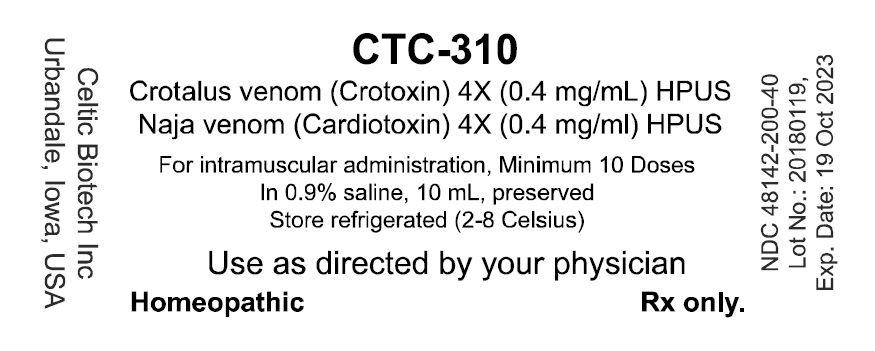
Principal Display Panel - Ndc: 48142-200-40 - 10 Ml Vial Label

10 mL Vial Label (Ctc 310 01)

10 mL Vial Label (Ctc 310 01)


* Please review the disclaimer below.