In individuals whose RVNA status is not known and who 1) have not received the full recommended regimen of a cell culture vaccine either in a pre-exposure or post-exposure prophylaxis regimen OR 2) received another (non-cell culture) rabies vaccine regimen,
- Administer a dose of IMOVAX RABIES immediately after exposure (at Day 0) and at Day 3, 7, 14, and 28. Administer each dose of IMOVAX RABIES at an anatomical site distant from the HRIG administration site(s).
- Administer HRIG at Day 0 according to its Prescribing Information.
- If antibody levels ≥ 0.5 IU/mL by RFFIT can be demonstrated in a serum sample collected before vaccine is given, vaccinations may be discontinued after at least two doses of IMOVAX RABIES. (1) (2)
Instructions for vaccine reconstitution
Step 1: Screw the plunger rod into the syringe containing Sterile Water diluent if the plunger rod is provided separately.
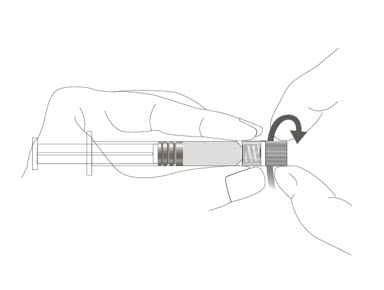
| Step 2: Hold the syringe cap (avoid holding the plunger rod or syringe barrel) and unscrew the tip cap by twisting it counterclockwise. | 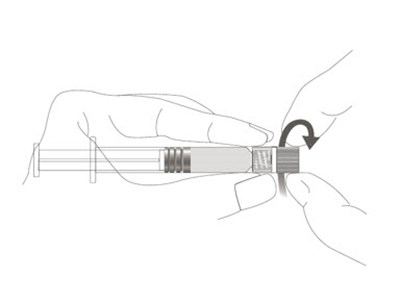 Figure (Ba8d4e72 F452 4859 Ae6f 3644b4b0a78c 01) |
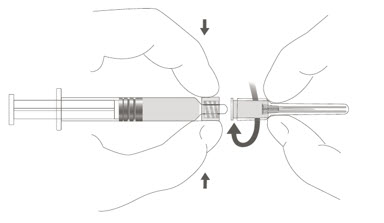
| Step 3: Attach the reconstitution needle to the syringe, by gently twisting the needle clockwise into the syringe until slight resistance is felt. | 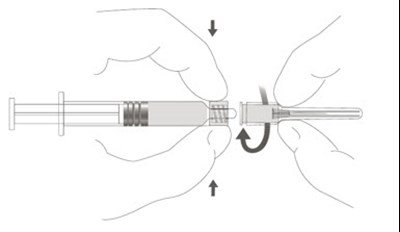 Figure (Ba8d4e72 F452 4859 Ae6f 3644b4b0a78c 02) |
Step 4: Transfer the entire content of the syringe containing Sterile Water diluent into the vial containing lyophilized vaccine.
Step 5: Gently swirl the vial until completely dissolved. After reconstitution, IMOVAX RABIES is pink to red.
Step 6: Unscrew the syringe from the reconstitution needle to eliminate negative pressure.
Reattach the syringe to the reconstitution needle which has remained in the vial.
Step 7: Withdraw the total content of the vial (approximately 1 mL) containing reconstituted vaccine. Remove the reconstitution needle and discard it.
Step 8: Attach a new sterile needle (as per Step 3) of a proper length and gauge suitable for intramuscular administration.
Parenteral drug products should be inspected for particulate matter and discoloration prior to administration, whenever solution and container permit. If either of these conditions exist, IMOVAX RABIES should not be administered.
Pre-exposure Prophylaxis
Do not administer to anyone with a known life-threatening systemic hypersensitivity reaction to any component of the vaccine [See Warnings and Precautions (5.2) and Description (11)].
Post-exposure Prophylaxis
None.
Post-exposure Prophylaxis
Reactions after vaccination with IMOVAX RABIES have been observed. (9) In a study using five doses of IMOVAX RABIES, local reactions such as pain, erythema, swelling or itching at the injection site were reported in about 25% of recipients of IMOVAX RABIES, and mild systemic reactions such as headache, nausea, abdominal pain, muscle aches, and dizziness were reported in about 20% of recipients. (7)
Pre-exposure Prophylaxis
The 2-dose and 3-dose pre-exposure prophylaxis regimens of IMOVAX RABIES were evaluated in two clinical trials.
Study 1 (NCT03700242), a randomized, open-label, controlled multicenter study included healthy participants 2 years of age and older. In this study, the safety analysis set included 228 participants who received a 2-dose pre-exposure prophylaxis regimen (on Day 0 and Day 7) and 115 participants who received a 3-dose pre-exposure prophylaxis regimen (on Day 0, Day 7 and Day 21). Of these participants, 101 were 2 years through 11 years of age (66 received 2-dose regimen, 35 received 3-dose regimen), 46 were 12 years through 17 years of age (35 received 2-dose regimen, 11 received 3-dose regimen), and 196 were 18 years through 59 years of age (127 received 2-dose regimen, 69 received 3-dose regimen).
Study 2 (NCT04127786), an observer blind, randomized, controlled multicenter study included healthy participants 1 year of age and older. In this study, the safety analysis set included 139 participants who received a 2-dose pre-exposure prophylaxis regimen (on Day 0, and Day 7) and 200 participants who received a 3-dose pre-exposure prophylaxis regimen (on Day 0, Day 7, and Day 28). Of those who received the 3-dose pre-exposure prophylaxis regimen, 100 participants were 1 year through 17 years of age (70 from 1 year through 11 years of age and 30 from 12 years through 17 years of age) and 100 participants were 18 years of age and older, including 2 participants 65 years of age and older. Per study design, no participants 1 year through 17 years of age were included in the 2-dose pre-exposure prophylaxis regimen group.
In both Study 1 and 2, solicited local (injection site) and systemic adverse reactions were recorded by participants or by parents/guardians in a diary card daily for 7 days after any dose. At subsequent visits, approximately 7 to 21 days post-vaccination, participants or parents/guardians reviewed diary cards with study investigators and when necessary, made corrections or clarifications. Unsolicited non-serious adverse events were recorded through 28 days after any dose, and serious adverse events were recorded for at least 6 months following the last vaccination.
The solicited adverse reactions that occurred within 7 days following any dose of IMOVAX RABIES in participants 18 years and older and participants 2 years through 17 years of age in Study 1 are presented in Table 1.
Table 1: Percentages of Participants with Solicited Local and Systemic Adverse Reactions within 7 Days after 2-dose and 3-dose Pre-exposure Prophylaxis Regimens of IMOVAX RABIES (Study 1) | ≥ 18 years of age | 2 years through 17 years of age |
|---|
| Solicited Adverse Reactions | IMOVAX RABIES
2-dose Pre-exposure Prophylaxis
(N=127) | IMOVAX RABIES
3-dose Pre-exposure Prophylaxis
(N=69) | IMOVAX RABIES
2-dose Pre-exposure Prophylaxis
(N=101) | IMOVAX RABIES
3-dose Pre-exposure prophylaxis
(N=46) |
|---|
| N = Number of participants who received at least one dose |
| Local (injection site) | | | | |
| Pain, any Any: From "easily tolerated" to "unable to perform usual activities" (2 years through 11 years of age) or from "no interference" to "significant interference with daily activities" (> 12 years); Grade 3: Unable to perform usual activities (2 years through 11 years of age) and prevents daily activity (>12 years) | 35.4 | 30.4 | 25.7 | 43.5 |
| Pain, Grade 3 | 0.0 | 0.0 | 0.0 | 0.0 |
| Erythema, any Any: 0 mm (2 years through 11 years of age) and ≥ 25 mm (>12 years); Grade 3: 50 mm (2 years through 11 years) and > 100 mm (>12 years) | 0.0 | 2.9 | 1.0 | 2.2 |
| Erythema, Grade 3 | 0.0 | 0.0 | 0.0 | 0.0 |
| Swelling, any | 0.0 | 1.4 | 2.0 | 6.5 |
| Swelling, Grade 3 | 0.0 | 0.0 | 0.0 | 0.0 |
| Systemic | | | | |
| Fever, any Any: ≥ 100.4°F (38.0°C); Grade 3: ≥ 102.1°F (39.0°C) | 4.7 | 7.2 | 4.0 | 17.4 |
| Fever, Grade 3 | 0.8 | 1.4 | 2.0 | 2.2 |
| Headache, any Any: From "no interference" to "significant interference with daily activities"; Grade 3: Prevents daily activity | 21.3 | 27.5 | 13.9 | 19.6 |
| Headache, Grade 3 | 0.0 | 0.0 | 0.0 | 0.0 |
| Malaise, any | 26.0 | 23.2 | 9.9 | 17.4 |
| Malaise, Grade 3 | 0.8 | 0.0 | 0.0 | 0.0 |
| Myalgia, any | 22.8 | 18.8 | 5.9 | 10.9 |
| Myalgia, Grade 3 | 0.0 | 0.0 | 0.0 | 0.0 |
In Study 2 participants, the commonly reported adverse reactions were generally consistent with those reported in Study 1 participants. In the two participants 1 year to less than 2 years of age in Study 2, the only reported systemic adverse reactions were vomiting and abnormal crying, both occurring in the same participant.
In both Study 1 and Study 2, most solicited adverse reactions resolved within 3 days. No related serious adverse events or deaths were reported in either study.
Risk Summary
All pregnancies have a risk of birth defect, loss, or other adverse outcomes. In the US general population, the estimated background risk of major birth defects and miscarriage in clinically recognized pregnancies is 2% to 4% and 15% to 20%, respectively.
There are no adequate and well-controlled studies of IMOVAX RABIES in pregnant women. Data on IMOVAX RABIES administered to pregnant women are insufficient to inform vaccine-associated risks in pregnancy.
Animal reproduction studies have not been conducted with IMOVAX RABIES.
Clinical considerations
Disease-Associated Maternal and/or Embryo/Fetal Risk
Confirmed rabies infection nearly always results in death.
Risk Summary
It is not known whether IMOVAX RABIES is excreted in human milk. Data are not available to assess the effects of IMOVAX RABIES on the breastfed infant or on milk production/excretion.
The developmental and health benefits of breastfeeding should be considered along with the mother's clinical need for IMOVAX RABIES and any potential adverse effects on the breastfed child from IMOVAX RABIES or from the underlying maternal condition. For preventive vaccines, the underlying maternal condition is susceptibility to the disease prevented by the vaccine.
Three-dose regimen for pre-exposure prophylaxis
Antibody responses to IMOVAX RABIES have been demonstrated in trials conducted in England (13), Germany (14) (15), France (16) and Belgium. (17) In the US, IMOVAX RABIES resulted in geometric mean titers (GMT) of 12.9 IU/mL at Day 49 and 5.1 IU/mL at Day 90 when three doses were given intramuscularly during the course of one month. The range of RVNA responses was 2.8 to 55.0 IU/mL at Day 49 and 1.8 to 12.4 IU/mL at Day 90. (18) The definition of a minimally accepted RVNA titer varies among laboratories and is influenced by the type of test conducted. The thresholds for an adequate immune response used in these trials were either 1:5 or 0.5 IU/mL depending on the trials.
Two-dose regimen for pre-exposure prophylaxis
The two-dose regimen (on Day 0, and Day 7) was assessed in two phase 3 studies.
In one observer-blind, randomized, controlled, multicenter study conducted in Thailand (Study 2), RVNA responses after 2 doses of IMOVAX RABIES were compared to RVNA responses after 3 doses of IMOVAX RABIES. In this study, 100 healthy participants 18 years of age and older (including 2 participants 65 years of age and older), and 100 participants 1 year through 17 years of age received a 3-dose pre-exposure prophylaxis regimen of IMOVAX RABIES. A key secondary objective of the study was to demonstrate in the pooled participants (from 1 year through 17 years of age and 18 years of age and older), the noninferiority of a 2-dose pre-exposure prophylaxis regimen of IMOVAX RABIES (on Day 0, and Day 7) at Day 28 compared to the 3-dose pre-exposure prophylaxis regimen of IMOVAX RABIES (on Day 0, Day 7, and Day 28) at Day 42 in terms of the percentage of participants with an RVNA titer ≥ 0.5 IU/mL. The analysis was done in the per protocol analysis set (PPAS) with data from Day 28 and Day 42 contributed from the same participants, and with the prespecified noninferiority margins of -10% and -5%.
At Day 28 (after 2 doses of IMOVAX RABIES), 98.8% of participants had an RVNA titer ≥ 0.5 IU/mL. At Day 42 (after 3 doses of IMOVAX RABIES), 100% participants had an RVNA titer ≥ 0.5 IU/mL. The difference in the percentage of participants who achieved an RVNA titer ≥ 0.5 IU/mL was -1.3% [95% confidence interval (CI): -4.4; 1.3]. As the lower bound of the 95% CI of this difference (-4.4%) was greater than the prespecified noninferiority margins of -10% and -5%, noninferiority of the 2-dose pre-exposure prophylaxis regimen at Day 28 to the 3-dose pre-exposure prophylaxis regimen at Day 42 was demonstrated.
In an open-label, randomized, controlled, multicenter study (Study 1) conducted in the Philippines, 228 healthy participants (including 101 participants from 2 years through 17 years of age and 127 participants 18 years through 52 years of age) were randomized to receive the 2-dose pre-exposure prophylaxis regimen of IMOVAX RABIES and 115 healthy participants (including 46 participants from 2 years through 17 years of age and 69 participants 18 years through 59 years of age) were randomized to receive a 3-dose pre-exposure prophylaxis regimen of IMOVAX RABIES. One year later, 200 participants from the 2-dose pre-exposure prophylaxis group and 107 participants from the 3-dose pre-exposure prophylaxis group received two doses of IMOVAX RABIES 3 days apart (on Day 0 and Day 3) to mimic a post-exposure prophylaxis regimen without actual rabies exposure (simulated post-exposure prophylaxis).
The primary objective of the study was to demonstrate noninferiority of a 2-dose pre-exposure prophylaxis regimen of IMOVAX RABIES (on Day 0 and Day 7) at Day 21 compared with the 3-dose pre-exposure prophylaxis regimen of IMOVAX RABIES (on Day 0, Day 7 and Day 28) at Day 35, in terms of the percentage of participants with an RVNA titer ≥ 0.5 IU/mL. The analysis was done in the PPAS with the prespecified noninferiority margin of -5%.
At Day 21, 96.7% of participants who received the 2-dose pre-exposure prophylaxis regimen of IMOVAX RABIES had an RVNA titer ≥ 0.5 IU/mL. At Day 35, 100% participants who received the 3-dose pre-exposure prophylaxis regimen of IMOVAX RABIES had an RVNA titer ≥ 0.5 IU/mL. Noninferiority was not demonstrated as the difference in the percentage of participants who had an RVNA titer ≥ 0.5 IU/mL threshold was ‑3.3% (95% CI: -6.8; 0.5) and the lower bound of the 95% CI was below the prespecified noninferiority margin (‑5%). All participants 2 years through 17 years of age who received the 2-dose pre-exposure prophylaxis regimen of IMOVAX RABIES had an RVNA titer ≥ 0.5 IU/mL at Day 21.
One year later, following the simulated post-exposure prophylaxis, 100% of participants primed with either a 2-dose or 3-dose pre-exposure prophylaxis regimen of IMOVAX RABIES had an RVNA titer ≥ 0.5 IU/mL at 7 and 14 days after the first simulated post-exposure prophylaxis injection, which demonstrated an anamnestic response.
Storage before Reconstitution
Store refrigerated between 2°C and 8°C (35°F to 46°F) in the original carton.
Do not freeze.
Storage after Reconstitution
Administer IMOVAX RABIES immediately after reconstitution.
IMOVAX is a registered trademark of Sanofi Vaccines US Inc.
Luer-Lok is a registered trademark of Becton Dickinson and Company.
© 2026 Sanofi Vaccines US Inc. – All rights reserved
Manufactured by:
Sanofi Winthrop Industrie
Marcy l'Etoile France
Distributed by:
Sanofi Vaccines US Inc.
Swiftwater, PA 18370 USA
1-800-VACCINE (1-800-822-2463)