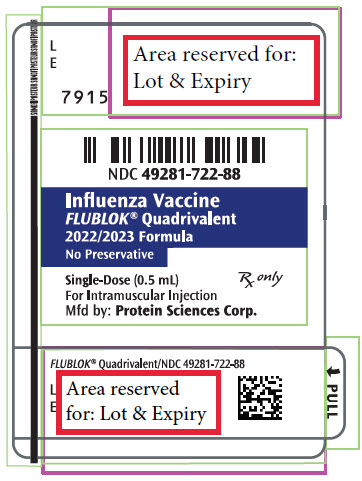
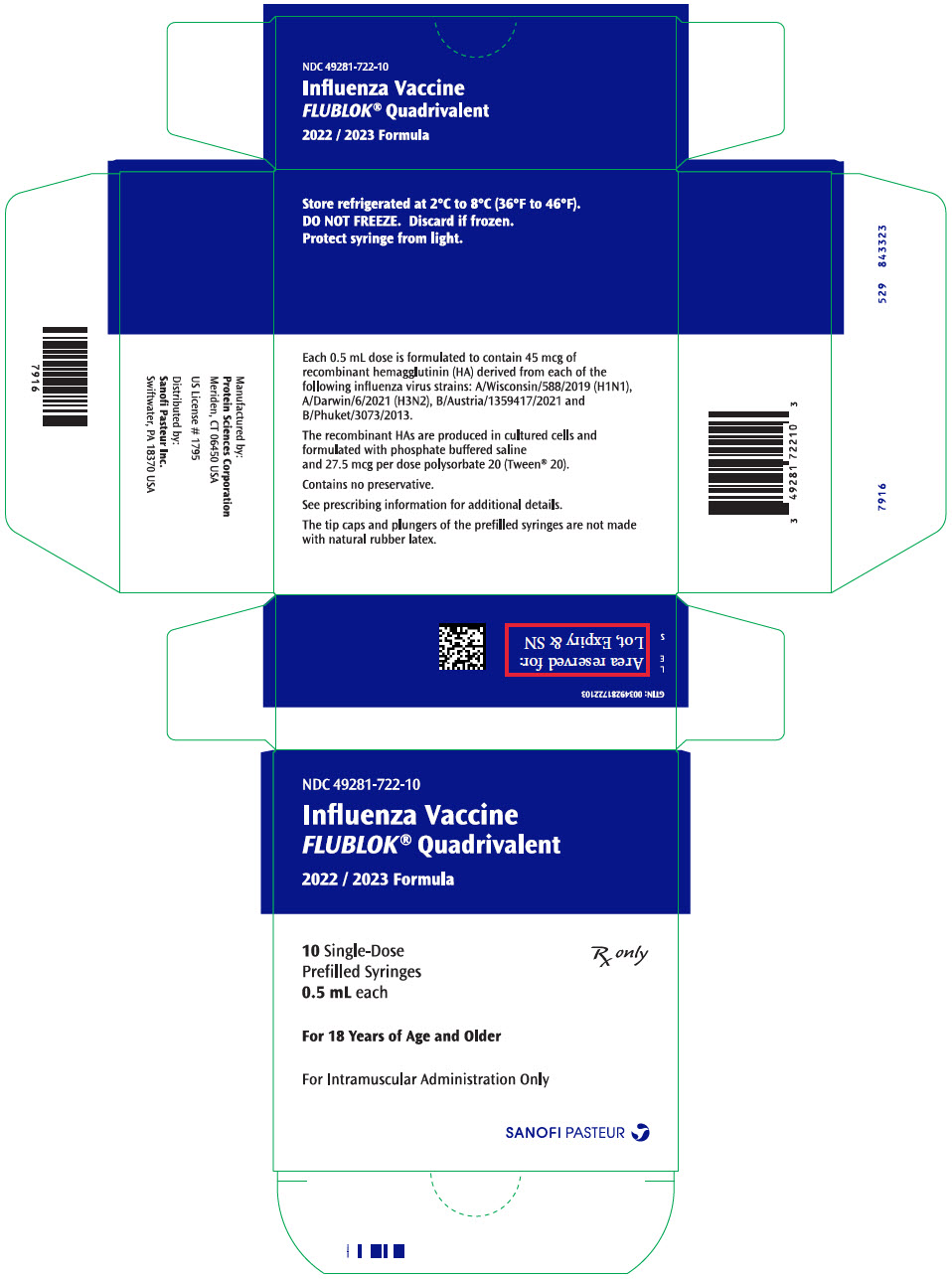
Flublok Quadrivalent
Flublok Quadrivalent has been administered to and safety data collected from 998 adults 18-49 years of age (Study 1) and 4328 adults 50 years of age and older (Study 2).
In Studies 1 and 2, local (injection site) and systemic adverse reactions were solicited with the use of a memory aid for 7 days following vaccination, unsolicited adverse events were collected for ~28 days post-vaccination, and serious adverse events (SAEs) were collected for 6 months post-vaccination via clinic visit or remote contact.
Study 1 included 1330 subjects 18 through 49 years of age for safety analysis, randomized to receive Flublok Quadrivalent (n=998) or a comparator inactivated influenza vaccine (Fluarix® Quadrivalent, manufactured by GlaxoSmithKline) (n=332) [see Clinical Studies (14)]. The mean age of participants was 33.5 years. Overall, 65% of subjects were female, 59% white/Caucasian, 37% black/African American, 1.0% Native Hawaiian/Pacific Islander, 0.8% American Indian/Alaskan Native, 0.5% Asian, 1.4% other racial groups, and 16% of Hispanic/Latino ethnicity. Table 1 summarizes the incidence of solicited local and systemic adverse reactions reported within seven days of vaccination with Flublok Quadrivalent or the comparator vaccine.
Table 1: Frequency of Solicited Local Injection Site Reactions and Systemic Adverse Reactions within 7 Days of Administration of Flublok Quadrivalent or ComparatorComparator = U.S.-licensed comparator quadrivalent inactivated influenza vaccine manufactured by GlaxoSmithKline.
in Adults 18-49 Years of Age, Study 1 (Reactogenicity Populations),Study 1 is registered as NCT02290509 under the National Clinical Trials registry.
Reactogenicity
Term | Flublok Quadrivalent
N=996
% | Comparator
N=332
% |
|---|
| Any Grade Denominators for fever: Flublok Quadrivalent n = 990, Comparator n = 327. | Grade 3 | Grade 4 | Any Grade | Grade 3 | Grade 4 |
|---|
| NOTE: Data based on the most severe response reported by subjects. Results ≥1% reported to nearest whole percent; results >0 but <1% reported as <1%. |
| Subjects with ≥1 injection site reaction Reactogenicity Populations were defined as all randomized subjects who received study vaccine according to the treatment actually received and who had at least one non-missing data point for injection site, systemic or body temperature reactogenicity categories. For local pain, tenderness and systemic reactions: Grade 1 = No interference with activities. Grade 2 = Prevented some activities, and headache may have required non-narcotic pain reliever. Grade 3 = Prevented most or all normal activities or required prescription medications. Grade 4 = Required visit to ER or hospitalization. For injection site redness and firmness/swelling: Grade 1=25 to ≤50 mm (small). Grade 2=51 to ≤100 mm (medium). Grade 3=>100 mm (large). Grade 4=necrosis or exfoliative dermatitis. , Denominators for injection site reactions: Flublok Quadrivalent n = 996, Comparator n =332. | 51 | 1 | 0 | 52 | 2 | 0 |
| Local Tenderness | 48 | 1 | 0 | 47 | 1 | 0 |
| Local Pain | 37 | 1 | 0 | 36 | 1 | 0 |
| Firmness / Swelling | 5 | 0 | 0 | 3 | 0 | 0 |
| Redness | 4 | 0 | 0 | 1 | 0 | 0 |
| Subjects with ≥1 systemic reaction, Denominators for systemic reactions: Flublok Quadrivalent n = 994, Comparator n = 332. | 34 | 2 | <1 | 36 | 3 | <1 |
| Headache | 20 | 1 | 0 | 21 | 2 | <1 |
| Fatigue | 17 | 1 | 0 | 17 | 1 | 0 |
| Muscle Pain | 13 | 1 | 0 | 12 | 1 | 0 |
| Joint Pain | 10 | 1 | 0 | 10 | 1 | 0 |
| Nausea | 9 | 1 | <1 | 9 | 1 | 0 |
| Shivering / Chills | 7 | 1 | 0 | 6 | 1 | 0 |
| Fever, Fever defined as ≥100.4°F (38°C). Grade 1 (≥100.4°F to ≤101.1°F); Grade 2 (101.2°F to ≤102.0°F); Grade 3 (102.1°F to ≤104°F). Grade 4 >104°F. | 2 | <1 | 0 | 1 | <1 | 0 |
Study 2 included 8672 subjects 50 years of age and older for safety analysis, randomized to receive Flublok Quadrivalent (n=4328) or Comparator (Fluarix Quadrivalent, manufactured by GlaxoSmithKline) as an active control (n=4344) [see Clinical Studies (14)]. The mean age of participants was 62.7 years. Overall, 58% of subjects were female, 80% white/Caucasian, 18% black/African American, 0.9% American Indian/Alaskan Native, 0.4% Asian, 0.2% Native Hawaiian/Pacific Islander, 0.7% other racial groups, and 5% of Hispanic/Latino ethnicity. Table 2 summarizes the incidence of solicited local and systemic adverse reactions reported within seven days of vaccination with Flublok Quadrivalent or Comparator.
Table 2: Frequency of Solicited Local Injection Site Reactions and Systemic Adverse Reactions within 7 Days of Administration of Flublok Quadrivalent or ComparatorComparator = U.S.-licensed comparator quadrivalent inactivated influenza vaccine, Fluarix Quadrivalent, manufactured by GlaxoSmithKline.
in Adults 50 Years of Age and Older, Study 2 (Reactogenicity Populations)Study 2 is registered as NCT02285998 under the National Clinical Trials registry.
, Reactogenicity Populations were defined as all randomized subjects who received study vaccine according to the treatment actually received and who had at least one non-missing data point for injection site, systemic or body temperature reactogenicity categories. For local pain, tenderness, and systemic reactions: Grade 1=No interference with activity. Grade 2=Some interference with activity. Grade 3=Prevents daily activity. Grade 4=Required ER visit or hospitalization. For injection site redness and firmness/swelling: Grade 1=25 to ≤50 mm (small). Grade 2=51 to ≤100 mm (medium). Grade 3=>100 mm (large). Grade 4=necrosis or exfoliative dermatitis.
| Reactogenicity Term | Flublok Quadrivalent
N=4312
% | Comparator
N=4327
% |
|---|
| Any Grade | Grade 3 | Grade 4 | Any Grade | Grade 3 | Grade 4 |
|---|
| NOTE: Data based on the most severe response reported by subjects. Results ≥1% reported to nearest whole percent; results >0 but <1% reported as <1%. |
| Subjects with ≥1 injection site reaction, Denominators for injection site reactions: Flublok Quadrivalent n = 4307, Comparator n = 4319. | 38 | <1 | <1 | 40 | <1 | <1 |
| Local Tenderness | 34 | <1 | <1 | 37 | <1 | <1 |
| Local Pain | 19 | <1 | 0 | 22 | <1 | <1 |
| Firmness / Swelling | 3 | <1 | 0 | 3 | <1 | 0 |
| Redness | 3 | <1 | 0 | 2 | <1 | 0 |
| Subjects with ≥1 systemic reactogenicity event, Denominators for systemic reactions: Flublok Quadrivalent n = 4306, Comparator n = 4318. | 25 | 1 | <1 | 26 | 1 | <1 |
| Headache | 13 | <1 | <1 | 14 | 1 | <1 |
| Fatigue | 12 | <1 | 0 | 12 | <1 | <1 |
| Muscle Pain | 9 | <1 | <1 | 9 | <1 | <1 |
| Joint Pain | 8 | <1 | 0 | 8 | <1 | <1 |
| Nausea | 5 | <1 | 0 | 5 | <1 | <1 |
| Shivering / Chills | 5 | <1 | 0 | 4 | <1 | <1 |
| Fever Denominators for fever: Flublok Quadrivalent n = 4262, Comparator n = 4282. ,Fever defined as ≥100.4°F (38°C). Grade 1 (≥100.4°F to ≤101.1°F); Grade 2 (101.2°F to ≤102.0°F); Grade 3 (102.1°F to ≤104°F). Grade 4 >104°F. | <1 | <1 | 0 | 1 | <1 | 0 |
Among adults 18-49 years of age (Study 1), through 6 months post-vaccination, no deaths were reported. SAEs were reported by 12 subjects, 10 (1%) Flublok Quadrivalent recipients and 2 (0.6%) Comparator recipients. No SAEs were considered related to study vaccine.
Among adults 50 years of age and older (Study 2), 20 deaths occurred in the 6 months post-vaccination, including 8 Flublok Quadrivalent and 12 Comparator recipients. No deaths were considered related to study vaccine. SAEs were reported by 145 (3.4%) Flublok Quadrivalent recipients and 132 (3%) Comparator recipients. No SAEs were considered related to study vaccine.
In the 28 days following vaccination, one or more unsolicited treatment emergent adverse events occurred in 10.3% of Flublok Quadrivalent and 10.5% of Comparator recipients in Study 1 (adults 18-49 years of age) and in 13.9% of Flublok Quadrivalent and 14.1% of Comparator recipients in Study 2 (adults ≥50 years of age). In both studies, rates of individual events were similar between treatment groups, and most events were mild to moderate in severity.
Flublok (Trivalent Formulation)
The safety experience with Flublok is relevant to Flublok Quadrivalent because both vaccines are manufactured using the same process and have overlapping compositions [see Description (11)].
Flublok (trivalent formulation) has been administered to and safety data collected from a total of 4547 subjects in five clinical trials (Studies 3-7): 2497 adults 18 through 49 years, 972 adults 50 through 64 years, and 1078 adults 65 years and older. In Studies 3 - 5 and 7, SAEs were collected for 6 months post-vaccination. Study 6 collected SAEs through 30 days following receipt of vaccine. Study 6 also actively solicited pre-specified common hypersensitivity-type reactions through 30 days following receipt of vaccine as a primary endpoint.
Study 3 included 4648 subjects 18 through 49 years of age for safety analysis, randomized to receive Flublok (n=2344) or placebo (n=2304) [see Clinical Studies (14)].
Study 4 included 602 subjects 50 through 64 years of age for safety analysis, randomized to receive Flublok (n=300) or another U.S.-licensed trivalent influenza vaccine (Fluzone®, manufactured by Sanofi Pasteur, Inc.) as an active control (n=302).
Study 5 included 869 subjects aged 65 years and older for safety analysis, randomized to receive Flublok (n=436) or another U.S.-licensed trivalent influenza vaccine (Fluzone) as an active control (n=433).
Study 6 included 2627 subjects aged 50 years and older for safety analysis, randomized to receive Flublok (n=1314) or another U.S.-licensed trivalent influenza vaccine (Afluria, manufactured by Seqirus Pty Ltd.) as an active control (n=1313). Among subjects 50 through 64 years of age, 672 received Flublok and 665 received Afluria. Among subjects aged 65 years and older, 642 received Flublok and 648 received Afluria.
Study 7 was a Phase 2 dose-finding trial conducted in adults 18 through 49 years of age, 153 of whom received Flublok 135 mcg, the licensed trivalent formulation.
Serious Adverse Events
Among 2497 adults 18-49 years of age (Studies 3 and 7 pooled), through 6 months post-vaccination, two deaths were reported, one in a Flublok recipient and one in a placebo recipient. Both deaths occurred more than 28 days following vaccination and neither was considered vaccine-related. SAEs were reported by 32 Flublok recipients and 35 placebo recipients. One SAE (pleuropericarditis) in a Flublok recipient was assessed as possibly related to the vaccine.
Among 972 adults 50-64 years of age (Studies 4 and 6 pooled), through up to 6 months post-vaccination, no deaths occurred, and SAEs were reported by 10 subjects, 6 Flublok recipients and 4 Comparator recipients. One of the SAEs, vasovagal syncope following injection of Flublok, was considered related to administration of study vaccine.
Among 1078 adults 65 years of age and older (Studies 5 and 6 pooled), through up to 6 months post-vaccination, 4 deaths occurred, 2 in Flublok recipients and 2 in Comparator recipients. None were considered related to the study vaccines. SAEs were reported by 80 subjects (37 Flublok recipients, 43 Comparator recipients). None were considered related to the study vaccines.
Among 1314 adults 50 years of age and older (Study 7) for whom the incidence of rash, urticaria, swelling, non-pitting edema, or other potential hypersensitivity reactions were actively solicited for 30 days following vaccination, a total of 2.4% of Flublok recipients and 1.6% of Comparator recipients reported such events over the 30 day follow-up period. A total of 1.9% and 0.9% of Flublok and Comparator recipients, respectively, reported these events in the 7 days following vaccination. Of these solicited events, rash was most frequently reported (Flublok 1.3%, Comparator 0.8%) over the 30 day follow-up period.
Pregnancy Exposure
Pregnancy outcomes in women who have been exposed to Flublok Quadrivalent during pregnancy are being monitored. Sanofi Pasteur Inc. is maintaining a prospective pregnancy exposure registry to collect data on pregnancy outcomes and newborn health status following vaccination with Flublok Quadrivalent during pregnancy. Healthcare providers are encouraged to enroll women who receive Flublok Quadrivalent during pregnancy in Sanofi Pasteur Inc.'s vaccination pregnancy registry by calling 1-800-822-2463.
Risk Summary
All pregnancies have a risk of birth defect, loss, or other adverse outcomes. In the U.S. general population, the estimated background risks of major birth defects and miscarriage in clinically recognized pregnancies are 2% to 4% and 15% to 20%, respectively. Available data on Flublok Quadrivalent and Flublok (trivalent formulation) administered to pregnant women are insufficient to inform vaccine-associated risks in pregnant women.
There were no developmental studies of Flublok Quadrivalent formulation performed in animals. The developmental effects of Flublok (trivalent formulation) are relevant to Flublok Quadrivalent because both vaccines are manufactured using the same process and have overlapping compositions. A developmental study of Flublok (trivalent formulation) has been performed in rats administered 0.5 mL divided of Flublok (trivalent formulation) prior to mating and during gestation. This study revealed no evidence of harm to the fetus due to Flublok (trivalent formulation) [see Data].
Clinical Considerations
Disease-associated Maternal and/or Embryo/Fetal Risk
Pregnant women are at increased risk of complications associated with influenza infection compared to non-pregnant women. Pregnant women with influenza may be at increased risk for adverse pregnancy outcomes, including preterm labor and delivery.
Data
Animal
In a developmental toxicity study, female rats were administered 0.5 mL divided of Flublok (trivalent formulation) by intramuscular injection twice prior to mating (35 days and 14 days prior to mating) and on gestation Day 6. No vaccine-related fetal malformations or variations and no adverse effects on pre-weaning development were observed in the study.
Risk Summary
It is not known whether Flublok Quadrivalent is excreted in human milk. Data are not available to assess the effects of Flublok (trivalent formulation) or Flublok Quadrivalent on the breastfed infant or on milk production/excretion.
The developmental and health benefits of breastfeeding should be considered along with the mother's clinical need for Flublok Quadrivalent and any potential adverse effects on the breastfed child from Flublok Quadrivalent or from the underlying maternal condition. For preventive vaccines, the underlying condition is susceptibility to disease prevented by the vaccine.
Manufactured by Protein Sciences Corporation (Meriden, CT).
U.S. license No. 1795.
Distributed by Sanofi Pasteur Inc.
Flublok is a registered trademark of Protein Sciences Corporation.