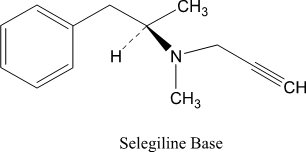
Selegiline (the drug substance of EMSAM) is an irreversible inhibitor of monoamine oxidase (MAO), a ubiquitous intracellular enzyme. MAO exists as two isoenzymes, referred to as MAO-A and MAO-B. Selegiline shows greater affinity for MAO-B; however, as selegiline concentration increases, this selectivity is lost with resulting dose-related inhibition of MAO-A. Intestinal MAO is predominantly type A, while in the brain both isoenzymes exist.
MAO plays a vital physiological role in terminating the biological activity of both endogenous and exogenous amines. In addition to their role in the catabolism of monoamines in the CNS, MAOs are also important in the catabolism of exogenous amines found in a variety of foods and drugs. MAO in the gastrointestinal tract (primarily type A) provides protection from exogenous amines with vasopressor actions, such as tyramine, which if absorbed intact can cause a hypertensive crisis, the so-called “cheese reaction”. If a large amount of tyramine is absorbed systemically, it is taken up by adrenergic neurons and causes norepinephrine release from neuronal storage sites with resultant elevation of blood pressure. While most foods contain negligible amounts or no tyramine, certain food products may contain large amounts of tyramine that represent a potential risk for hypertensive crisis [see Warnings and Precautions (5.3)].
To define the risk of hypertensive crises with use of EMSAM, several Phase I tyramine challenge studies were conducted both with and without food. Fourteen tyramine challenge studies including 214 healthy subjects (age range 18 to 65; 31 subjects greater than 50 years of age) were conducted to determine the pressor effects of oral tyramine with concurrent EMSAM treatment (6 mg per 24 hours to 12 mg per 24 hours), measured as the dose of tyramine required to raise systolic blood pressure by 30 mmHg (TYR30). Studies were conducted with and without concomitant administration of food. Studies conducted with food are most relevant to clinical practice since tyramine typically will be consumed in food. A high-tyramine meal is considered to contain up to 40 mg of tyramine.
One study using a crossover design in 13 subjects investigated tyramine pressor doses (TYR30) after administration of EMSAM 6 mg per 24 hours and oral selegiline (5 mg twice daily) for 9 days. Mean pressor doses (TYR30) of tyramine capsules administered without food were 338 mg and 385 mg in subjects treated with EMSAM and oral selegiline, respectively.
Another study using a crossover design in 10 subjects investigated tyramine pressor doses after administration of EMSAM 6 mg per 24 hours or tranylcypromine 30 mg per day for 10 days. Mean pressor doses (TYR30) of tyramine capsules administered without food were 270 mg in subjects treated with EMSAM 6 mg per 24 hours and 10 mg in subjects treated with tranylcypromine.
In a third crossover study, tyramine without food was administered to 12 subjects. The mean tyramine pressor doses (TYR30) after administration of EMSAM 6 mg per 24 hours for 9 and 33 days were 292 mg and 204 mg, respectively. The lowest pressor dose was 50 mg in one subject in the 33-day group.
Tyramine pressor doses were also studied in 11 subjects after extended treatment with EMSAM 12 mg per 24 hours. At 30, 60, and 90 days, the mean pressor doses (TYR30) of tyramine administered without food were 95 mg, 72 mg, and 88 mg, respectively. The lowest pressor dose without food was 25 mg in three subjects at day 30 while on EMSAM 12 mg per 24 hours. Eight subjects from this study, with a mean tyramine pressor dose of 64 mg at 90 days, were subsequently administered tyramine with food, resulting in a mean pressor dose of 172 mg (2.7 times the mean pressor dose observed without food, p less than 0.003).
With the exception of one study (N = 153), the Phase III clinical development program was conducted without requiring a modified diet (N = 2,553, 1,606 at 6 mg per 24 hours, and 947 at 9 mg per 24 hours or 12 mg per 24 hours). No hypertensive crises were reported in any patient receiving EMSAM.
Overall, the data for EMSAM 6 mg per 24 hours support a recommendation that a modified diet is not required at this dose. Due to the more limited data available for EMSAM 9 mg per 24 hours and the results from the Phase I tyramine challenge study in fed volunteers administered EMSAM 12 mg per 24 hours, patients receiving these doses should follow Dietary Modifications Required for Patients Taking EMSAM 9 mg per 24 hours and 12 mg per 24 hours [see Warnings and Precautions (5.3)].