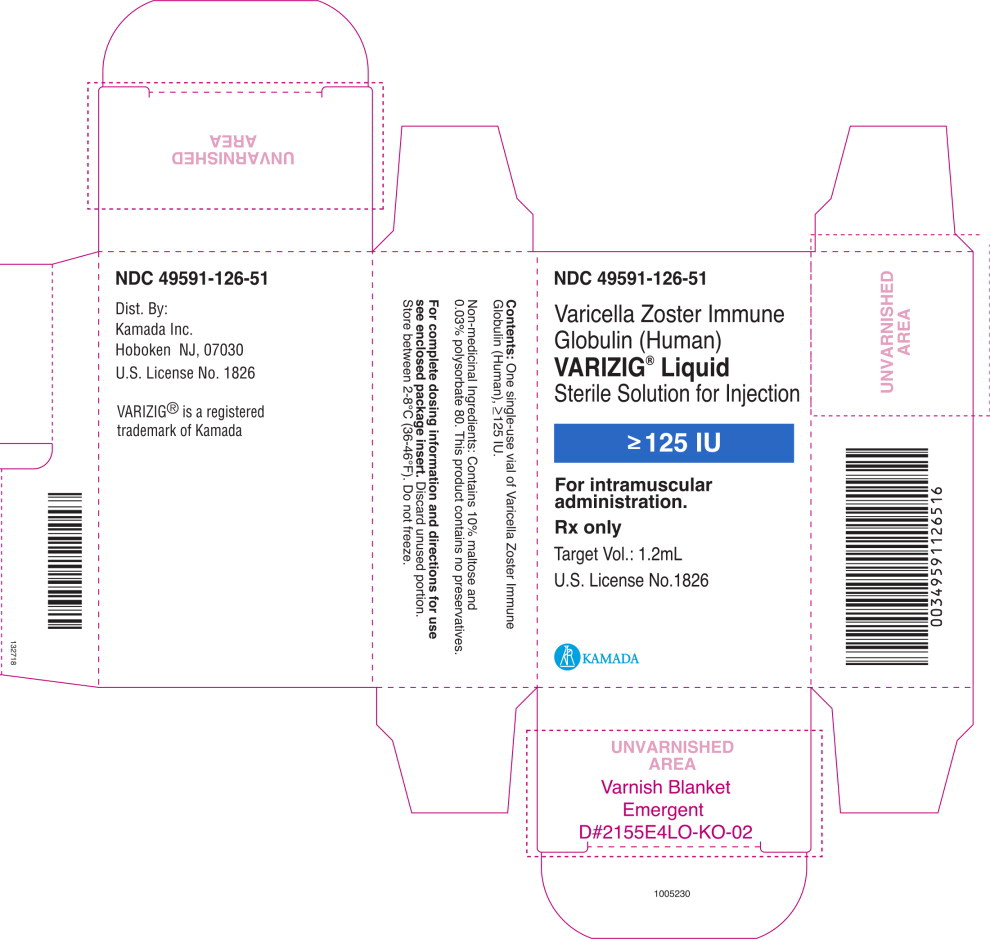
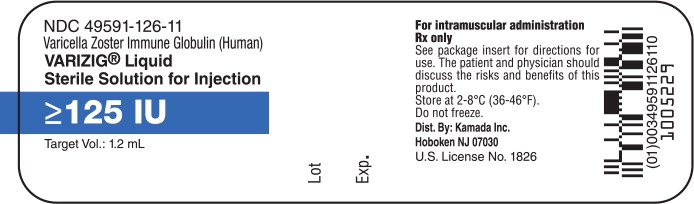
VARIZIG [Varicella Zoster Immune Globulin (Human)] is a solvent/detergent-treated sterile liquid preparation of purified human immune globulin G (IgG) containing antibodies to varicella zoster virus (anti-VZV). VZV is the causative agent of chickenpox. VARIZIG is prepared from plasma donated by healthy, screened donors with high titers of antibodies to VZV, which is purified by an anion-exchange column chromatography manufacturing method. This donor selection process includes donors with high anti-VZV titers due to recent natural infection by VZV, or due to recurrent zoster infection (shingles).
VARIZIG is intended for single use and should be administered intramuscularly [see 2 DOSAGE AND ADMINISTRATION].
The product potency is expressed in international units by comparison to the World Health Organization (WHO) international reference preparation for anti-VZV immune globulin. Each vial contains 125 international units of anti-VZV. VARIZIG is formulated with 10% maltose and 0.03% polysorbate 80. VARIZIG has a pH of 5.0 – 6.5 and contains no preservative.
The presence of anti-Protein S antibodies has been reported to arise transiently in patients after VZV infection (4). Low levels of anti-Protein S antibodies have been reported in VARIZIG.
The source plasma used in the manufacture of this product was tested by FDA licensed nucleic acid testing (NAT) for human immunodeficiency virus-1 (HIV-1), hepatitis B virus (HBV) and hepatitis C virus (HCV) and found to be negative. Plasma also was tested by in-process NAT for hepatitis A virus (HAV) and parvovirus B19 (B19) via minipool testing; the limit for B19 in the manufacturing pool is set not to exceed 104 international units of B19 DNA per milliliter.
The manufacturing process contains two steps implemented specifically for virus clearance. The solvent/detergent step (using tri-n-butyl phosphate and Triton® X-100) is effective in the inactivation of enveloped viruses, such as HBV, HCV and HIV-1. Virus filtration, using a Planova® 20N virus filter, is effective for the removal of viruses based on their size, including some non-enveloped viruses. These two viral clearance steps are designed to increase product safety by reducing the risk of transmission of enveloped and non-enveloped viruses. In addition to these two specific steps, the process step of anion-exchange chromatography was identified as contributing to the overall viral clearance capacity for small non-enveloped viruses.
The inactivation and reduction of known enveloped and non-enveloped model viruses were validated in laboratory studies as summarized in Table 2. The viruses employed for spiking studies were selected to represent those viruses that are potential contaminants in the product, and to represent a wide range of physiochemical properties in order to challenge the manufacturing process's ability for viral clearance in general.
Table 2 Virus Reduction Values (Log10) Obtained through Validation Studies
|
|
|
|
|
|
|
|
|
|
| Enveloped | Non-Enveloped |
| Genome
| RNA | DNA | RNA | DNA |
| Virus
| HIV-1 | BVDV | PRV | HAV | EMC | MMV | PPV |
| Family
| retro
| flavi
| herpes
| picorna
| parvo
|
| Size (nm)
| 80–100
| 50–70
| 120–200
| 25–30
| 30
| 20–25
| 18–24
|
| Anion Exchange Chromatography (partitioning)
| Not evaluated
| 2.3
| n.e.
| 3.4
| n.e.
|
| 20N Filtration (size exclusion)
| ≥4.7
| ≥3.5
| ≥5.6*
| n.e.
| 4.8
| n.e.
| 4.1
|
| Solvent/Detergent (inactivation)
| ≥4.7
| ≥7.3
| ≥5.5
| Not evaluated
|
| Total Reduction (log10) | ≥9.4 | ≥10.8 | ≥11.1 | 2.3 | 4.8 | 3.4 | 4.1 |