Mechanism of Action
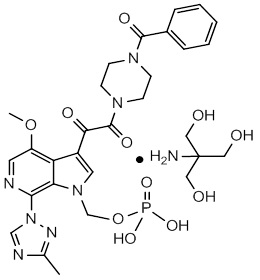
Fostemsavir is a prodrug without significant biochemical or antiviral activity that is hydrolyzed to the active moiety, temsavir, which is an HIV-1 attachment inhibitor. Temsavir binds directly to the gp120 subunit within the HIV-1 envelope glycoprotein gp160 and selectively inhibits the interaction between the virus and cellular CD4 receptors, thereby preventing attachment. Additionally, temsavir can inhibit gp120-dependent post-attachment steps required for viral entry into host cells. Temsavir inhibited the binding of soluble CD4 to surface immobilized gp120 with an IC50 value of 14 nM using an enzyme-linked immunosorbent assay (ELISA).
Antiviral Activity in Cell Culture
Temsavir exhibited antiviral activity against 3 CCR5-tropic laboratory strains of subtype B HIV‑1, with EC50 values ranging from 0.4 to 1.7 nM. The range of susceptibility to temsavir was broader for CXCR4-tropic laboratory strains with 2 strains having EC50 values of 0.7 and 2.2 nM and 3 strains having EC50 values of 14.8, 16.2, and >2,000 nM. Antiviral activity of temsavir against HIV-1 subtype B clinical isolates varied depending on tropism with median EC50 values against the CCR5-tropic viruses, CXCR4-tropic viruses, and dual/mixed viruses of 3.7 nM (n = 9; range: 0.3 to 345 nM), 40.9 nM (n = 4; range: 0.6 to >2,000 nM), and 0.8 nM (n = 2; range: 0.3 to 1.3), respectively, showing a broad range of EC50 values for temsavir across the different tropic strains.
Analysis of data from 1,337 clinical samples from the fostemsavir clinical development program (881 subtype B samples, 156 subtype C samples, 43 subtype A samples, 17 subtype A1 samples, 48 subtype F1 samples, 29 subtype BF1 samples, 19 subtype BF samples, 5 CRF01_AE samples, and 139 other) showed temsavir susceptibility is highly variable across subtypes with a wide range in EC50 values from 0.018 nM to >5,000 nM. The majority of subtype B isolates (84%, 740/881) had EC50 values below 10 nM, with 6% of isolates having EC50 values >100 nM. Of all isolates from all subtypes tested, 9% exhibited EC50 values >100 nM. Subtypes BF, F1 and BF1 had higher proportions (21% to 38%) of isolates with EC50 values >100 nM, and all 5 of 5 subtype AE isolates had EC50 values >100 nM. From an additional panel of clinical isolates with non-B subtypes, temsavir EC50 values were greater than the upper limits of the concentrations tested (>1,800 nM) in all subtype E (AE; 3 of 3), Group O (2 of 2), and HIV-2 (1 of 1) isolates, and some subtype D (1 of 4) and subtype G (1 of 3) isolates.
Reduced Antiviral Activity against Subtype AE
Temsavir showed reduced antiviral activity against 14 different subtype AE isolates in peripheral blood mononuclear cell (PBMC) assays and the Phenosense Entry assay indicating that subtype AE (or E) viruses are inherently less sensitive to temsavir. Genotyping of subtype AE viruses identified polymorphisms at amino acid positions S375H and M475I in gp120, which have been associated with reduced susceptibility to fostemsavir. Subtype AE is a predominant subtype in Southeast Asia, but it is not found in high frequencies elsewhere throughout the world.
There were 2 subjects with subtype AE virus at screening in the randomized cohort of the clinical trial. One subject (EC50 fold change >4,747-fold and gp120 substitutions at S375H and M475I at baseline) did not respond to RUKOBIA at Day 8. A second subject (EC50 fold change 298-fold and gp120 substitution at S375N at baseline) received placebo during functional monotherapy. Both subjects were virologically suppressed at Week 96 while receiving OBT (with dolutegravir) plus RUKOBIA.
Antiviral Activity in Combination with Other Antiviral Agents
The antiviral activity of temsavir was not antagonistic in cell culture when combined with the CD4-directed post-attachment HIV-1 inhibitor ibalizumab, the CCR5 co-receptor antagonist maraviroc, the gp41 fusion inhibitor enfuvirtide, integrase strand transfer inhibitors (INSTIs) (dolutegravir, raltegravir), non-nucleoside reverse transcriptase inhibitors (NNRTIs) (delavirdine, efavirenz, nevirapine, rilpivirine), nucleoside reverse transcriptase inhibitors (NRTIs) (abacavir, didanosine, emtricitabine, lamivudine, stavudine, tenofovir disoproxil fumarate, zidovudine), or protease inhibitors (PIs) (amprenavir, atazanavir, darunavir, indinavir, lopinavir, nelfinavir, ritonavir, saquinavir). In addition, temsavir antiviral activity was not antagonistic in cell culture with the anti-HBV drug entecavir and the anti-HCV drug ribavirin.
Resistance in Cell Culture
HIV-1 variants with reduced susceptibility to temsavir were selected following 14 to 49 days passage in cell culture of NL4-3, LAI, and BaL viruses in a T-cell line. Selected viruses exhibited 18- to 159-fold decreased temsavir susceptibility and genotypic analysis identified the following emerging amino acid substitutions in gp120: L116P/Q, L175P, A204D, V255I, A281V, M426L, M434I, and M475I (S375 substitutions were identified based on in vivo data with a related attachment inhibitor). In general, most substitutions mapped to the conserved regions (C1, C2, C4, and C5) of the gp120 envelope, confirming temsavir targets the viral envelope protein during infection.
Single-substitution recombinant viruses at these amino acid positions were engineered into the HIV-1 LAI viral background and the resultant recombinants demonstrated reduced susceptibility to temsavir (L116P [>340-fold], A204D [>340-fold], S375M [47-fold], S375V [5.5-fold], S375Y [>10,000-fold], M426L [81-fold], M426V [3.3-fold], M434I [11-fold], M434T [15-fold], M475I [5-fold], M475L [17-fold], and M475V [9.5-fold]).
Temsavir remained active against laboratory-derived CD4-independent viruses and temsavir-resistant viruses showed no evidence of a CD4-independent phenotype. Therefore, treatment with RUKOBIA is unlikely to promote resistance to temsavir via generation of CD4-independent virus.
Response at Day 8 by Genotype
The effect of the gp120 resistance-associated polymorphisms (RAPs) on response to fostemsavir functional monotherapy at Day 8 was assessed in an as-treated analysis by censoring the subjects who had a >0.4 log10 decline in HIV-1 RNA from screening to baseline or <400 copies/mL at screening (n = 47 subjects were censored). The presence of gp120 RAPs at key sites S375, M426, M434, or M475 was associated with a lower overall decline in HIV-1 RNA and fewer subjects achieving >0.5 log10 decline in HIV-1 RNA compared with subjects with no changes at these sites (Table 8). However, the presence of the gp120 RAPs did not preclude some subjects from achieving a response of >0.5 log10 copies/mL at Day 8. Baseline gp120 RAPs most associated with decreased response of <0.5 log10 copies/mL at Day 8 were S375M, M426L, and M475V (Table 8). There was no difference in response rates and median decline in viral load for subjects with more than one gp120 RAP.
Table 8. Outcome of Randomized Fostemsavir Cohort by Presence of Screening gp120 RAPs (As-Treated Analysisa)| a Removed subjects who had <400 copies/mL at screening or >0.4 log10 decline from screening to baseline. |
Envelope RAPs | Response Rate at Day 8 (>0.5 log10 decline) n = 151 | Median Log10 Decline in Viral Load: Baseline to Day 8 n = 151 |
Overall | 107/151 (71%) | 1.05 |
No gp120 RAPs (at predefined sites) | 70/83 (84%) | 1.11 |
Predefined gp120 RAPs: | | |
S375I/M/N/T, M426L, M434I, or M475I/V | 37/68 (54%) | 0.66 |
S375M | 1/5 (20%) | 0.32 |
M426L | 6/17 (35%) | 0.19 |
M434I | 3/6 (50%) | 0.66 |
M475V | 0/1 (0%) | 0 |
1 gp120 RAP | 38/62 (61%) | 1.03 |
2 or 3 gp120 RAPs | 18/26 (69%) | 1.09 |
Response at Day 8 by Phenotype
The fold change in susceptibility to temsavir for subject isolates at screening was highly variable ranging from 0.06 to 6,651. The effect of screening fostemsavir phenotype on response of >0.5 log10 decline at Day 8 was assessed in the as-treated analysis. The majority of these subjects (55%, 83/151) had a screening temsavir EC50 fold change normalized to a reference virus of <2‑fold. The response rate for fostemsavir phenotypes ≤2 was 80% (66/83) (Table 9). Response rates for fostemsavir phenotypic fold changes of >2 to 200 were moderately decreased to 69% (29/42). Phenotypic fold changes of >200 resulted in lower response rates to fostemsavir (29%, 5/17). Five subjects, despite having >200-fold decreased fostemsavir susceptibility and the presence of screening gp120 RAPs, had over 1 log10 declines in HIV-1 RNA at Day 8. Lack of resistance to background drugs or higher fostemsavir concentrations do not explain the >1 log10 response of these 5 subjects.
Table 9. Response Rate of Randomized Fostemsavir Cohort (>0.5 Log10 Decline Day 8) by Screening Phenotype| a Removed subjects who had <400 copies/mL at screening or >0.4 log10 decline from screening to baseline. |
Fostemsavir Phenotypic
Fold Change | Response Rate at Day 8 (>0.5 log10 decline) As-Treated Analysisa n = 151 |
Not Reported | 9 |
0 - 2 | 66/83 (80%) |
>2 - 10 | 17/25 (68%) |
10 - 200 (Range 11 - 104) | 12/17 (71%) |
>200 (Range 234 - 6,651) | 5/17 (29%) |
Resistance in Clinical Subjects
The percentage of subjects who experienced virologic failure through the Week 96 analysis was 25% (69/272) in the randomized cohort (including 25% [51/203] among subjects who received blinded fostemsavir functional monotherapy and 26% [18/69] among subjects who received blinded placebo during the 8‑day double-blind period) (Table 10). Virologic failure = confirmed ≥400 copies/mL after prior confirmed suppression to <400 copies/mL, ≥400 copies/mL at last available prior to discontinuation, or >1 log10 copies/mL increase in HIV‑1 RNA at any time above nadir level (≥40 copies/mL). Overall, 51% (27/53) of evaluable subjects with virologic failure in the randomized cohorts had treatment-emergent gp120 genotypic substitutions at 4 key sites (S375, M426, M434, and M475) (Table 10).
The median temsavir EC50 fold change at failure in randomized evaluable subject isolates with emergent gp120 substitutions at positions 375, 426, 434, or 475 (n = 26) was 1,755-fold. In randomized evaluable subject isolates with no emergent gp120 substitutions at those positions (n = 27), the median temsavir EC50 fold change at failure was 3.6-fold.
Thirty percent (21/69) of the virologic failures in the randomized groups combined had genotypic or phenotypic resistance to at least one drug in the OBT at screening, and 48% (31/64) of the virologic failures with post-baseline data had emergent resistance to at least one drug in the OBT.
Rates of virologic failure were higher in the nonrandomized cohort at 51% (50/99) (Table 10). While the proportion of virologic failures with gp120 RAPs at screening was similar between subjects in the randomized and nonrandomized cohorts, the proportion of subjects with emergent gp120 resistance-associated substitutions at the time of failure was higher among nonrandomized subjects (Table 10). The median temsavir EC50 fold change at failure in nonrandomized evaluable subject isolates with emergent substitutions at positions 375, 426, 434, or 475 (n = 33) was 4,216-fold and was 767-fold among failure subject isolates without emergent resistance-associated substitutions (n = 12). Consistent with the nonrandomized group of subjects having fewer antiretroviral options, 90% (45/50) of the virologic failures in this group had genotypic or phenotypic resistance to at least one drug in the OBT at screening, and 55% (27/49) of the virologic failures with post-baseline data in the nonrandomized group had emergent resistance to at least one drug in the OBT.
Table 10. Virologic Failures in BRIGHTE Trial | RAPs = Resistance-associated polymorphisms; RAS = Resistance-associated substitutions. |
| Randomized Cohort Total | Nonrandomized Cohort Total |
Number of virologic failures | 69/272 (25%) | 50/99 (51%) |
With gp120 RAPs at screening (of those with genotypic data) | 42/68 (62%) | 26/48 (54%) |
Virologic failures with post-baseline data | 53 | 45 |
With emergent gp120 RAS | 27/53 (51%) | 33/45 (73%) |
S375N | 18/53 (34%) | 21/45 (47%) |
M426L/I | 17/53 (32%) | 23/45 (51%) |
M434I/L | 5/53 (9%) | 5/45 (11%) |
M475I/L/V | 8/53 (15%) | 5/45 (11%) |
Cross-Resistance
Both the CD4-directed post-attachment inhibitor ibalizumab and the gp120-directed attachment inhibitor fostemsavir develop resistance in gp120. Five of 7 viruses resistant to ibalizumab retained susceptibility to temsavir while the other 2 viruses had reduced susceptibility to both temsavir (>1,400-fold decreased susceptibility) and ibaluzimab. Resistance to the CCR5 coreceptor antagonist maraviroc can also develop in the gp120 envelope. Some CCR5-tropic maraviroc-resistant viruses showed reduced susceptibility to temsavir. Viruses resistant to the gp41 fusion inhibitor enfuvirtide retained susceptibility to temsavir.
Temsavir retained wild-type activity against viruses resistant to the INSTI raltegravir; the NNRTI rilpivirine; the NRTIs abacavir, lamivudine, tenofovir, zidovudine; and the PIs atazanavir and darunavir.
Additionally, ibalizumab, maraviroc, enfuvirtide, the INSTI raltegravir, NNRTIs (efavirenz, rilpivirine), NRTIs (abacavir, tenofovir), and PIs (atazanavir, darunavir) retained activity against site-directed mutants with reduced temsavir susceptibility (S375M, M426L, or M426L plus M475I) or against clinical envelopes that had decreased baseline susceptibility to temsavir.