Because clinical trials are conducted under widely varying conditions, adverse reaction rates observed in the clinical trials of a drug cannot be directly compared to rates in the clinical trials of another drug and may not reflect or predict the rates observed in practice.
The data in the tables represent the proportion of individuals who experienced, at least once, a treatment-emergent adverse reaction of the type listed. A reaction was considered treatment-emergent if it occurred for the first time or worsened while receiving therapy following baseline evaluation.
Adults – The information below is derived from a clinical study database for olanzapine and fluoxetine consisting of 2547 patients with treatment resistant depression, depression episodes associated with Bipolar 1 Disorder, Major Depressive Disorder with psychosis, or sexual dysfunction with approximately 1085 patient years of exposure. The conditions and duration of treatment with olanzapine and fluoxetine varied greatly and included (in overlapping categories) open label and double blind phases of studies, inpatients and outpatients, fixed dose and dose titration studies, and short term or long term exposure.
Adverse Reactions Associated with Discontinuation of Treatment in Short-Term, Controlled Studies Including Depressive Episodes Associated with Bipolar 1 Disorder and Treatment Resistant Depression— Overall, 11.3% of the 771 patients in the olanzapine and fluoxetine HCl group discontinued due to adverse reactions compared with 4.4% of the 477 patients for placebo. Adverse reactions leading to discontinuation associated with the use of olanzapine and fluoxetine HCl (incidence of at least 1% for olanzapine and fluoxetine HCl and greater than that for placebo) using MedDRA Dictionary coding were weight increased (2%) and sedation (1%) versus placebo patients which had 0% incidence of weight increased and sedation.
Commonly Observed Adverse Reactions , Controlled Studies Depressive Episodes Associated with Bipolar 1 Disorder and Treatment Resistant Depression— In short-term studies, the most commonly observed adverse reactions associated with the use of olanzapine and fluoxetine HCl (incidence ≥5% and at least twice that for placebo in the olanzapine and fluoxetine HCl -controlled database) using MedDRA Dictionary coding were: disturbance in attention, dry mouth, fatigue, hypersomnia, increased appetite, peripheral edema, sedation, somnolence, tremor, vision blurred, and weight increased. Adverse reactions reported in clinical trials of olanzapine and fluoxetine in combination are generally consistent with treatment-emergent adverse reactions during olanzapine or fluoxetine monotherapy.
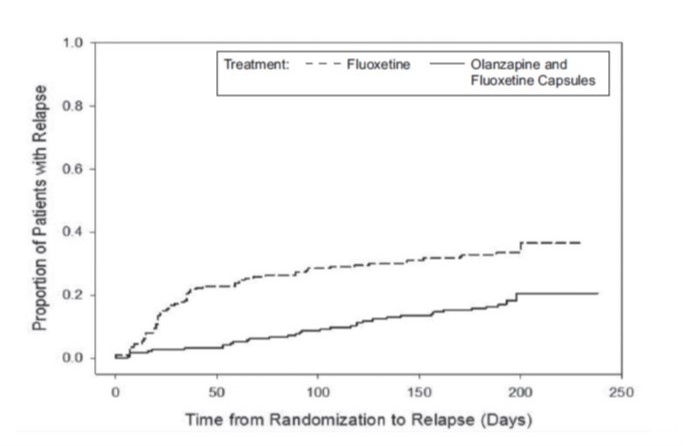
In a 47-week maintenance study in adults with treatment resistant depression, adverse reactions associated with olanzapine and fluoxetine use were generally similar to those seen in short-term studies. Weight gain, hyperlipidemia, and hyperglycemia were observed in olanzapine and fluoxetine-treated patients throughout the study.
Adverse Reactions Occurring at an Incidence of 2% or More in Short-Term Controlled Studies Depressive Episodes Associated with Bipolar 1 Disorder and Treatment Resistant Depression— Table 16 enumerates the treatment-emergent adverse reactions associated with the use of olanzapine and fluoxetine HCl (incidence of at least 2% for olanzapine and fluoxetine HCl and twice or more than for placebo). The olanzapine and fluoxetine HCl -controlled column includes patients with various diagnoses while the placebo column includes only patients with bipolar depression and major depression with psychotic features.
Table 16: Adverse Reactions: Incidence in the Short-Term Controlled Clinical Studies in Adults
System Organ Class | Adverse Reaction | Percentage of Patients Reporting Event |
Olanzapine and Fluoxetine-Controlled (N=771) | Placebo (N=477) |
Eye disorders | Vision blurred | 5 | 2 |
Gastrointestinal disorders | Dry mouth | 15 | 6 |
Flatulence | 3 | 1 |
Abdominal distension | 2 | 0 |
General disorders and administration site conditions | Fatigue | 12 | 2 |
Edema a | 15 | 2 |
Asthenia | 3 | 1 |
Pain | 2 | 1 |
Pyrexia | 2 | 1 |
Infections and infestations | Sinusitis | 2 | 1 |
Investigations | Weight increased | 25 | 3 |
Metabolism and nutrition disorders | Increased appetite | 20 | 4 |
Musculoskeletal and connective tissue disorders | Arthralgia | 4 | 1 |
Pain in extremity | 3 | 1 |
Musculoskeletal stiffness | 2 | 1 |
Nervous system disorders | Somnolence b | 27 | 11 |
Tremor | 9 | 3 |
Disturbance in attention | 5 | 1 |
Psychiatric disorders | Restlessness | 4 | 1 |
Thinking abnormal | 2 | 1 |
Nervousness | 2 | 1 |
Reproductive system and breast disorders | Erectile dysfunction | 2 | 1 |
a. Includes edema, edema peripheral, pitting edema, generalized edema, eyelid edema, face edema, gravitational edema, localized edema, periorbital edema, swelling, joint swelling, swelling face, and eye swelling.
b. Includes somnolence, sedation, hypersomnia, and lethargy.
Extrapyramidal Symptoms
Dystonia, Class Effect for Antipsychotics — Symptoms of dystonia, prolonged abnormal contractions of muscle groups, may occur in susceptible individuals during the first few days of treatment. Dystonic symptoms include: spasm of the neck muscles, sometimes progressing to tightness of the throat, swallowing difficulty, difficulty breathing, and/or protrusion of the tongue. While these symptoms can occur at low doses, the frequency and severity are greater with high potency and at higher doses of first generation antipsychotic drugs. In general, an elevated risk of acute dystonia may be observed in males and younger age groups receiving antipsychotics; however, events of dystonia have been reported infrequently (<1%) with the olanzapine and fluoxetine combination.
Additional Findings Observed in Clinical Studies
Sexual Dysfunction — In the pool of controlled olanzapine and fluoxetine HCl studies in patients with bipolar depression, there were higher rates of the treatment-emergent adverse reactions decreased libido, anorgasmia, erectile dysfunction and abnormal ejaculation in the olanzapine and fluoxetine HCl group than in the placebo group. One case of decreased libido led to discontinuation in the olanzapine and fluoxetine HCl group. In the controlled studies that contained a fluoxetine arm, the rates of decreased libido and abnormal ejaculation in the olanzapine and fluoxetine HCl group were less than the rates in the fluoxetine group. None of the differences were statistically significant. Sexual dysfunction, including priapism, has been reported with all SSRIs. While it is difficult to know the precise risk of sexual dysfunction associated with the use of SSRIs, physicians should routinely inquire about such possible side effects.
There are no adequate and well-controlled studies examining dysfunction with olanzapine and fluoxetine or fluoxetine treatment. Symptoms of sexual dysfunction occasionally persist after discontinuation of fluoxetine treatment.
Difference Among Dose Levels Observed in Other Olanzapine Clinical Trials
In a single 8-week randomized, double-blind, fixed-dose study comparing 10 (N=199), 20 (N=200), and 40 (N=200) mg/day of olanzapine in patients with Schizophrenia or Schizoaffective Disorder, statistically significant differences among 3 dose groups were observed for the following safety outcomes: weight gain, prolactin elevation, fatigue, and dizziness. Mean baseline to endpoint increase in weight (10 mg/day: 1.9 kg; 20 mg/day: 2.3 kg; 40 mg/day: 3 kg) was observed with significant differences between 10 vs 40 mg/day. Incidence of treatment-emergent prolactin elevation >24.2 ng/mL (female) or >18.77 ng/mL (male) at any time during the trial (10 mg/day: 31.2%; 20 mg/day: 42.7%; 40 mg/day: 61.1%) with significant differences between 10 vs 40 mg/day and 20 vs 40 mg/day; fatigue (10 mg/day: 1.5%; 20 mg/day: 2.1%; 40 mg/day: 6.6%) with significant differences between 10 vs 40 and 20 vs 40 mg/day; and dizziness (10 mg/day: 2.6%; 20 mg/day: 1.6%; 40 mg/day: 6.6%) with significant differences between 20 vs 40 mg, was observed.
Other Adverse Reactions Observed in Clinical Studies
Following is a list of treatment-emergent adverse reactions reported by patients treated with olanzapine and fluoxetine HCl in clinical trials. This listing is not intended to include reactions (1) already listed in previous tables or elsewhere in labeling, (2) for which a drug cause was remote, (3) which were so general as to be uninformative, (4) which were not considered to have significant clinical implications, or (5) which occurred at a rate equal to or less than placebo.
Reactions are classified by body system using the following definitions: frequent adverse reactions are those occurring in at least 1/100 patients; infrequent adverse reactions are those occurring in 1/100 to 1/1000 patients; and rare reactions are those occurring in fewer than 1/1000 patients.
Body as a Whole — Frequent: chills, neck rigidity, photosensitivity reaction; Rare: death1.
Cardiovascular System — Frequent: vasodilatation
Digestive System — Frequent: diarrhea; Infrequent: gastritis, gastroenteritis, nausea and vomiting, peptic ulcer; Rare: gastrointestinal hemorrhage, intestinal obstruction, liver fatty deposit, pancreatitis.
Hemic and Lymphatic System — Frequent: ecchymosis; Infrequent: anemia, thrombocytopenia; Rare: leukopenia, purpura.
Metabolic and Nutritional — Frequent: generalized edema, weight loss; Rare: bilirubinemia, creatinine increased, gout.
Musculoskeletal System — Rare: osteoporosis.
Nervous System — Frequent: amnesia; Infrequent: ataxia, buccoglossal syndrome, coma, depersonalization, dysarthria, emotional lability, euphoria, hypokinesia, movement disorder, myoclonus; Rare: hyperkinesia, libido increased, withdrawal syndrome.
Respiratory System — Infrequent: epistaxis, yawn; Rare: laryngismus.
Skin and Appendages — Infrequent: alopecia, dry skin, pruritis; Rare: exfoliative dermatitis.
Special Senses — Frequent: taste perversion; Infrequent: abnormality of accommodation, dry eyes.
Urogenital System — Frequent: breast pain, menorrhagia2, urinary frequency, urinary incontinence; Infrequent: amenorrhea2, female lactation2, hypomenorrhea2, metrorrhagia2, urinary retention, urinary urgency, urination impaired; Rare: breast engorgement2.
1This term represents a serious adverse event but does not meet the definition for adverse drug reactions. It is included here because of its seriousness.
2Adjusted for gender.
Other Adverse Reactions Observed with Olanzapine or Fluoxetine Monotherapy
The following adverse reactions were not observed in olanzapine and fluoxetine HCl -treated patients during premarketing clinical studies but have been reported with olanzapine or fluoxetine monotherapy: aplastic anemia, bruxism, cholestatic jaundice, diabetic coma, dyskinesia, eosinophilic pneumonia 3, erythema multiforme, espohgeal ulcer, gynecological bleeding, headache, hypotension, jaundice, neutropenia, restless legs syndrome, sudden unexpected death3, sweating, and violent behaviors3. Random triglyceride levels of ≥1000 mg/dL have been reported.
3These terms represent serious adverse events but do not meet the definition for adverse drug reactions. They are included here because of their seriousness.
Children andAdolescent Patients(aged10to 17years)witha Diagnosis of Bipolar Depression
The information below is derived from asingle, 8-week, randomized, placebo-controlledclinical trial investigating olanzapine and fluoxetine for thetreatment of bipolarI depression in patients 10 to 17 years of age.
Adverse Reactions Associated with Discontinuation of Treatment in the single pediatric study – Overall, 14% of the 170 patients in the olanzapine and fluoxetine group discontinued to adverse reactions compared to 5.9% of the 85 patients for placebo. Adverse reactions leading to discontinuation associated with the use of olanzapine and fluoxetine ( incidence of a least 1% for olanzapine and fluoxetine and greater than that for placebo) using MedDRA Dictionary coding were weight increased (2.9%), suicidal ideation (1.8), bipolar disorder (1.2%), and somnolence (1.2% ) versus placebo patients which had 0% incidence of weight increased, bipolar disorder, and somnolence, and a 1.2% incidence of suicidal ideation.
Adverse Reactions Occurring at an Incidence of 2% or more and greater than placebo – Table 17 enumerates the treatment emergent adverse reactions associated with the use of olanzapine and fluoxetine (incidence of at least 2% for olanzapine and fluoxetine and twice or more than for placebo).
Table 17: Treatment-Emergent Adverse Reactions: Incidence in a 8-week randomized, double blind, placebo-controlled clinical trial in pediatric bipolar I depression
| System Organ Class | Adverse Reaction | Percentage of Patients Reporting Event |
| Olanzapine and Fluoxetine (N=170) | Placebo (N=85) |
| Nervous system disorders | Somnolence a | 24 | 2 |
| Tremor | 9 | 1 |
| Investigations | Weight Increased | 20 | 1 |
| Blood triglycerides increased | 7 | 2 |
| Blood cholesterol increased | 4 | 0 |
| Hepatic Enzyme increased b | 9 | 1 |
| Gastrointestinal disorders | Dyspepsia | 3 | 1 |
| Metabolism and nutrition disorders | Increased appetite | 17 | 1 |
| Psychiatric disorders | Anxiety | 3 | 1 |
| Restlessness | 3 | 1 |
| Suicidal Ideation | 2 | 1 |
| Musculoskeletal and connective tissue disorders | Back pain | 2 | 1 |
| Injury, poisoning and procedural complications | Accidental overdose | 3 | 1 |
| Reproductive system and breast disorders | Dysmenorrhea | 2 | 0 |
aIncludes somnolence, sedation, and hypersomnia. No lethargy was reported.
bIncludes alanine aminotransferase increased, aspartate aminotransferase increased, hepatic enzyme increased, liver function test abnormal, gamma-glutamyltransferase increased, and transaminases increased.