Budesonide Suspension
Product Images NDC 50090-1467

View Photos of Packaging, Regulatory Labels, and Product Appearance

Product Visual Gallery

This gallery contains 9 technical images submitted to the FDA as part of the official labeling for Budesonide (NDC 50090-1467). Unlike standard consumer photos, these assets often include clinical data figures, molecular chemical structures, and official manufacturer packaging layouts.

As provided by A-s Medication Solutions, these visuals offer a comprehensive scientific overview of the product's physical and chemical identity, aiding pharmacists and researchers in product verification and study.

FDA Label Image

Chemical Structure For Budesonide (Image 1)
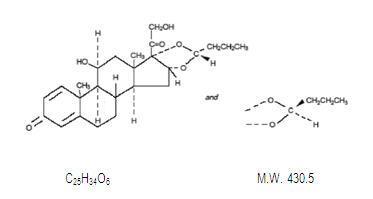
Chemical Structure For Budesonide (Image 1)
Chemical structure diagram of Budesonide showing its molecular formula C25H34O6 and molecular weight 430.5. The structure includes steroid backbone and side groups characteristic of Budesonide.*
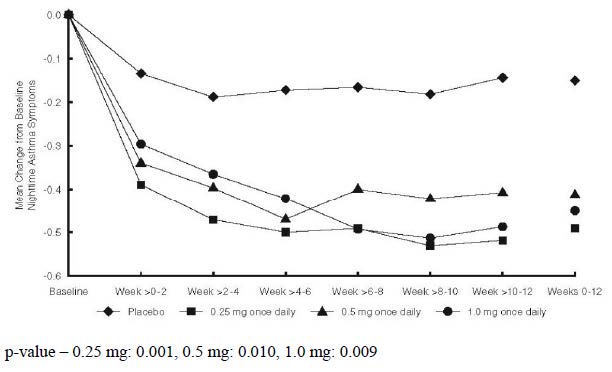
FDA Label Image

1 (Image 2)

1 (Image 2)
A line graph depicting mean change from baseline nighttime asthma symptoms over a 12-week period for placebo and three budesonide dosages (0.25 mg, 0.5 mg, 1.0 mg once daily). The vertical axis represents symptom change, and the horizontal axis represents time intervals. The graph includes p-values for statistical significance of each dosage compared to placebo.*
FDA Label Image

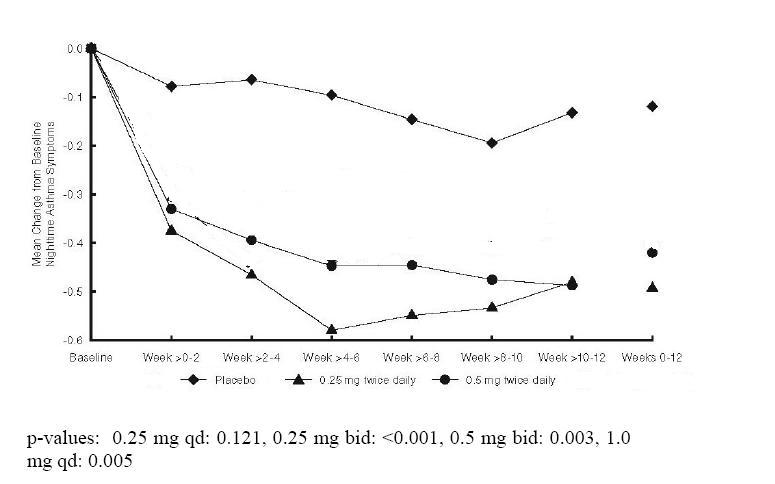
Figure 2: A 12-week Trail In Pediatric Patients (Image 3)

Figure 2: A 12-week Trail In Pediatric Patients (Image 3)
A line graph depicting the mean change from baseline in nighttime asthma symptoms over 12 weeks for three groups: placebo, 0.25 mg twice daily, and 0.5 mg twice daily. The y-axis shows mean change from baseline, and the x-axis tracks time in weeks with data points at baseline and intervals up to week 12. The graph includes p-values for 0.25 mg and 0.5 mg dosages indicating statistical significance.*
FDA Label Image

Figure 3: A 12-week Trail In Pediatric (Image 4)

Figure 3: A 12-week Trail In Pediatric (Image 4)
A line graph depicting the mean change from baseline in nighttime asthma symptoms over weeks 0 to 12. It compares four groups: placebo, 0.25 mg twice daily, 0.5 mg twice daily, and 0.25 mg once daily, showing symptom reduction trends over time. P-values for each dose group versus placebo are noted below.*
FDA Label Image

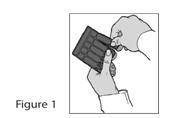
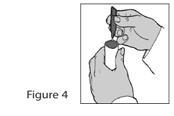
Figure 4 (Image 5)

Figure 4 (Image 5)
Illustration showing a person opening a blister pack of medication by peeling back the foil backing to access the individual capsules or tablets inside.*
FDA Label Image

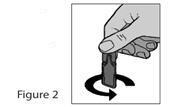
Figure 5 (Image 6)

Figure 5 (Image 6)
An instructional illustration showing a hand holding a small bottle, demonstrating a twisting motion to mix or activate the contents. This figure is likely related to preparation or use instructions for a respiratory inhalation suspension.*
FDA Label Image

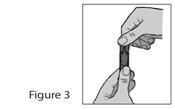
Figure 6 (Image 7)

Figure 6 (Image 7)
An instructional illustration labeled Figure 3 showing a hand using a dropper to dispense liquid into a small container. This image likely demonstrates proper handling or usage technique for a liquid medication suspension such as Budesonide inhalation suspension.*
FDA Label Image

Figure 7 (Image 8)

Figure 7 (Image 8)
An instructional illustration showing a hand holding an inhalation device while another hand dispenses liquid from a dropper or vial above the device. The image indicates proper technique for preparing or using the Budesonide suspension for respiratory inhalation.*
FDA Label Image

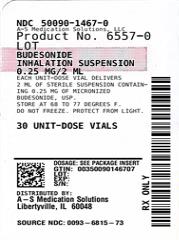
Label Image (Lbl500901467)

Label Image (Lbl500901467)
Budesonide 0.25 mg/2 mL inhalation suspension label from A-S Medication Solutions. The label includes NDC 50090-1467-0, lot number, and states it contains 30 unit-dose vials of 2 mL each. The product is a sterile respiratory suspension requiring refrigeration at 36°F to 46°F and protection from light.*

* About these descriptions: Image descriptions on this page are generated by automated AI analysis of the product label images from the manufacturer's FDA label submission (SPL). They are provided for reference only and may contain errors or omissions. Always rely on the printed label itself and the official FDA labeling, and consult a pharmacist or healthcare professional with any questions about this product.