Progesterone
Product Images NDC 50090-2527

10 FDA label images from A-s Medication Solutions · Packaging, Regulatory Labels, and Product Appearance

Product Visual Gallery

This gallery contains 10 technical images submitted to the FDA as part of the official labeling for Progesterone (NDC 50090-2527). Unlike standard consumer photos, these assets often include clinical data figures, molecular chemical structures, and official manufacturer packaging layouts.

As provided by A-s Medication Solutions, these visuals offer a comprehensive scientific overview of the product's physical and chemical identity, aiding pharmacists and researchers in product verification and study.

FDA Label Image

Label Image (Lbl500902527)
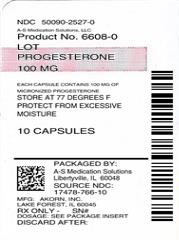
Label Image (Lbl500902527)
Packaging label for Progesterone 100 mg capsules by A-S Medication Solutions. The label includes the product NDC 50090-2527-0, lot number 6608-0, and storage instructions to keep at 77 degrees Fahrenheit, protecting from excessive moisture. The package contains 10 capsules.*
FDA Label Image

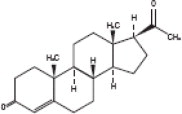
Structural Formula (Pro0g 0003 01)

Structural Formula (Pro0g 0003 01)
Chemical structure diagram of progesterone showing its steroid backbone with four fused rings, various hydrogen atoms, and ketone functional groups. The image highlights the molecular geometry typical of the progesterone hormone.*
FDA Label Image

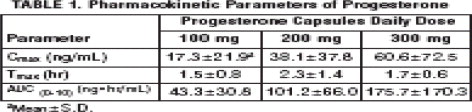
Table 1 (Pro0g 0003 02)

Table 1 (Pro0g 0003 02)
Data table presenting pharmacokinetic parameters of progesterone capsules at daily doses of 100 mg, 200 mg, and 300 mg, including Cmax (ng/mL), Tmax (hours), and AUC (ng·hr/mL) values with associated means and standard deviations.*
FDA Label Image

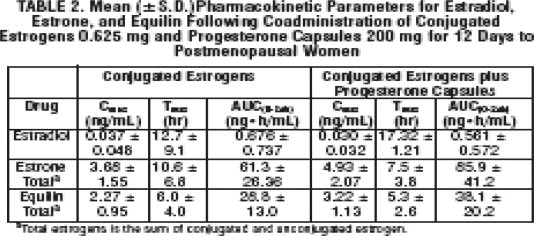
Table 2 (Pro0g 0003 03)

Table 2 (Pro0g 0003 03)
A data table titled 'TABLE 2. Mean (± S.D.) Pharmacokinetic Parameters for Estradiol, Estrone, and Equilin Following Coadministration of Conjugated Estrogens 0.625 mg and Progesterone Capsules 200 mg for 12 Days to Postmenopausal Women.' The table compares pharmacokinetic parameters of conjugated estrogens alone versus combined with progesterone capsules in postmenopausal women. Parameters include Cmax (ng/mL), Tmax (hr), and AUC0-24 hr (ng·h/mL) for Estradiol, Estrone, and Equilin.*
FDA Label Image

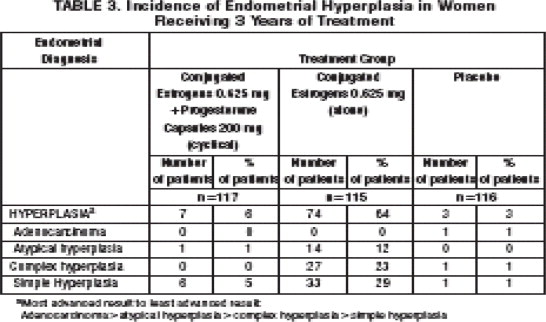
Table 3 (Pro0g 0003 04)

Table 3 (Pro0g 0003 04)
A data table titled 'TABLE 3. Incidence of Endometrial Hyperplasia in Women Receiving 3 Years of Treatment.' It compares the number and percentage of patients with various endometrial diagnoses across three treatment groups: Conjugated Estrogens 0.625 mg alone, Conjugated Estrogens 0.625 mg plus Progesterone Capsules 200 mg cyclically, and Placebo. The table details hyperplasia types including adenocarcinoma, atypical hyperplasia, complex hyperplasia, and simple hyperplasia with patient counts and percentages for each group.*
FDA Label Image

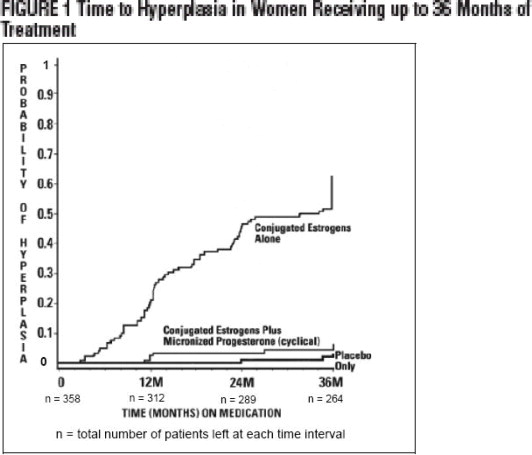
Figure 1 (Pro0g 0003 05)

Figure 1 (Pro0g 0003 05)
A Kaplan-Meier plot showing the probability of hyperplasia in women over 36 months of treatment. The graph compares three groups: Conjugated Estrogens Alone, Conjugated Estrogens Plus Micronized Progesterone (cyclical), and Placebo Only, with time in months on the x-axis and probability of hyperplasia on the y-axis. Patient counts at different intervals are noted below the x-axis.*
FDA Label Image

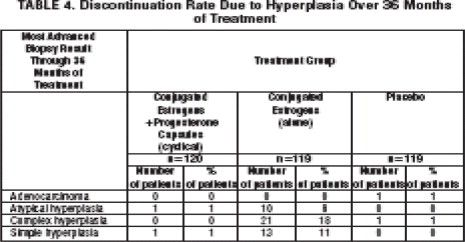
Table 4 (Pro0g 0003 06)

Table 4 (Pro0g 0003 06)
Data table titled 'Discontinuation Rate Due to Hyperplasia Over 36 Months of Treatment' comparing hyperplasia biopsy results among three treatment groups: Conjugated Estrogens plus Progesterone Capsules (cyclic), Conjugated Estrogens (alone), and Placebo, showing number and percentage of patients with atypical hyperplasia, complex hyperplasia, simple hyperplasia, and adenocarcinoma.*
FDA Label Image

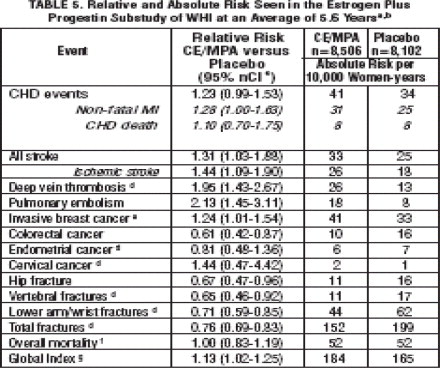
Table 5 (Pro0g 0003 07)

Table 5 (Pro0g 0003 07)
A data table titled 'TABLE 5. Relative and Absolute Risk Seen in the Estrogen Plus Progestin Substudy of WHI at an Average of 5.6 Years.' It presents relative risk, absolute risk per 10,000 woman-years, and 95% confidence intervals for various health events comparing CE/MPA and placebo groups.*
FDA Label Image

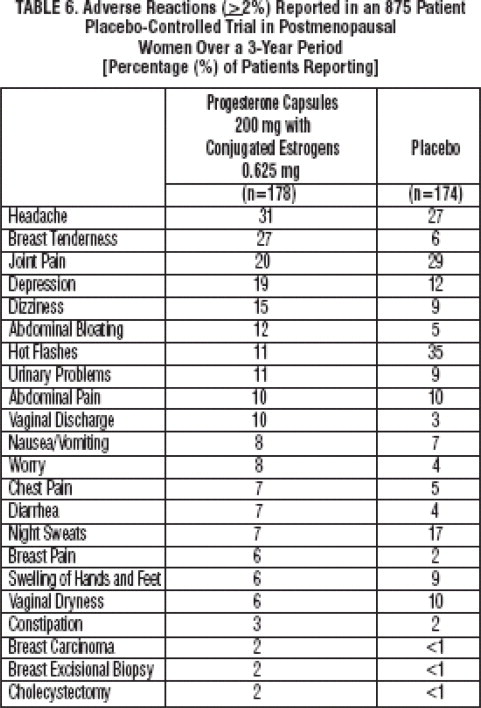
Table 6 (Pro0g 0003 08)

Table 6 (Pro0g 0003 08)
A data table titled 'Adverse Reactions (≥2%) Reported in an 875 Patient Placebo-Controlled Trial in Postmenopausal Women Over a 3-Year Period.' It compares percentage of patients reporting various adverse reactions between Progesterone Capsules 200 mg with Conjugated Estrogens 0.625 mg (n=178) and placebo (n=174). It lists reactions like headache, breast tenderness, joint pain, depression, and others with respective percentages for each group.*
FDA Label Image

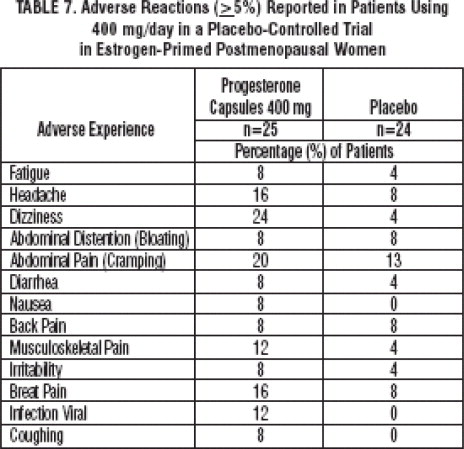
Table 7 (Pro0g 0003 09)

Table 7 (Pro0g 0003 09)
A data table titled 'Adverse Reactions (≥5%) Reported in Patients Using 400 mg/day in a Placebo-Controlled Trial in Estrogen-Primed Postmenopausal Women.' The table compares the percentage of patients experiencing various adverse experiences between progesterone capsules 400 mg (n=25) and placebo (n=24), listing side effects such as fatigue, headache, dizziness, abdominal discomfort, diarrhea, nausea, back pain, musculoskeletal pain, irritability, breast pain, viral infection, and coughing.*

* About these descriptions: Image descriptions on this page are generated by automated AI analysis of the product label images from the manufacturer's FDA label submission (SPL). They are provided for reference only and may contain errors or omissions. Always rely on the printed label itself and the official FDA labeling, and consult a pharmacist or healthcare professional with any questions about this product.