Pradaxa
Product Images NDC 50090-3617

9 FDA label images from A-s Medication Solutions · Packaging, Regulatory Labels, and Product Appearance

Product Visual Gallery

This gallery contains 9 technical images submitted to the FDA as part of the official labeling for Pradaxa (NDC 50090-3617). Unlike standard consumer photos, these assets often include clinical data figures, molecular chemical structures, and official manufacturer packaging layouts.

As provided by A-s Medication Solutions, these visuals offer a comprehensive scientific overview of the product's physical and chemical identity, aiding pharmacists and researchers in product verification and study.

FDA Label Image

Label Image (Lbl500903617)
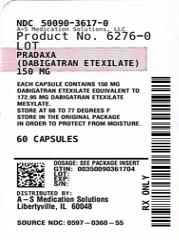
Label Image (Lbl500903617)
Pradaxa 150 mg capsules packaging label from A-S Medication Solutions. The label states each capsule contains 150 mg dabigatran etexilate. It includes storage instructions between 68 to 77 degrees Fahrenheit and warns not to freeze or refrigerate. The label shows a lot number and the product number 6276-0. Package contains 60 capsules with an NDC of 50090-3617-0.*
FDA Label Image

Figure 1 (Pradaxa 01)

Figure 1 (Pradaxa 01)
A forest plot chart showing major bleeding events on treatment plus 2 days comparing Pradaxa 150 mg with Warfarin across various patient subgroups. The horizontal axis represents the hazard ratio with confidence intervals, indicating whether Pradaxa or Warfarin is favored in subgroups such as age, gender, weight, medical history, diabetes status, CHADS2 score, renal function, region, and ASA use at baseline. Each subgroup includes patient counts and event rates for both drugs.*
FDA Label Image

Chemical Structure (Pradaxa 02)

Chemical Structure (Pradaxa 02)
Chemical structure of the active ingredient in Pradaxa, as shown in the image, depicting its molecular arrangement with various rings and functional groups, including a methanesulfonate (CH3SO3H) component.*
FDA Label Image

Figure 2 (Pradaxa 03)

Figure 2 (Pradaxa 03)
Line chart titled 'aPTT Time Course' showing activated partial thromboplastin time (aPTT) in seconds over 96 hours. The graph compares aPTT for different creatinine clearance (CrCl) ranges with Pradaxa dosing instructions for 150 mg BID when CrCl is greater than 30 mL/min and 75 mg BID when CrCl is 30 mL/min or less. Four lines correspond to CrCl ≤ 30 mL/min, > 30 and ≤ 50 mL/min, > 50 and ≤ 80 mL/min, and > 80 mL/min.*
FDA Label Image

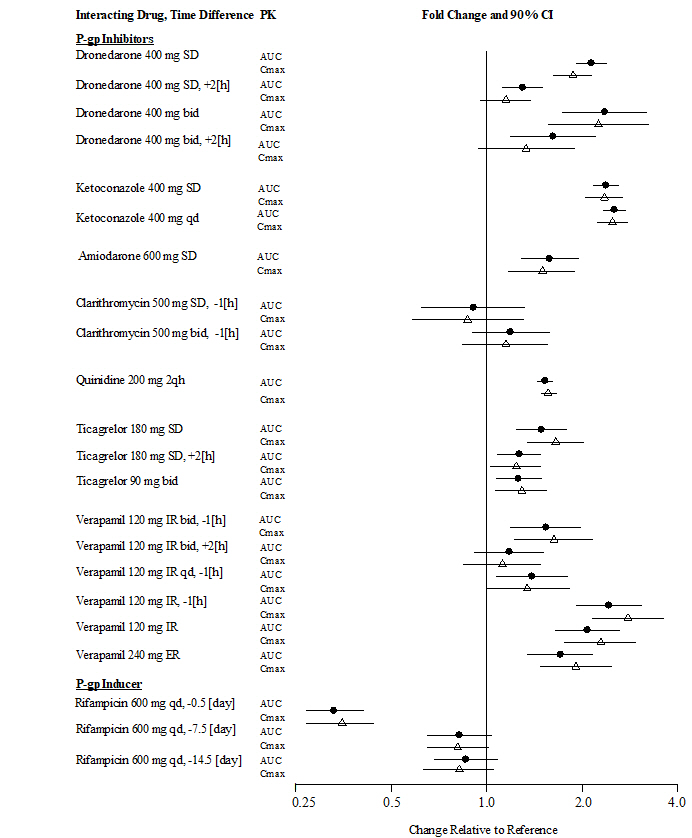
Figure 3.1 (Pradaxa 04)

Figure 3.1 (Pradaxa 04)
A scatter plot showing fold change and 90% confidence intervals for pharmacokinetic parameters (AUC and Cmax) of various interacting drugs relative to a reference. The chart lists P-gp inhibitors (e.g., Dronedarone, Ketoconazole, Amiodarone, Clarithromycin, Quinidine, Ticagrelor, Verapamil) and a P-gp inducer (Rifampicin) with different dosing regimens and time differences. The x-axis represents change relative to reference on a scale of 0.25 to 4.0.*
FDA Label Image

Figure 3.2 (Pradaxa 05)

Figure 3.2 (Pradaxa 05)
A forest plot chart displaying fold changes and 90% confidence intervals for pharmacokinetic parameters (AUC and Cmax) of various interacting drugs relative to a reference. The drugs listed include Atorvastatin, Clopidogrel (at different doses), Diclofenac, Digoxin, Enoxaparin, Pantoprazole, and Ranitidine, with corresponding fold change values plotted along a horizontal axis labeled 'Change Relative to Reference' ranging from 0.5 to 2.0.*
FDA Label Image

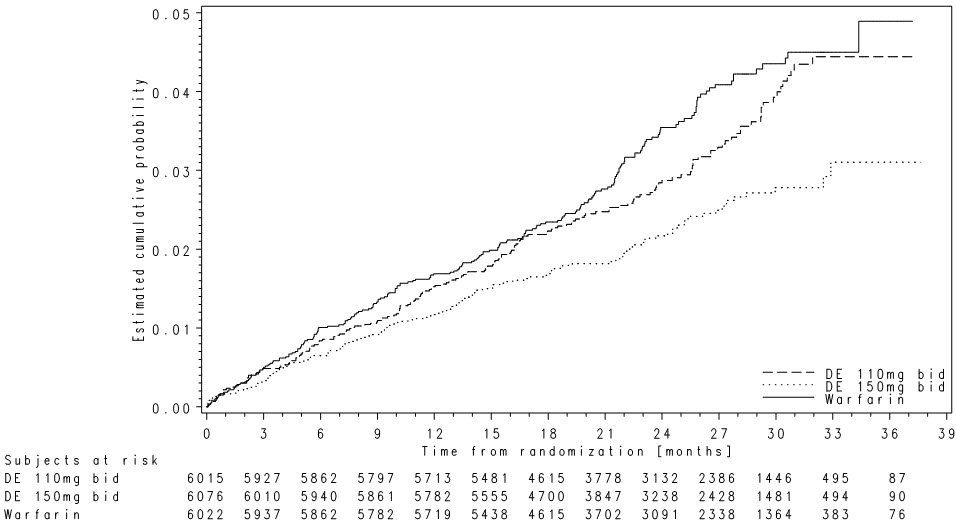
Figure 4 (Pradaxa 06)

Figure 4 (Pradaxa 06)
A line chart showing the estimated cumulative probability over time in months from randomization, comparing three groups: DE 110 mg bid, DE 150 mg bid, and Warfarin. The x-axis represents time from 0 to about 39 months, and the y-axis shows cumulative probability from 0 to 0.05. The chart includes a risk table below indicating the number of subjects at risk for each group at various time points.*
FDA Label Image

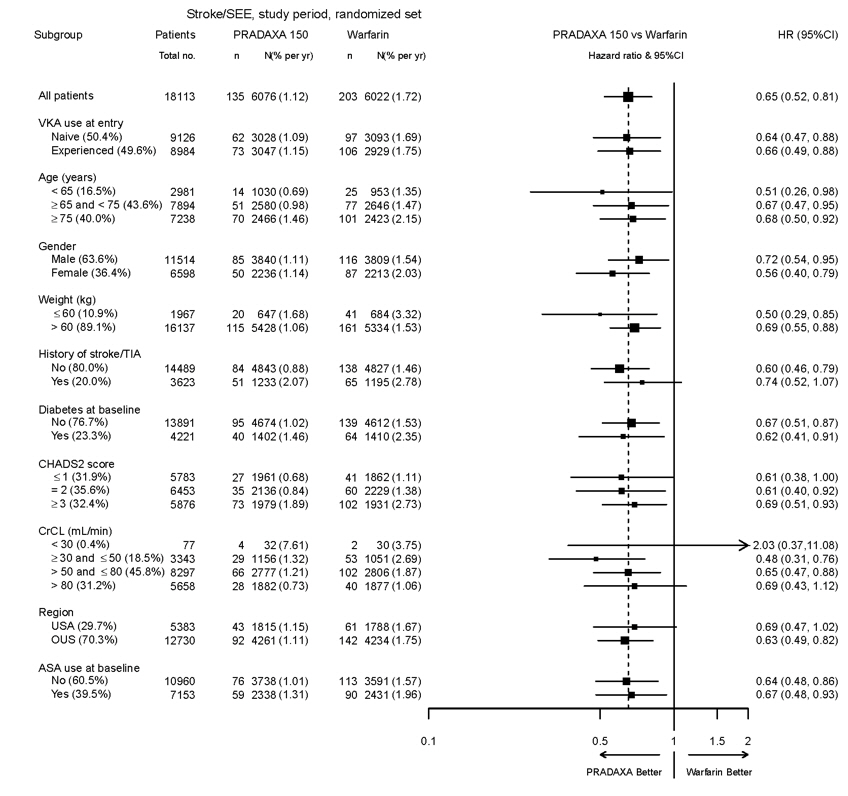
Figure 5 (Pradaxa 07)

Figure 5 (Pradaxa 07)
A forest plot comparing stroke/SEE rates during the study period for PRADAXA 150 mg versus Warfarin across various patient subgroups. Subgroups include age, gender, weight, history of stroke/TIA, diabetes, CHADS2 score, creatinine clearance, geographic region, and use of VKA or ASA at baseline. The graph shows hazard ratios with 95% confidence intervals, indicating comparative risk, with a vertical line marking equal effect between PRADAXA and Warfarin.*
FDA Label Image

Figure (Pradaxa 08)

* About these descriptions: Image descriptions on this page are generated by automated AI analysis of the product label images from the manufacturer's FDA label submission (SPL). They are provided for reference only and may contain errors or omissions. Always rely on the printed label itself and the official FDA labeling, and consult a pharmacist or healthcare professional with any questions about this product.