- patients with severe renal impairment, including those receiving dialysis [see CLINICAL PHARMACOLOGY (12.3) ].
- patients with active liver disease, including those with primary biliary cirrhosis and unexplained persistent liver function abnormalities [see WARNINGS AND PRECAUTIONS (5.3) ].
- patients with preexisting gallbladder disease [see WARNINGS AND PRECAUTIONS (5.5) ].
- nursing mothers [see USE IN SPECIFIC POPULATIONS (8.2)]
- patients with known hypersensitivity to fenofibrate or fenofibric acid [see WARNINGS AND PRECAUTIONS (5.9) ].
There is no specific treatment for overdose with fenofibrate. General supportive care of the patient is indicated, including monitoring of vital signs and observation of clinical status, should an overdose occur. If indicated, elimination of unabsorbed drug should be achieved by emesis or gastric lavage; usual precautions should be observed to maintain the airway. Because fenofibric acid is highly bound to plasma proteins, hemodialysis should not be considered.
Fenofibrate is a lipid regulating agent available as tablets for oral administration. Each tablet contains 48 mg or 145 mg of fenofibrate. The chemical name for fenofibrate is 2-[4-(4-chlorobenzoyl) phenoxy]-2-methyl-propanoic acid, 1-methylethyl ester with the following structural formula:
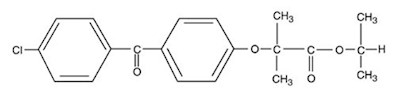
Fenofibrate-molecular Structure (De4b026a 74c1 404f 9055 De1e5b081fc1 01)
The empirical formula is C20H21O4Cl and the molecular weight is 360.83; fenofibrate is insoluble in water. The melting point is 79 to 82°C. Fenofibrate is a white solid which is stable under ordinary conditions.
Inactive Ingredients
Each tablet contains colloidal silicon dioxide, crospovidone, hypromellose, magnesium stearate, lactose monohydrate, polacrillin potassium, sodium lauryl sulphate, and sucrose,
In addition, individual tablets contain:
48 mg tablets
Polyethylene glycol, polyvinyl alcohol, talc, titanium dioxide, yellow iron oxide.
145 mg tablets
Polyethylene glycol, polyvinyl alcohol, talc, titanium dioxide.
Metabolism
Following oral administration, fenofibrate is rapidly hydrolyzed by esterases to the active metabolite, fenofibric acid; no unchanged fenofibrate is detected in plasma.
Fenofibric acid is primarily conjugated with glucuronic acid and then excreted in urine. A small amount of fenofibric acid is reduced at the carbonyl moiety to a benzhydrol metabolite which is, in turn, conjugated with glucuronic acid and excreted in urine.
In vivo metabolism data indicate that neither fenofibrate nor fenofibric acid undergo oxidative metabolism (e.g., cytochrome P450) to a significant extent.
Elimination
After absorption, fenofibrate is mainly excreted in the urine in the form of metabolites, primarily fenofibric acid and fenofibric acid glucuronide. After administration of radiolabelled fenofibrate, approximately 60% of the dose appeared in the urine and 25% was excreted in the feces.
Fenofibric acid is eliminated with a half-life of 20 hours, allowing once daily dosing.
Special Populations
Geriatrics
In elderly volunteers 77 to 87 years of age, the oral clearance of fenofibric acid following a single oral dose of fenofibrate was 1.2 L/h, which compares to 1.1 L/h in young adults. This indicates that a similar dosage regimen can be used in elderly with normal renal function, without increasing accumulation of the drug or metabolites [see DOSAGE AND ADMINISTRATION (2.5) and USE IN SPECIFIC POPULATIONS (8.5)].
Pediatrics
The pharmacokinetics of fenofibrate has not been studied in pediatric populations.
Gender
No pharmacokinetic difference between males and females has been observed for fenofibrate.
Race
The influence of race on the pharmacokinetics of fenofibrate has not been studied, however fenofibrate is not metabolized by enzymes known for exhibiting inter-ethnic variability.
Renal Impairment
The pharmacokinetics of fenofibric acid was examined in patients with mild, moderate, and severe renal impairment. Patients with severe renal impairment (estimated glomerular filtration rate [eGFR] < 30 mL/min/1.73 m2) showed 2.7-fold increase in exposure for fenofibric acid and increased accumulation of fenofibric acid during chronic dosing compared to that of healthy subjects. Patients with mild to moderate renal impairment (eGFR 30 to 59 mL/min/1.73 m2) had similar exposure but an increase in the half-life for fenofibric acid compared to that of healthy subjects. Based on these findings, the use of fenofibrate should be avoided in patients who have severe renal impairment and dose reduction is required in patients having mild to moderate renal impairment [see DOSAGE AND ADMINISTRATION (2.4)].
Hepatic Impairment
No pharmacokinetic studies have been conducted in patients with hepatic impairment.
Drug-drug Interactions
In vitro studies using human liver microsomes indicate that fenofibrate and fenofibric acid are not inhibitors of cytochrome (CYP) P450 isoforms CYP3A4, CYP2D6, CYP2E1, or CYP1A2. They are weak inhibitors of CYP2C8, CYP2C19 and CYP2A6, and mild-to-moderate inhibitors of CYP2C9 at therapeutic concentrations.
Table 2 describes the effects of co-administered drugs on fenofibric acid systemic exposure. Table 3 describes the effects of co-administered fenofibrate or fenofibric acid on other drugs.
Table 2: Effects of Co-Administered Drugs on Fenofibric Acid Systemic Exposure from Fenofibrate AdministrationCo-Administered Drug
| Dosage Regimen of Co-Administered Drug
| Dosage Regimen of Fenofibrate
| Changes in Fenofibric Acid Exposure
|
|
|
| AUC
| Cmax
|
Lipid-lowering agents
|
Atorvastatin
| 20 mg once daily for 10 days
| Fenofibrate 160 mg Fenofibrate oral tablet once daily for 10 days
| ↓2%
| ↓4%
|
Pravastatin
| 40 mg as a single dose
| Fenofibrate 3 x 67 mg Fenofibrate oral micronized capsule as a single dose
| ↓1%
| ↓2%
|
Fluvastatin
| 40 mg as a single dose
| Fenofibrate 160 mg as a single dose
| ↓2%
| ↓10%
|
Anti-diabetic agents
|
Glimepiride
| 1 mg as a single dose
| Fenofibrate 145 mg once daily for 10 days
| ↑1%
| ↓1%
|
Metformin
| 850 mg three times daily for 10 days
| Fenofibrate 54 mg three times daily for 10 days
| ↓9%
| ↓6%
|
Rosiglitazone
| 8 mg once daily for 5 days
| Fenofibrate 145 mg once daily for 14 days
| ↑10%
| ↑3%
|
Table 3: Effects of Fenofibrate Co-Administration on Systemic Exposure of Other DrugsDosage Regimen of Fenofibrate
| Dosage Regimen of Co-Administered Drug
| Changes in Co-Administered Drug Exposure
|
|
| Analyte
| AUC
| Cmax
|
Lipid-lowering agents
|
| Fenofibrate 160 mg Fenofibrate oral tablet once daily for 10 days
| Atorvastatin, 20 mg once daily for 10 days
| Atorvastatin
|
↓17%
| 0%
|
| Fenofibrate 3 x 67 mg Fenofibrate oral micronized capsule as a single dose
| Pravastatin, 40 mg as a single dose
| Pravastatin
3α-Hydroxyl-iso-pravastatin
| ↑13%
↑26%
| ↑13%
↑29%
|
Fenofibrate 160 mg as a single dose
| Fluvastatin, 40 mg as a single dose
| (+)-3R, 5S-
Fluvastatin
|
↑15%
|
↑16%
|
Anti-diabetic agents
|
Fenofibrate 145 mg once daily for 10 days
| Glimepiride, 1 mg as a single dose
| Glimepiride
|
↑35%
|
↑18%
|
Fenofibrate 54 mg three times daily for 10 days
| Metformin, 850 mg three times daily for 10 days
| Metformin
|
↑3%
|
↑6%
|
Fenofibrate 145 mg once daily for 14 days
| Rosiglitazone, 8 mg once daily for 5 days
| Rosiglitazone
|
↑6%
|
↓1%
|
In a subset of the subjects, measurements of apo B were conducted. Fenofibrate treatment significantly reduced apo B from baseline to endpoint as compared with placebo (-25.1% vs. 2.4%, p < 0.0001, n=213 and 143 respectively).

