Clinical Experience from Dose Finding Studies in Type 2 Diabetes Mellitus Patients on Dietary Treatment Only: Results from six controlled, fixed-dose, monotherapy studies of acarbose in the treatment of type 2 diabetes mellitus, involving 769 acarbose-treated patients, were combined and a weighted average of the difference from placebo in the mean change from baseline in glycosylated hemoglobin (HbA1c) was calculated for each dose level as presented below:
Table Mean Placebo-Subtracted Change in HbA1c in Fixed-Dose Monotherapy StudiesDose of acarbose Acarbose was statistically significantly different from placebo at all doses. Although there were no statistically significant differences among the mean results for doses ranging from 50 to 300 mg t.i.d., some patients may derive benefit by increasing the dosage from 50 to 100 mg t.i.d. * | N | Change in HbA1c % | |
| 110 | -0.44 | |
| 131 | -0.77 | |
| 244 | -0.74 | |
| 231 | -0.86 | |
| 53 | -1.00 | |
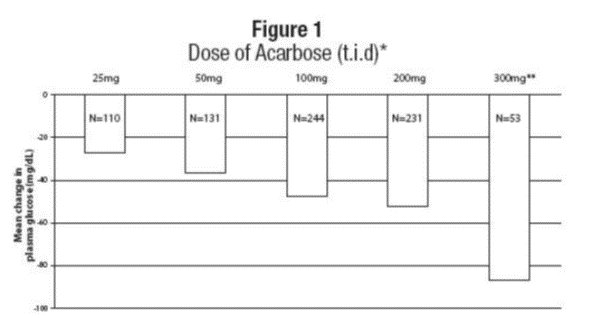
Results from these six fixed-dose, monotherapy studies were also combined to derive a weighted average of the difference from placebo in mean change from baseline for one-hour postprandial plasma glucose levels as shown in the following figure:
* Acarbose was statistically significantly different from placebo at all doses with respect to effect on one-hour postprandial plasma glucose.
**The 300 mg t.i.d. acarbose regimen was superior to lower doses, but there were no statistically significant differences from 50 to 200 mg t.i.d.
Clinical Experience in Type 2 Diabetes Mellitus Patients on Monotherapy, or in Combination with Sulfonylureas, Metformin or Insulin: acarbose was studied as monotherapy and as combination therapy to sulfonylurea, metformin, or insulin treatment. The treatment effects on HbA1c levels and one-hour postprandial glucose levels are summarized for four placebo-controlled, double-blind, randomized studies conducted in the United States in Tables 2 and 3, respectively. The placebo-subtracted treatment differences, which are summarized below, were statistically significant for both variables in all of these studies.
Study 1 (n=109) involved patients on background treatment with diet only. The mean effect of the addition of acarbose to diet therapy was a change in HbA1c of -0.78%, and an improvement of one-hour postprandial glucose of -74.4 mg/dL.
In Study 2 (n=137), the mean effect of the addition of acarbose to maximum sulfonylurea therapy was a change in HbA1c of -0.54%, and an improvement of one-hour postprandial glucose of -33.5 mg/dL.
In Study 3 (n=147), the mean effect of the addition of acarbose to maximum metformin therapy was a change in HbA1c of -0.65%, and an improvement of one-hour postprandial glucose of -34.3 mg/dL.
Study 4 (n=145) demonstrated that acarbose added to patients on background treatment with insulin resulted in a mean change in HbA1c of -0.69%, and an improvement of one-hour postprandial glucose of -36.0 mg/dL.
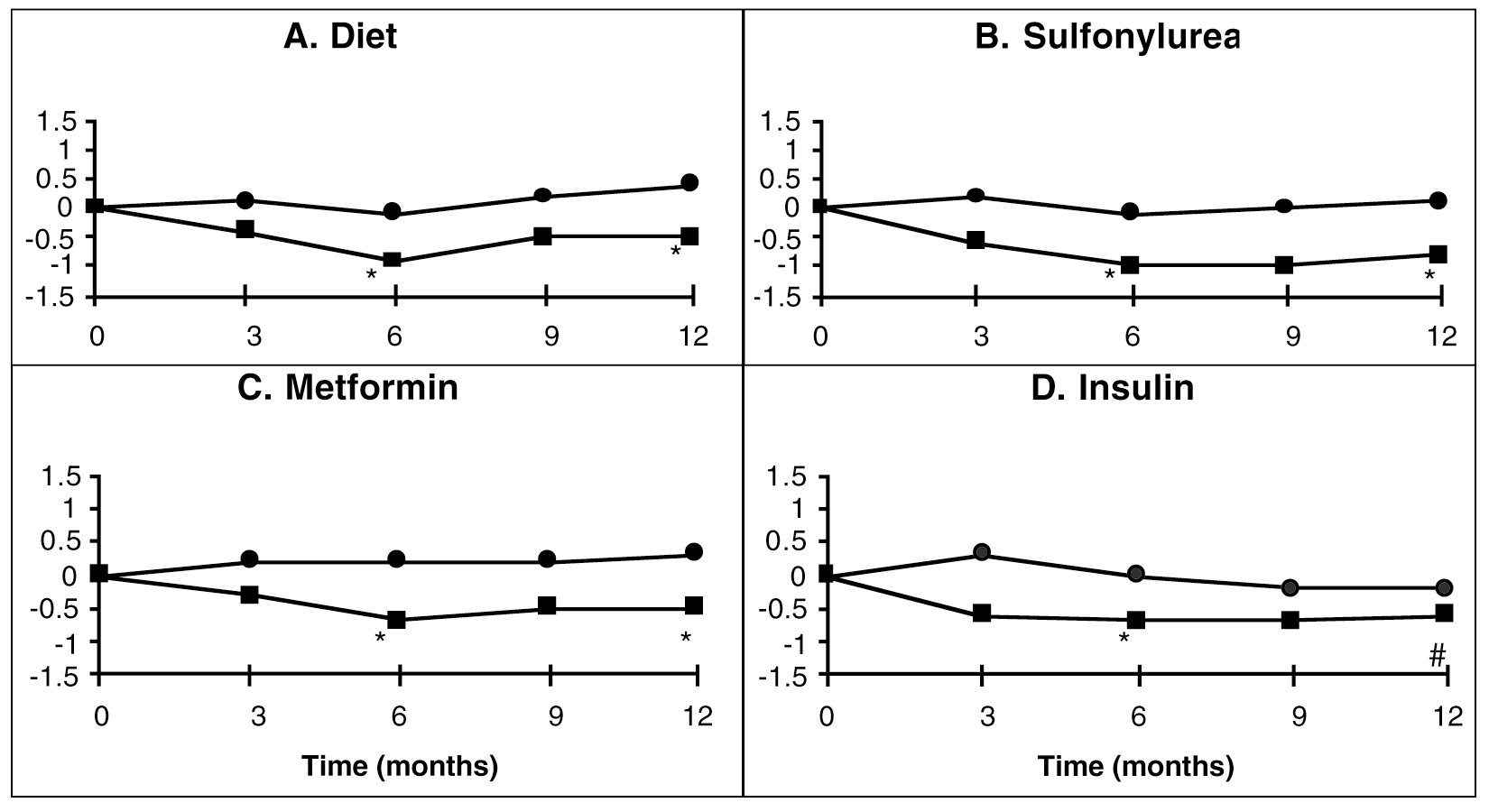
A one year study of acarbose as monotherapy or in combination with sulfonylurea, metformin or insulin treatment was conducted in Canada in which 316 patients were included in the primary efficacy analysis (Figure 2). In the diet, sulfonylurea and metformin groups, the mean decrease in HbA1c produced by the addition of acarbose was statistically significant at six months, and this effect was persistent at one year. In the acarbose-treated patients on insulin, there was a statistically significant reduction in HbA1c at six months, and a trend for a reduction at one year.
Table : Effect of Acarbose on HbA1c | | HbA1c (%) HbA1c Normal Range: 4–6% | |
Study | | Mean | Mean change | Treatment | p-Value |
| | Baseline | from baseline After four months treatment in Study 1, and six months in Studies 2, 3, and 4 | Difference | |
1 | | 8.67 | +0.33 | | — |
| | 8.69 | -0.45 | | 0.0001 |
| | | | | |
2 | | 9.56 | +0.24 | | — |
| | 9.64 | -0.30 | | 0.0096 |
| | | | | |
3 | | 8.17 | +0.08 g | | — |
| - acarbose 50–100 mg t.i.d.
| 8.46 | -0.57 g | | 0.0001 |
| | | | | |
4 | | 8.69 | +0.11 | | — |
| - acarbose 50–100 mg t.i.d.
| 8.77 | -0.58 | | 0.0001 |
| | | | | |
Table : Effect of Acarbose on Postprandial Glucose | | One-Hour Postprandial Glucose (mg/dL) | |
Study | | Mean | Mean change | Treatment | p-Value |
| | Baseline | from baseline After four months treatment in Study 1, and six months in Studies 2, 3, and 4 | Difference | |
1 | | 297.1 | +31.8 | — | — |
| | 299.1 | -42.6 | -74.4 | 0.0001 |
| | | | | |
2 | | 308.6 | +6.2 | — | — |
| | 311.1 | -27.3 | -33.5 | 0.0017 |
| | | | | |
3 | | 263.9 | +3.3 Results are adjusted to a common baseline of 273 mg/dL | — | — |
| - acarbose 50–100 mg t.i.d.
| 283.0 | -31.0 | -34.3 | 0.0001 |
| | | | | |
4 | | 279.2 | +8.0 | — | — |
| - acarbose 50–100 mg t.i.d.
| 277.8 | -28.0 | -36.0 | 0.0178 |
| | | | | |
Figure 2
Figure 2: Effects of Acarbose ( ■ ) and Placebo ( ● ) on mean change in HbA1c levels from baseline throughout a one-year study in patients with type 2 diabetes mellitus when used in combination with: (A) diet alone; (B) sulfonylurea; (C) metformin; or (D) insulin. Treatment differences at 6 and 12 months were tested: * p < 0.01; # p = 0.077.