Finasteride Tablets, USP is generally well tolerated; adverse reactions usually have been mild and transient.
4-Year Placebo-Controlled Study (A Long-Term Efficacy and Safety Study)
In A Long-Term Efficacy and Safety Study, 1524 patients treated with Finasteride Tablets, USP and 1516 patients treated with placebo were evaluated for safety over a period of 4 years. The most frequently reported adverse reactions were related to sexual function. 3.7% (57 patients) treated with Finasteride Tablets, USP and 2.1% (32 patients) treated with placebo discontinued therapy as a result of adverse reactions related to sexual function, which are the most frequently reported adverse reactions.
Table 1 presents the only clinical adverse reactions considered possibly, probably or definitely drug related by the investigator, for which the incidence on Finasteride Tablets, USP was ≥1% and greater than placebo over the 4 years of the study. In years 2 to 4 of the study, there was no significant difference between treatment groups in the incidences of impotence, decreased libido and ejaculation disorder.
Table 1: Drug-Related Adverse Experiences
|
| Year 1
(%)
| Years 2, 3 and 4*(%)
|
Finasteride
| Placebo
| Finasteride
| Placebo
|
Impotence
| 8.1
| 3.7
| 5.1
| 5.1
|
Decreased Libido
| 6.4
| 3.4
| 2.6
| 2.6
|
Decreased Volume of Ejaculate
| 3.7
| 0.8
| 1.5
| 0.5
|
Ejaculation Disorder
| 0.8
| 0.1
| 0.2
| 0.1
|
Breast Enlargement
| 0.5
| 0.1
| 1.8
| 1.1
|
Breast Tenderness
| 0.4
| 0.1
| 0.7
| 0.3
|
Rash
| 0.5
| 0.2
| 0.5
| 0.1
|
*Combined Years 2 to 4
N = 1524 and 1516, finasteride vs placebo, respectively
Phase III Studies and 5-Year Open Extensions
The adverse experience profile in the 1-year, placebo-controlled, Phase III studies, the 5-year open extensions, and A Long-Term Efficacy and Safety Study were similar.
Medical Therapy of Prostatic Symptoms (MTOPS) Study
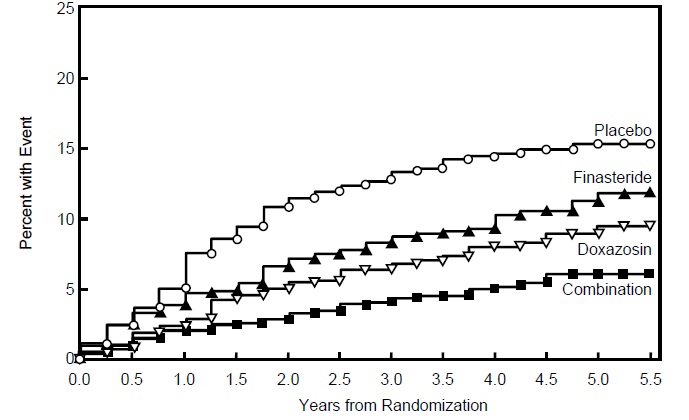
In the MTOPS study, 3047 men with symptomatic BPH were randomized to receive Finasteride Tablets, USP 5 mg/day (n=768), doxazosin 4 or 8 mg/day (n=756), the combination of Finasteride Tablets, USP 5 mg/day and doxazosin 4 or 8 mg/day (n=786), or placebo (n=737) for 4 to 6 years. [See Clinical Studies (14.2).]
The incidence rates of drug-related adverse experiences reported by ≥2% of patients in any treatment group in the MTOPS Study are listed in Table 2.
The individual adverse effects which occurred more frequently in the combination group compared to either drug alone were:
asthenia, postural hypotension, peripheral edema, dizziness, decreased libido, rhinitis, abnormal ejaculation, impotence and abnormal sexual function (see Table 2). Of these, the incidence of abnormal ejaculation in patients receiving combination therapy was comparable to the sum of the incidences of this adverse experience reported for the two monotherapies.
Combination therapy with finasteride and doxazosin was associated with no new clinical adverse experience.
Four patients in MTOPS reported the adverse experience breast cancer. Three of these patients were on finasteride only and one was on combination therapy. [See Long Term Data.]
The MTOPS Study was not specifically designed to make statistical comparisons between groups for reported adverse experiences. In addition, direct comparisons of safety data between the MTOPS study and previous studies of the single agents may not be appropriate based upon differences in patient population, dosage or dose regimen, and other procedural and study design elements.
| Adverse Experience | Placebo
(N=737)
(%) | Doxazosin
4 mg or
8 mg*
(N=756)
(%) | Finasteride
(N=768)
(%) | Combination
(N=786)
(%) |
|---|
Table 2:
Incidence ≥2% in One or More Treatment Groups
Drug-Related Clinical Adverse Experiences in MTOPS |
Body as a whole
|
Asthenia
| 7.1
| 15.7
| 5.3
| 16.8
|
Headache
| 2.3
| 4.1
| 2.0
| 2.3
|
Cardiovascular
|
Hypotension
| 0.7
| 3.4
| 1.2
| 1.5
|
Postural Hypotension
| 8.0
| 16.7
| 9.1
| 17.8
|
Metabolic and Nutritional
|
Peripheral Edema
| 0.9
| 2.6
| 1.3
| 3.3
|
Nervous
|
Dizziness
| 8.1
| 17.7
| 7.4
| 23.2
|
Libido Decreased
| 5.7
| 7.0
| 10.0
| 11.6
|
Somnolence
| 1.5
| 3.7
| 1.7
| 3.1
|
Respiratory
|
Dyspnea
| 0.7
| 2.1
| 0.7
| 1.9
|
Rhinitis
| 0.5
| 1.3
| 1.0
| 2.4
|
Urogenital
|
Abnormal Ejaculation
| 2.3
| 4.5
| 7.2
| 14.1
|
Gynecomastia
| 0.7
| 1.1
| 2.2
| 1.5
|
Impotence
| 12.2
| 14.4
| 18.5
| 22.6
|
Sexual Function Abnormal
| 0.9
| 2.0
| 2.5
| 3.1
|
* Doxazosin dose was achieved by weekly titration (1 to 2 to 4 to 8 mg). The final tolerated dose (4 mg or 8 mg) was administered at end-Week 4. Only those patients tolerating at least 4 mg were kept on doxazosin. The majority of patients received the 8-mg dose over the duration of the study.
Long-Term Data
High-Grade Prostate Cancer
The PCPT trial was a 7-year randomized, double-blind, placebo-controlled trial that enrolled 18,882 men ≥55 years of age with a normal digital rectal examination and a PSA ≤3.0 ng/mL. Men received either Finasteride Tablets, USP 5 mg or placebo daily. Patients were evaluated annually with PSA and digital rectal exams. Biopsies were performed for elevated PSA, an abnormal digital rectal exam, or the end of study. The incidence of Gleason score 8 to 10 prostate cancer was higher in men treated with finasteride (1.8%) than in those treated with placebo (1.1%) [see Indications and Usage (1.3) and Warnings and Precautions (5.2)]. In a 4-year placebo-controlled clinical trial with another 5α-reductase inhibitor (dutasteride, AVODART), similar results for Gleason score 8 to 10 prostate cancer were observed (1% dutasteride vs 0.5% placebo).
No clinical benefit has been demonstrated in patients with prostate cancer treated with Finasteride Tablets, USP.
Breast Cancer
During the 4- to 6-year placebo- and comparator-controlled MTOPS study that enrolled 3047 men, there were 4 cases of breast cancer in men treated with finasteride but no cases in men not treated with finasteride. During the 4-year, placebo-controlled A Long-Term Efficacy and Safety Study study that enrolled 3040 men, there were 2 cases of breast cancer in placebo-treated men but no cases in men treated with finasteride. During the 7-year placebo-controlled Prostate Cancer Prevention Trial (PCPT) that enrolled 18,882 men, there was 1 case of breast cancer in men treated with finasteride, and 1 case of breast cancer in men treated with placebo. The relationship between long-term use of finasteride and male breast neoplasia is currently unknown.
Sexual Function
There is no evidence of increased sexual adverse experiences with increased duration of treatment with Finasteride Tablets, USP. New reports of drug-related sexual adverse experiences decreased with duration of therapy.