Nuvaring Insert, Extended Release
Product Images NDC 50090-5611

View Photos of Packaging, Regulatory Labels, and Product Appearance

Product Visual Gallery

This gallery contains 13 technical images submitted to the FDA as part of the official labeling for Nuvaring (NDC 50090-5611). Unlike standard consumer photos, these assets often include clinical data figures, molecular chemical structures, and official manufacturer packaging layouts.

As provided by A-s Medication Solutions, these visuals offer a comprehensive scientific overview of the product's physical and chemical identity, aiding pharmacists and researchers in product verification and study.

FDA Label Image

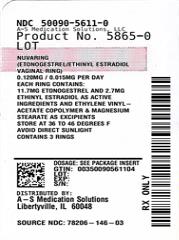
Label Image (Lbl500905611)
Label Image (Lbl500905611)
Label of NUVARING vaginal insert, extended release, containing etonogestrel and ethinyl estradiol with strengths .12 mg/d and .015 mg/d. The label includes storage instructions, lot and product numbers, manufacturer A-S Medication Solutions, and cautions to avoid direct sunlight and store at 36 to 46 degrees Fahrenheit.*
FDA Label Image

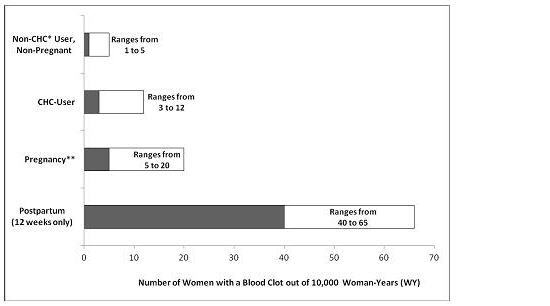
Figure 1 (Nuvaring 01)

Figure 1 (Nuvaring 01)
A horizontal bar chart showing the number of women with a blood clot out of 10,000 woman-years (WY) for different groups: Non-CHC users, CHC users, pregnant women, and postpartum women (12 weeks only). The chart indicates risk ranges for each group, with postpartum women having the highest range (40 to 65), followed by pregnant women (5 to 20), CHC users (3 to 12), and Non-CHC users (1 to 5).*
FDA Label Image

Chemical Structure (Nuvaring 02)

Chemical Structure (Nuvaring 02)
Chemical structures of the active ingredients etonogestrel and ethinyl estradiol as shown in the NUVARING product label. Each structure includes molecular formulas: C22H28O2 for etonogestrel and C20H24O2 for ethinyl estradiol.*
FDA Label Image

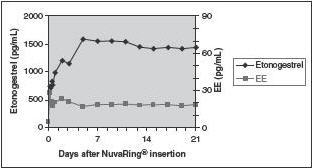
Figure 2 (Nuvaring 03)

Figure 2 (Nuvaring 03)
A line graph showing plasma concentrations over 21 days after NuvaRing insertion. The graph plots etonogestrel levels (pg/mL) on the left y-axis, with values rising and stabilizing around 1500 pg/mL, and ethinyl estradiol (EE) levels (pg/mL) on the right y-axis, remaining steady near 20 pg/mL. The x-axis represents days after insertion.*
FDA Label Image

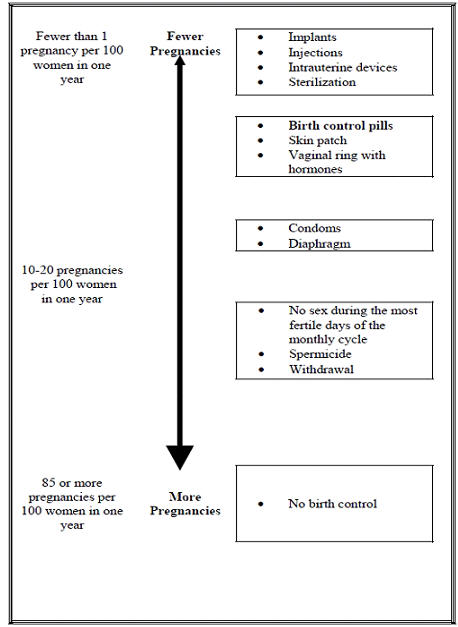
Figure 3 (Nuvaring 04)

Figure 3 (Nuvaring 04)
A diagram illustrating the effectiveness of various birth control methods based on the average number of pregnancies per 100 women in one year. Effectiveness ranges from fewer than 1 pregnancy to 85 or more, listing highly effective methods like implants, injections, intrauterine devices, and sterilization at the top, followed by birth control pills, skin patches, and vaginal rings with hormones, then condoms and diaphragms, methods involving behavioral changes such as abstinence during fertile days, spermicide, withdrawal, and lastly no birth control resulting in the highest pregnancy rate.*
FDA Label Image

Figure 4 (Nuvaring 05)

Figure 4 (Nuvaring 05)
A horizontal bar chart comparing the number of women with a blood clot per 10,000 woman-years (WY) across four groups: Non-CHC users/non-pregnant, CHC users, pregnant women, and postpartum women (12 weeks only). Each bar is divided to show ranges of blood clot occurrences for the respective groups.*
FDA Label Image

Figure A, Figure B, Figure C (Nuvaring 06)

Figure A, Figure B, Figure C (Nuvaring 06)
Instructional diagram with three grayscale illustrations showing different body positions for inserting NuvaRing vaginal insert: lying down (Figure A), squatting (Figure B), and resting one foot on a raised surface (Figure C). Each figure depicts a woman demonstrating a different posture to facilitate product use.*
FDA Label Image

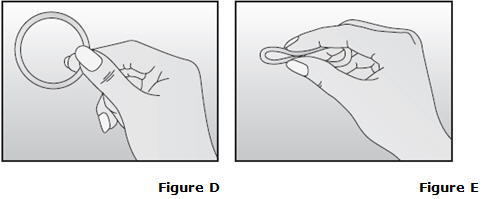
Figure D, Figure E (Nuvaring 07)

Figure D, Figure E (Nuvaring 07)
Illustrations showing hands holding a vaginal contraceptive device. Figure D depicts a hand holding a ring by a finger and thumb, while Figure E shows a hand pinching the ring in a loop, demonstrating how to handle or insert the NUVARING vaginal insert.*
FDA Label Image

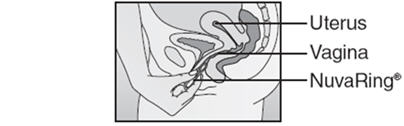
Figure F (Nuvaring 08)

Figure F (Nuvaring 08)
An anatomical illustration showing the female reproductive tract in a sagittal view, with labels indicating the uterus, vagina, and the position of a NuvaRing vaginal insert placed inside the vagina.*
FDA Label Image

Figure G (Nuvaring 09)

Figure G (Nuvaring 09)
An instructional anatomical illustration depicting the insertion of the NUVARING contraceptive vaginal ring. The diagram shows a hand positioning the ring inside the vaginal canal, highlighting the correct placement for use.*
FDA Label Image

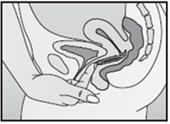
Figure H (Nuvaring 10)

Figure H (Nuvaring 10)
An anatomical diagram illustrating the female pelvic region showing the placement of a vaginal insert, likely representing the NUVARING contraceptive device positioned inside the vagina.*
FDA Label Image

Figure I (Nuvaring 11)

Figure I (Nuvaring 11)
An anatomical illustration showing the female pelvic region in a cross-sectional view, detailing the positioning of an intravaginal insert within the vaginal canal. The diagram highlights the placement relevant to vaginal drug delivery products like NuvaRing.*
FDA Label Image

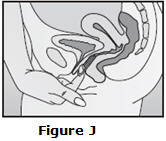
Figure J (Nuvaring 12)

Figure J (Nuvaring 12)
An instructional diagram showing the vaginal insertion of NUVARING, an extended release etonogestrel and ethinyl estradiol insert. The grayscale illustration depicts a hand placing the ring into the vaginal canal, demonstrating correct placement.*

* About these descriptions: Image descriptions on this page are generated by automated AI analysis of the product label images from the manufacturer's FDA label submission (SPL). They are provided for reference only and may contain errors or omissions. Always rely on the printed label itself and the official FDA labeling, and consult a pharmacist or healthcare professional with any questions about this product.