Clopidogrel Tablet
Product Images NDC 50090-5781

View Photos of Packaging, Regulatory Labels, and Product Appearance

Product Visual Gallery

This gallery contains 11 technical images submitted to the FDA as part of the official labeling for Clopidogrel (NDC 50090-5781). Unlike standard consumer photos, these assets often include clinical data figures, molecular chemical structures, and official manufacturer packaging layouts.

As provided by A-s Medication Solutions, these visuals offer a comprehensive scientific overview of the product's physical and chemical identity, aiding pharmacists and researchers in product verification and study.

FDA Label Image

189 (Clopidogrel Fig 3)
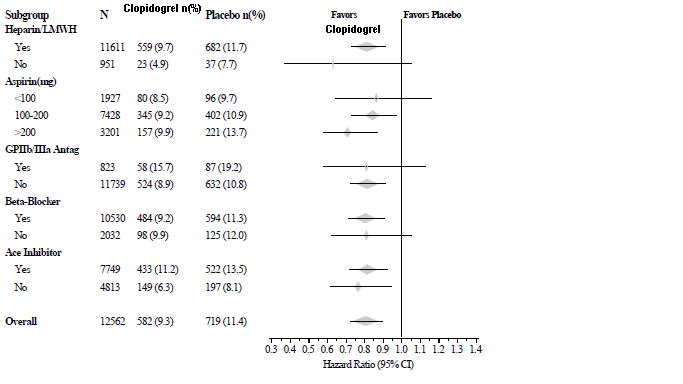
189 (Clopidogrel Fig 3)
A forest plot comparing the hazard ratios of Clopidogrel versus placebo across different patient subgroups including Heparin/LMWH, Aspirin dosage, GPIIb/IIIa antagonist use, Beta-blocker use, and ACE inhibitor use. The plot displays numerical counts and percentages for each group, with point estimates and 95% confidence intervals indicating the relative risk favoring either Clopidogrel or placebo.*
FDA Label Image

Figure-1 (Clopidogrel Figure 01)

Figure-1 (Clopidogrel Figure 01)
A horizontal error bar chart showing the effect of co-administered proton pump inhibitors (PPI) Dexlansoprazole (60 mg), Lansoprazole (30 mg), Pantoprazole (80 mg), and Omeprazole (80 mg) on the active metabolite AUC of Clopidogrel. The x-axis represents change relative to Clopidogrel administered alone, ranging from 0.4 to 1.4, with mean values and 90% confidence intervals for each PPI.*
FDA Label Image

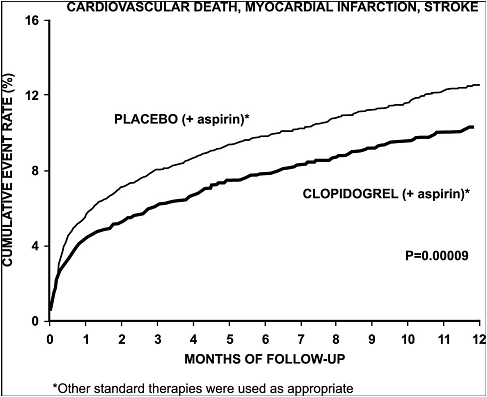
Figure-2 (Clopidogrel Figure 02)

Figure-2 (Clopidogrel Figure 02)
A line graph depicting cumulative event rates (%) of cardiovascular death, myocardial infarction, and stroke over 12 months of follow-up. It compares two groups: one receiving placebo plus aspirin and the other receiving clopidogrel plus aspirin. The graph shows a lower cumulative event rate in the clopidogrel plus aspirin group compared to the placebo plus aspirin group, with a statistically significant p-value of 0.00009.*
FDA Label Image

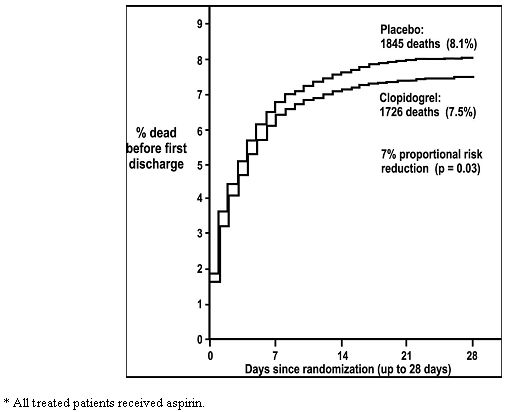
Figure-4 (Clopidogrel Figure 04)

Figure-4 (Clopidogrel Figure 04)
A survival curve chart showing percentage of deaths before first discharge over 28 days since randomization comparing Clopidogrel and placebo. The chart indicates a 7% proportional risk reduction in deaths with Clopidogrel (7.5%) versus placebo (8.1%), with death counts and statistical significance labeled.*
FDA Label Image

146 (Clopidogrel Figure 05)

146 (Clopidogrel Figure 05)
A Kaplan-Meier curve showing the percentage of patients with death, reinfarction, or stroke before first discharge over 28 days since randomization. The chart compares placebo and clopidogrel groups, indicating a lower event rate in the clopidogrel group with a noted 9% proportional risk reduction (p=0.002).*
FDA Label Image

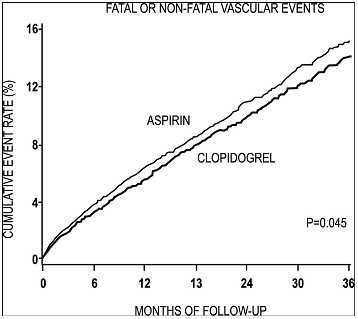
Fig-7 (Clopidogrel Figure 07)

Fig-7 (Clopidogrel Figure 07)
A line graph showing the cumulative event rate (%) of fatal or non-fatal vascular events over 36 months of follow-up. The graph compares two treatments, aspirin and clopidogrel, with clopidogrel showing a slightly lower event rate. The p-value noted on the graph is 0.045.*
FDA Label Image

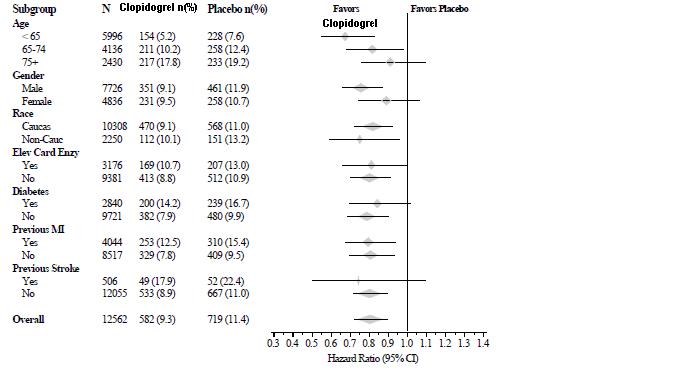
Figure-3 (Clopidogrel Figure 3)

Figure-3 (Clopidogrel Figure 3)
A forest plot chart depicting subgroup analysis comparing Clopidogrel to placebo across various categories such as age, gender, race, enzyme elevation, diabetes status, previous myocardial infarction, and previous stroke. The plot shows hazard ratios with 95% confidence intervals, illustrating favorability between Clopidogrel and placebo treatments.*
FDA Label Image

Figure-6 (Clopidogrel Figure 6)

Figure-6 (Clopidogrel Figure 6)
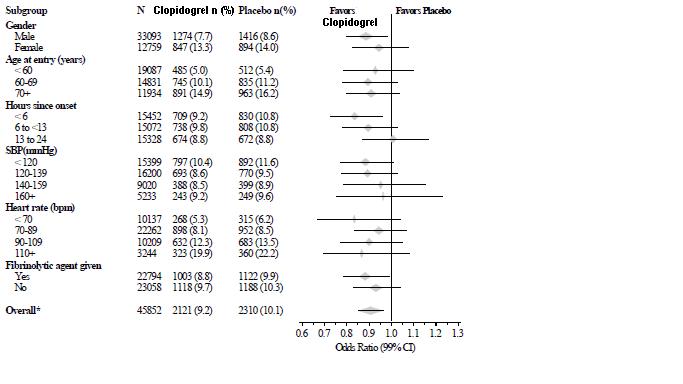
A forest plot chart showing odds ratios with 99% confidence intervals comparing Clopidogrel versus placebo across various subgroups by gender, age, hours since onset, systolic blood pressure, heart rate, and fibrinolytic agent use. The chart visually indicates which subgroups favor Clopidogrel or placebo based on position relative to the line of no effect.*
FDA Label Image

Figure-8 (Clopidogrel Figure 8)

Figure-8 (Clopidogrel Figure 8)
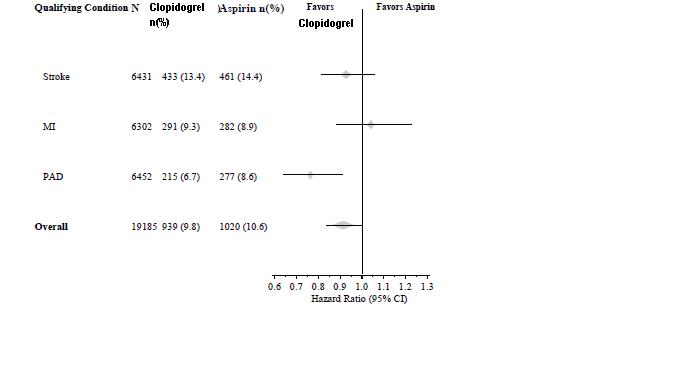
A hazard ratio forest plot comparing Clopidogrel versus Aspirin across qualifying conditions including Stroke, MI, and PAD, plus an overall estimate. The x-axis shows hazard ratios with 95% confidence intervals ranging from 0.6 to 1.3. Individual condition points display relative favor towards Clopidogrel or Aspirin based on the hazard ratio scale.*
FDA Label Image

Structure (Clopidogrel Structure)

Structure (Clopidogrel Structure)
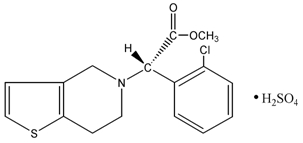
Chemical structure of Clopidogrel, showing its molecular framework including a thiophene ring and aromatic chlorophenyl group, accompanied by a sulfuric acid (H2SO4) moiety.*
FDA Label Image

Label Image (Lbl500905781)

Label Image (Lbl500905781)
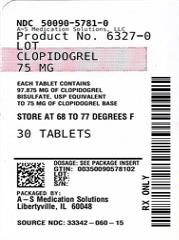
Clopidogrel 75 mg oral tablets packaging label from A-S Medication Solutions. The label indicates 30 tablets per package, with storage instructions to keep at 60 to 70 degrees Fahrenheit. The label also includes the NDC 50090-5781 and notes the quantity of clopidogrel in each tablet.*

* About these descriptions: Image descriptions on this page are generated by automated AI analysis of the product label images from the manufacturer's FDA label submission (SPL). They are provided for reference only and may contain errors or omissions. Always rely on the printed label itself and the official FDA labeling, and consult a pharmacist or healthcare professional with any questions about this product.