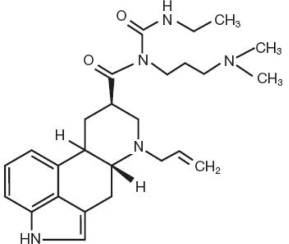
Clinical Studies: The prolactin-lowering efficacy of cabergoline was demonstrated in hyperprolactinemic women in two randomized, double-blind, comparative studies, one with placebo and the other with bromocriptine. In the placebo-controlled study (placebo n=20; cabergoline n=168), cabergoline produced a dose-related decrease in serum prolactin levels with prolactin normalized after 4 weeks of treatment in 29%, 76%, 74% and 95% of the patients receiving 0.125, 0.5, 0.75, and 1 mg twice weekly, respectively.
In the 8-week, double-blind period of the comparative trial with bromocriptine (cabergoline n=223; bromocriptine n=236 in the intent-to-treat analysis), prolactin was normalized in 77% of the patients treated with cabergoline at 0.5 mg twice weekly compared with 59% of those treated with bromocriptine at 2.5 mg twice daily. Restoration of menses occurred in 77% of the women treated with cabergoline, compared with 70% of those treated with bromocriptine. Among patients with galactorrhea, this symptom disappeared in 73% of those treated with cabergoline compared with 56% of those treated with bromocriptine.
Absorption: Following single oral doses of 0.5 mg to 1.5 mg given to 12 healthy adult volunteers, mean peak plasma levels of 30 to 70 picograms (pg)/mL of cabergoline were observed within 2 to 3 hours. Over the 0.5 to 7 mg dose range, cabergoline plasma levels appeared to be dose-proportional in 12 healthy adult volunteers and nine adult parkinsonian patients. A repeat-dose study in 12 healthy volunteers suggests that steady-state levels following a once-weekly dosing schedule are expected to be twofold to threefold higher than after a single dose. The absolute bioavailability of cabergoline is unknown. A significant fraction of the administered dose undergoes a first-pass effect. The elimination half-life of cabergoline estimated from urinary data of 12 healthy subjects ranged between 63 to 69 hours. The prolonged prolactin-lowering effect of cabergoline may be related to its slow elimination and long half-life.
Distribution: In animals, based on total radioactivity, cabergoline (and/or its metabolites) has shown extensive tissue distribution. Radioactivity in the pituitary exceeded that in plasma by >100-fold and was eliminated with a half-life of approximately 60 hours. This finding is consistent with the long-lasting prolactin-lowering effect of the drug. Whole body autoradiography studies in pregnant rats showed no fetal uptake but high levels in the uterine wall. Significant radioactivity (parent plus metabolites) detected in the milk of lactating rats suggests a potential for exposure to nursing infants. The drug is extensively distributed throughout the body. Cabergoline is moderately bound (40% to 42%) to human plasma proteins in a concentration-independent manner. Concomitant dosing of highly protein-bound drugs is unlikely to affect its disposition.
Metabolism: In both animals and humans, cabergoline is extensively metabolized, predominately via hydrolysis of the acylurea bond or the urea moiety. Cytochrome P-450 mediated metabolism appears to be minimal. Cabergoline does not cause enzyme induction and/or inhibition in the rat. Hydrolysis of the acylurea or urea moiety abolishes the prolactin-lowering effect of cabergoline, and major metabolites identified thus far do not contribute to the therapeutic effect.
Excretion: After oral dosing of radioactive cabergoline to five healthy volunteers, approximately 22% and 60% of the dose was excreted within 20 days in the urine and feces, respectively. Less than 4% of the dose was excreted unchanged in the urine. Nonrenal and renal clearances for cabergoline are about 3.2 L/min and 0.08 L/min, respectively. Urinary excretion in hyperprolactinemic patients was similar.
Renal Insufficiency: The pharmacokinetics of cabergoline were not altered in 12 patients with moderate-to severe renal insufficiency as assessed by creatinine clearance.
Hepatic Insufficiency: In 12 patients with mild-to-moderate hepatic dysfunction (Child-Pugh score ≤10), no effect on mean cabergoline Cmax or area under the plasma concentration curve (AUC) was observed. However, patients with severe insufficiency (Child-Pugh score >10) show a substantial increase in the mean cabergoline Cmax and AUC, and thus necessitate caution.
Elderly: Effect of age on the pharmacokinetics of cabergoline has not been studied.
Postpartum Lactation Inhibition or Suppression: Cabergoline is not indicated for the inhibition or suppression of physiologic lactation. Use of bromocriptine, another dopamine agonist for this purpose, has been associated with cases of hypertension, stroke, and seizures.
Hepatic Impairment: Since cabergoline is extensively metabolized by the liver, caution should be used, and careful monitoring exercised, when administering cabergoline to patients with hepatic impairment.
Psychiatric: Impulse control/compulsive behaviors, including pathological gambling, increased libido, and hypersexuality have been reported in patients treated with dopamine agonists including cabergoline. This has been generally reversible upon reduction of the dose or treatment discontinuation (see Post-marketing Surveillance data). Prescribers should consider dose reduction or stopping the medication if a patient develops such urges while taking cabergoline.
Post-marketing Surveillance data: The following events have been reported in association with cabergoline: Cardiac valvulopathy and extracardiac fibrotic reactions, (see WARNINGS, Cardiac Valvulopathy and Extracardiac Fibrotic Reactions).
Other events have been reported in association with cabergoline: impulse control/compulsive behavior symptoms, including hypersexuality, increased libido and pathological gambling (see PRECAUTIONS, Psychiatric). In addition, cases of alopecia, aggression and psychotic disorder have been reported in patients taking cabergoline. Some of these reports have been in patients who have had prior adverse reactions to dopamine agonist products.
To report SUSPECTED ADVERSE REACTIONS, contact Ingenus Pharmaceuticals, LLC at 1-877-748-1970 or FDA at 1-800-FDA-1088 or www.fda.gov/medwatch