Initial Dosing
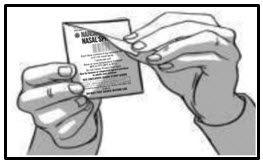
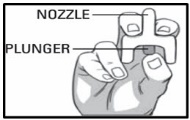
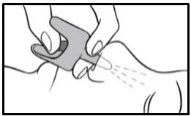
The recommended initial dose of Naloxone HCl Nasal Spray in adults and pediatric patients is one spray delivered by intranasal administration into one nostril.
Repeat Dosing
Seek emergency medical assistance as soon as possible after administering the first dose of Naloxone HCl Nasal Spray.
The requirement for repeat doses of Naloxone HCl Nasal Spray depends upon the amount, type, and route of administration of the opioid being antagonized.
Administer Naloxone HCl Nasal Spray in alternate nostrils with each dose.
If the patient responds to Naloxone HCl Nasal Spray and relapses back into respiratory depression before emergency assistance arrives, administer an additional dose of Naloxone HCl Nasal Spray using a new Naloxone HCl Nasal Spray and continue surveillance of the patient.
If the desired response is not obtained after 2 or 3 minutes, administer an additional dose of Naloxone HCl Nasal Spray using a new Naloxone HCl Nasal Spray. If there is still no response and additional doses are available, administer additional doses of Naloxone HCl Nasal Spray every 2 to 3 minutes using a new Naloxone HCl Nasal Spray with each dose until emergency medical assistance arrives.
Additional supportive and/or resuscitative measures may be helpful while awaiting emergency medical assistance.
Risk Summary
The limited available data on naloxone use in pregnant women are not sufficient to inform a drug-associated risk. However, there are clinical considerations [see Clinical Considerations]. In animal reproduction studies, no embryotoxic or teratogenic effects were observed in mice and rats treated with naloxone hydrochloride during the period of organogenesis at doses equivalent to 6-times and 12-times, respectively, a human dose of 8 mg/day (two Naloxone HCl Nasal Sprays) based on body surface area comparison [see Data].
The estimated background risk of major birth defects and miscarriage for the indicated population is unknown. In the U.S. general population, the estimated background risk of major birth defects and miscarriage in clinically recognized pregnancies is 2% to 4% and 15% to 20%, respectively.
Clinical Considerations
Fetal/Neonatal adverse reactions
Naloxone hydrochloride crosses the placenta, and may precipitate withdrawal in the fetus, as well as in the opioid-dependent mother [see Warnings and Precautions (5.3)]. The fetus should be evaluated for signs of distress after Naloxone HCl Nasal Spray is used. Careful monitoring is needed until the fetus and mother are stabilized.
Data
Animal Data
Naloxone hydrochloride was administered during organogenesis to mice and rats at subcutaneous doses up to 10 mg/kg/day (equivalent to 6-times and 12-times, respectively, a human dose of 8 mg (two Naloxone HCl Nasal Sprays)) (based on body surface area comparison). These studies demonstrated no embryotoxic or teratogenic effects due to naloxone hydrochloride.
Pregnant female rats were administered 2 or 10 mg/kg naloxone subcutaneously from Gestation Day 15 to Postnatal day 21. There were no adverse effects on the offspring (up to 12-times a human dose of 8 mg/day (two Naloxone HCl Nasal Sprays) based on body surface area comparison).
Risk Summary
There is no information regarding the presence of naloxone in human milk, or the effects of naloxone on the breastfed infant or on milk production. Studies in nursing mothers have shown that naloxone does not affect prolactin or oxytocin hormone levels. Naloxone is minimally orally bioavailable.
Distribution
Following parenteral administration, naloxone is distributed in the body and readily crosses the placenta. Plasma protein binding occurs but is relatively weak. Plasma albumin is the major binding constituent, but significant binding of naloxone also occurs to plasma constituents other than albumin. It is not known whether naloxone is excreted into human milk.
Elimination
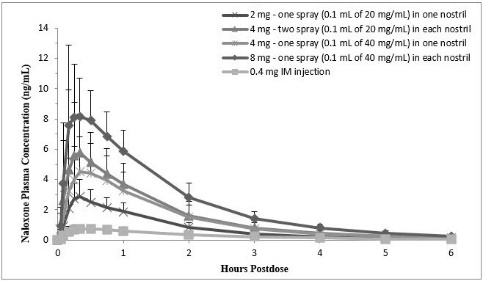
Following a single intranasal administration of Naloxone HCl Nasal Spray (2 mg or 4 mg dose of naloxone hydrochloride), the mean plasma half-life of naloxone in healthy adults was approximately 1.85 (33% CV) hours and 2.08 (30% CV) hours; respectively, which was longer than that observed after administrations of a 0.4 mg naloxone hydrochloride intramuscular injection, where the half-life was 1.24 hours (26% CV). In a neonatal study of naloxone hydrochloride injection, the mean (± SD) plasma half-life was observed to be 3.1 (± 0.5) hours.
Metabolism
Naloxone hydrochloride is metabolized in the liver, primarily by glucuronide conjugation, with naloxone-3-glucoronide as the major metabolite.
Excretion
After an oral or intravenous dose, about 25-40% of naloxone is excreted as metabolites in urine within 6 hours, about 50% in 24 hours, and 60-70% in 72 hours.
Carcinogenesis
Long-term animal studies to evaluate the carcinogenic potential of naloxone have not been completed.
Mutagenesis
Naloxone was weakly positive in the Ames mutagenicity and in the in vitro human lymphocyte chromosome aberration test but was negative in the in vitro Chinese hamster V79 cell HGPRT mutagenicity assay and in the in vivo rat bone marrow chromosome aberration study.
Impairment of Fertility
Male rats were treated with 2 or 10 mg/kg naloxone for 60 days prior to mating. Female rats treated for 14-days prior to mating and throughout gestation with the same doses of naloxone (up to 12-times a human dose of 8 mg/day (two Naloxone HCl Nasal Sprays) based on body surface area comparison). There was no adverse effect on fertility.
Recognition of Opioid Overdose
Inform patients and their family members or caregivers about how to recognize the signs and symptoms of an opioid overdose such as the following:
- Extreme somnolence - inability to awaken a patient verbally or upon a firm sternal rub.
- Respiratory depression - this can range from slow or shallow respiration to no respiration in a patient who is unarousable.
- Other signs and symptoms that may accompany somnolence and respiratory depression include the following:
- Miosis.
- Bradycardia and/or hypotension.
Risk of Recurrent Respiratory and Central Nervous System Depression
Instruct patients and their family members or caregivers that, since the duration of action of most opioids may exceed that of Naloxone HCl Nasal Spray, they must seek immediate emergency medical assistance after the first dose of Naloxone HCl Nasal Spray and keep the patient under continued surveillance [see Dosage and Administration (2.2), Warnings and Precautions (5.3)].
Limited Efficacy for/with Partial Agonists or Mixed Agonist/Antagonists
Instruct patients and their family members or caregivers that the reversal of respiratory depression caused by partial agonists or mixed agonist/antagonists, such as buprenorphine and pentazocine, may be incomplete and may require higher doses of naloxone hydrochloride or repeated administration of Naloxone HCl Nasal Spray, using a new nasal spray each time [see Dosage and Administration (2.3), Warnings and Precautions (5.2)].
Precipitation of Severe Opioid Withdrawal
Instruct patients and their family members or caregivers that the use of Naloxone HCl Nasal Spray in patients who are opioid dependent may precipitate opioid withdrawal [see Warnings and Precautions (5.3), Adverse Reactions (6)].
Administration Instructions
Instruct patients and their family members or caregivers to:
- Ensure Naloxone HCl Nasal Spray is present whenever persons may be intentionally or accidentally exposed to an opioid overdose (i.e., opioid emergencies).
- Administer Naloxone HCl Nasal Spray as quickly as possible if a patient is unresponsive and an opioid overdose is suspected, even when in doubt, because prolonged respiratory depression may result in damage to the central nervous system or death. Naloxone HCl Nasal Spray is not a substitute for emergency medical care [see Dosage and Administration (2.1)].
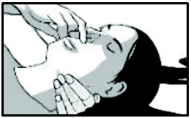
- Lay the patient on their back and administer Naloxone HCl Nasal Spray into one nostril while providing support to the back of the neck to allow the head to tilt back [see Dosage and Administration (2.1)].
- Use each nasal spray only one time [see Dosage and Administration (2.1)].
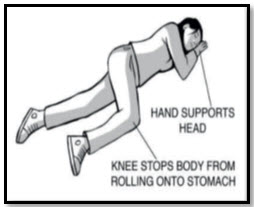
- Turn patient on their side as shown in the Instructions for Use and call for emergency medical assistance immediately after administration of the first dose of Naloxone HCl Nasal Spray. Additional supportive and/or resuscitative measures may be helpful while awaiting emergency medical assistance [see Dosage and Administration (2.1)].
- Monitor patients and re-administer Naloxone HCl Nasal Spray using a new Naloxone HCl Nasal Spray every 2 to 3 minutes, if the patient is not responding or responds and then relapses back into respiratory depression. Administer Naloxone HCl Nasal Spray in alternate nostrils with each dose [see Dosage and Administration (2.1)].
- Replace Naloxone HCl Nasal Spray before its expiration date.
Distributed by Sandoz Inc., Princeton, NJ 08540