Rosuvastatin Calcium Tablet, Film Coated
Product Images NDC 50090-7005

View Photos of Packaging, Regulatory Labels, and Product Appearance

Product Visual Gallery

This gallery contains 5 technical images submitted to the FDA as part of the official labeling for Rosuvastatin Calcium (NDC 50090-7005). Unlike standard consumer photos, these assets often include clinical data figures, molecular chemical structures, and official manufacturer packaging layouts.

As provided by A-s Medication Solutions, these visuals offer a comprehensive scientific overview of the product's physical and chemical identity, aiding pharmacists and researchers in product verification and study.

FDA Label Image

Figure1 (Figure1)

Figure1 (Figure1)
The text provided is a statistical result related to HR (Hazard Ratio) and cumulative incidence. The HR is 0.56 with a confidence interval of 0.46-0.69, indicating a significant effect. The p-value is less than 0.001, further supporting the significant result. The cumulative incidence is not readable and appears to be missing. The rest of the information includes the names "Rosuva" and "Placebo" as well as numbers representing the "Number at risk" for each group.*
FDA Label Image

Figure2 (Image 01)

Figure2 (Image 01)
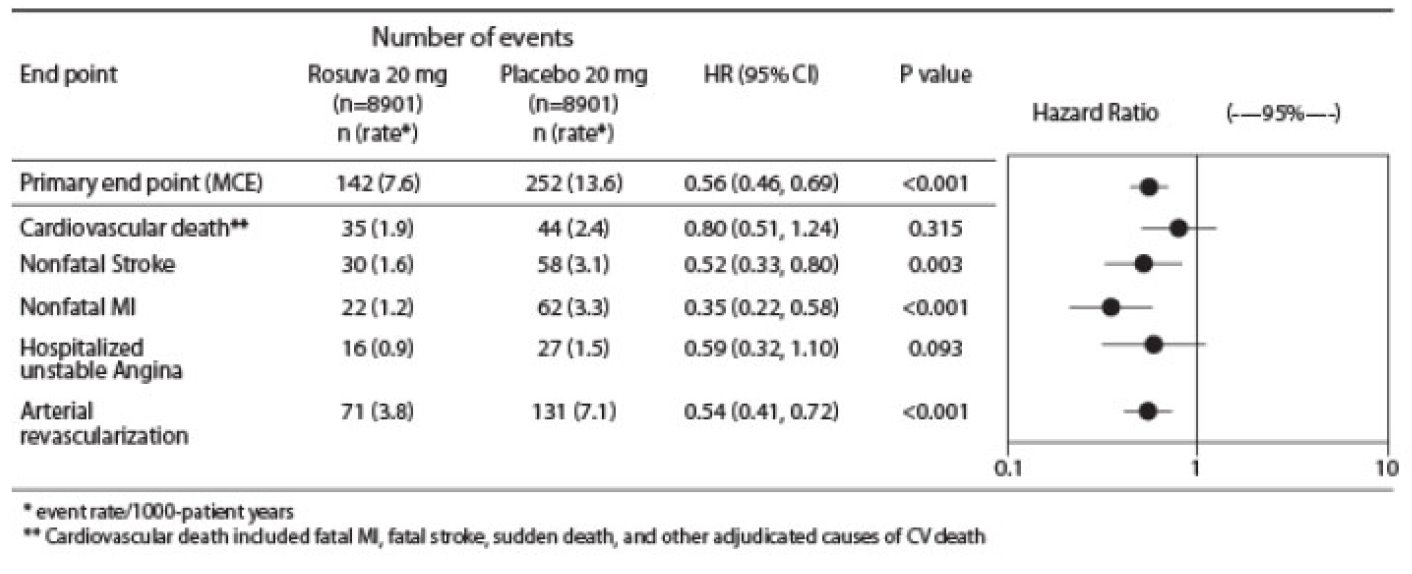
Number of events: This text provides information about the number of events observed in a study comparing two treatments (Rosuva 20 mg vs Placebo 20 mg) for a specific medical condition. Hazard Ratio (95% Confidence Interval): The hazard ratio is a measure of the relative risk of an event occurring in one treatment group compared to another. The 95% confidence interval provides a range within which the true hazard ratio is likely to fall. End points: The text lists several end points or outcomes that were evaluated in the study. - Primary end point (MCE): This refers to the primary outcome measure or main objective of the study, often referred to as the "Major Cardiovascular Event" (MCE). The numbers of events and event rates for each treatment group are provided, along with the hazard ratio and its confidence interval. - Cardiovascular death: This end point specifically refers to deaths related to cardiovascular causes. The numbers of events and event rates for each treatment group are provided, along with the hazard ratio and its confidence interval. - Nonfatal Stroke: This end point refers to incidents of stroke that did not result in death. The numbers of events and event rates for each treatment group are provided, along with the hazard ratio and its confidence interval. - Nonfatal MI: This end point refers to incidents of heart attack that did not result in death. The numbers of events and event rates for each treatment group are provided, along with the hazard ratio and its confidence interval. - Hospitalized unstable Angina: This end point refers to incidents of hospitalization due to unstable angina, a type of chest pain. The numbers of events and event rates for each treatment group are provided, along with the hazard ratio and its confidence interval. - Arterial revascularization: This end point refers to procedures performed to restore blood flow in blocked or narrowed blood vessels. The numbers of events and event rates for each treatment group are provided, along with the hazard ratio and its confidence interval. The text also provides the definition of "event rate" as the number of events per 1000-patient years. Note: The text seems to have some errors, including missing values and incorrect formatting. Nonetheless, the provided information allows for a basic understanding of the study results.*
FDA Label Image

Figure3 (Image 02)

FDA Label Image

Label Image (Lbl500907005)

FDA Label Image

Structure (Structure)

* These product label images have been analyzed using experimental machine learning. Please verify findings with the primary label text.