Duloxetine Capsule, Delayed Release
Product Images NDC 50090-7897
View Photos of Packaging, Regulatory Labels, and Product Appearance
Product Visual Gallery
This gallery contains 14 technical images submitted to the FDA as part of the official labeling for Duloxetine (NDC 50090-7897). Unlike standard consumer photos, these assets often include clinical data figures, molecular chemical structures, and official manufacturer packaging layouts.
As provided by A-s Medication Solutions, these visuals offer a comprehensive scientific overview of the product's physical and chemical identity, aiding pharmacists and researchers in product verification and study.
Product Images & Figures Index
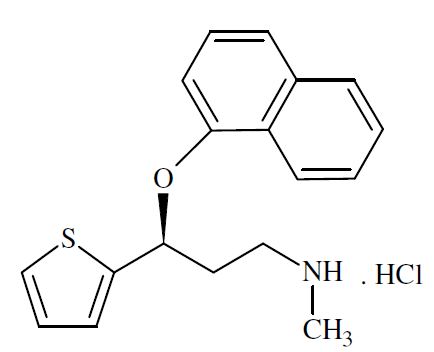
Structure (7efa28f3 0b15 4e1c 835f 2f1dff37bee8 01)
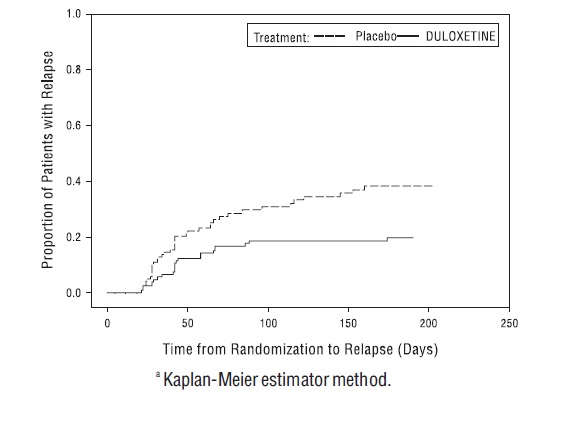
Figure 1 (7efa28f3 0b15 4e1c 835f 2f1dff37bee8 02)
This is a visual representation of the proportion of patients experiencing a relapse over time while using a placebo versus duloxetine treatment. The data is measured in days from randomization to relapse, using the Kaplan-Meier estimator method. The graph suggests that duloxetine treatment may have a lower relapse rate compared to the placebo.*
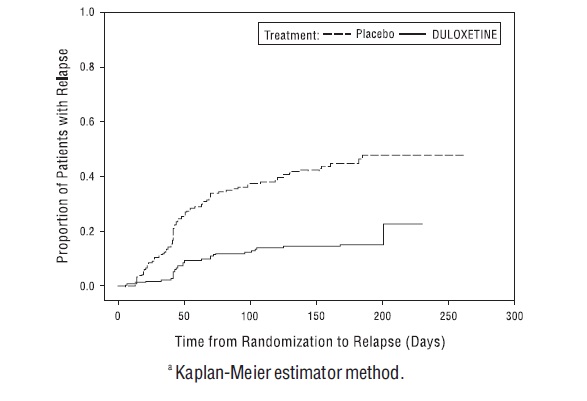
Figure 2 (7efa28f3 0b15 4e1c 835f 2f1dff37bee8 03)
This text provides information on the proportion of patients experiencing relapse over a period of time for both the placebo and duloxetine treatments. The data includes the number of patients at risk at various time points, the treatments administered, and the time from randomization to relapse in days. The Kaplan-Meier estimator method was used to calculate the relapse rates.*
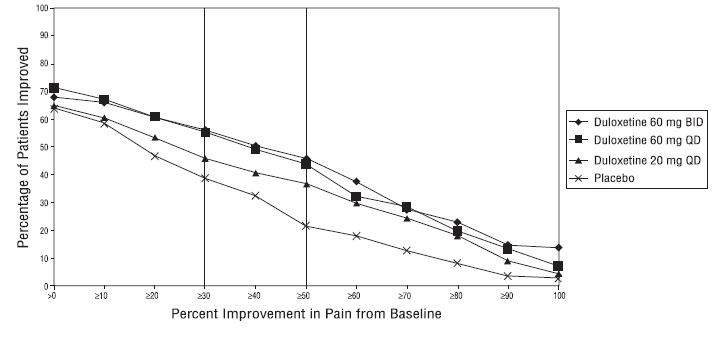
Figure 1 (7efa28f3 0b15 4e1c 835f 2f1dff37bee8 04)
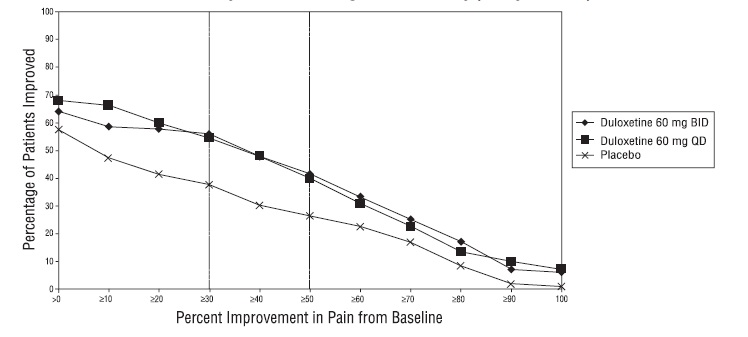
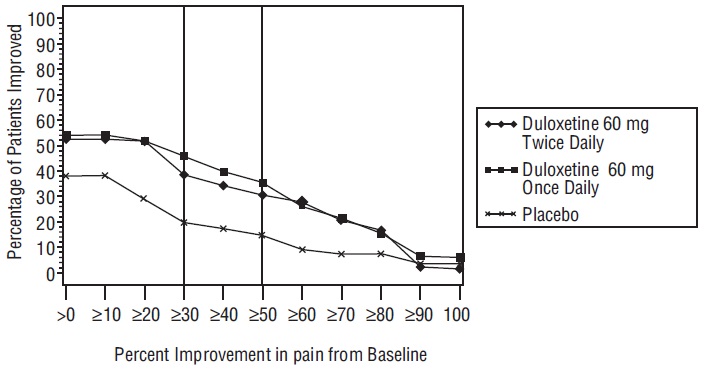
This text provides information on the percentage of patients improved through different treatments with Duloxetine and Placebo. It shows the percentage improvement in pain from baseline for Duloxetine 60 mg, Duloxetine 20 mg, and Placebo. The specific data for each treatment group is not fully visible in the provided text.*
Figure 2 (7efa28f3 0b15 4e1c 835f 2f1dff37bee8 05)
Fig 5 (7efa28f3 0b15 4e1c 835f 2f1dff37bee8 06)
Fig 6 (7efa28f3 0b15 4e1c 835f 2f1dff37bee8 07)
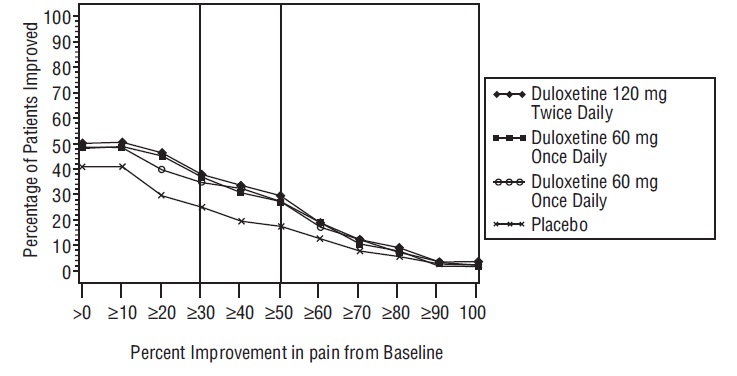
Percentage of Patients Improved: This text provides data on the percentage of patients who have shown improvement using different doses of Duloxetine medication compared to a placebo. The chart displays the percentage of improvement in pain from the baseline for each dosage, with 100 patients being the highest point of improvement. The information is shown for Duloxetine 120 mg twice daily, Duloxetine 60 mg once daily, and Placebo for assessment and comparison.*
Fig 7 (7efa28f3 0b15 4e1c 835f 2f1dff37bee8 08)
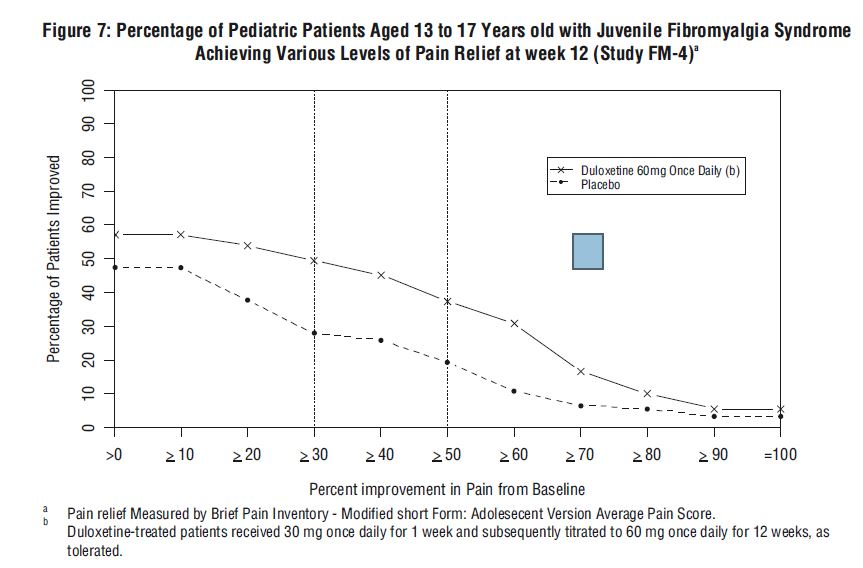
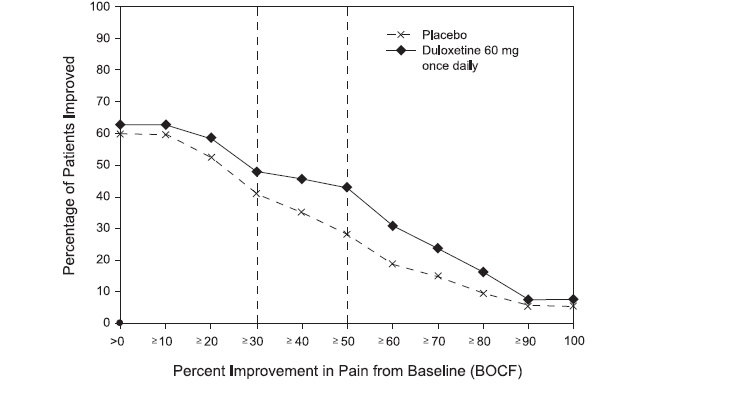
Percentage of Pediatric Patients Aged 13 to 17 Years old with Juvenile Fibromyalgia Syndrome achieving various levels of pain relief at week 12 are shown in Figure 7. The graph compares the pain relief achieved by patients treated with Duloxetine 60mg once daily to those given a placebo. The pain relief was measured by the Brief Pain Inventory - Modified short Form: Adolescent Version Average Pain Score. Patients on Duloxetine received 30mg once daily for a week, then titrated to 60mg once daily for 12 weeks based on tolerance levels.*
Figure 8 (7efa28f3 0b15 4e1c 835f 2f1dff37bee8 09)
Figure 9 (7efa28f3 0b15 4e1c 835f 2f1dff37bee8 10)
Figure 10 (7efa28f3 0b15 4e1c 835f 2f1dff37bee8 11)
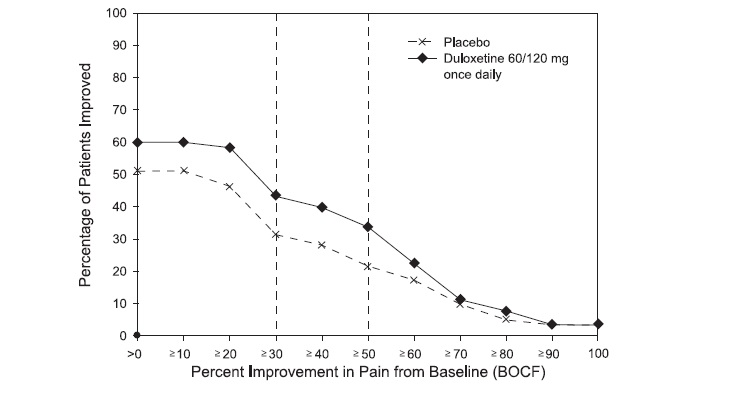
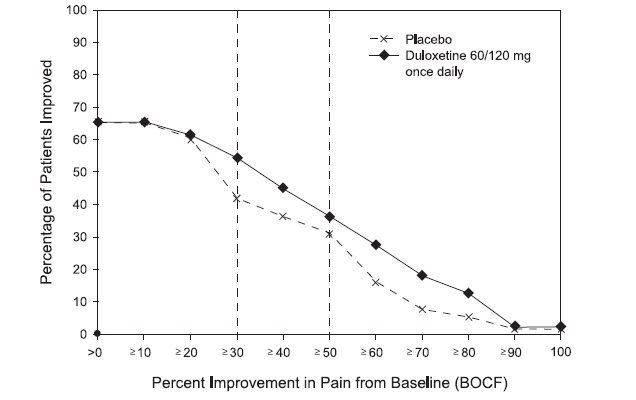
This text provides information on the percentage of patients improved after being treated with a placebo versus duloxetine at doses of 60/120 mg taken once daily. It also shows the percent improvement in pain from the baseline using the BOCF method. The chart displays values from 10% to 90% for analyzing the effectiveness of the treatments.*
Image (7efa28f3 0b15 4e1c 835f 2f1dff37bee8 935 1)
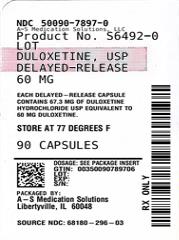
Label Image (Lbl500907897)
* These product label images have been analyzed using experimental machine learning. Please verify findings with the primary label text.