Other
Estrogen Plus Progestin Therapy
Cardiovascular Disorders and Probable Dementia
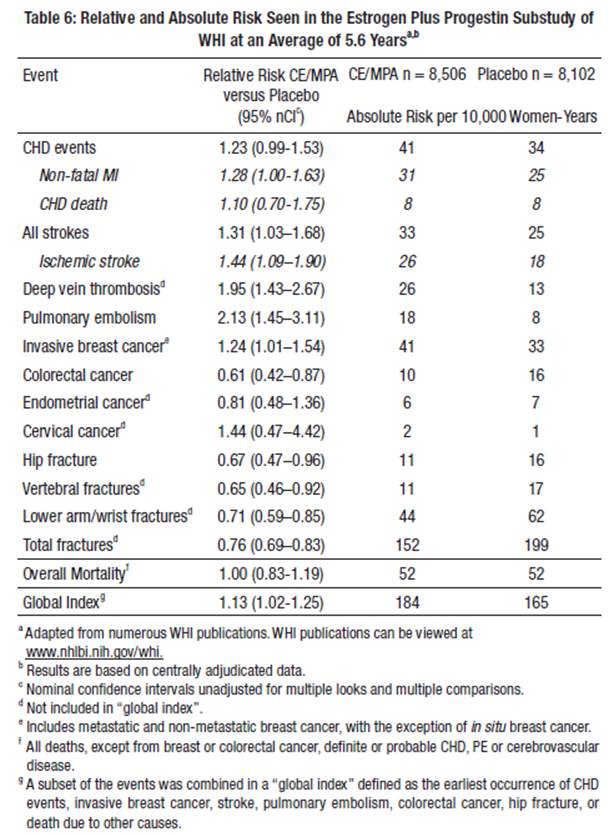
The Women's Health Initiative (WHI) estrogen plus progestin substudy reported increased risks of deep vein thrombosis (DVT), pulmonary embolism (PE), stroke and myocardial infarction (MI) in postmenopausal women (50 to 79 years of age) during 5.6 years of treatment with daily oral conjugated estrogen (CE) [0.625 mg] combined with medroxyprogesterone acetate (MPA) [2.5 mg], relative to placebo [see Warnings and Precautions (5.1), and Clinical Studies (14.5)].
The WHI Memory Study (WHIMS) estrogen plus progestin ancillary study of the WHI reported an increased risk of developing probable dementia in postmenopausal women 65 years of age and older during 4 years of treatment with daily CE (0.625 mg) combined with MPA (2.5 mg), relative to placebo. It is unknown whether this finding applies to younger postmenopausal women [see Warnings and Precautions (5.3), Use in Specific Populations (8.5), and Clinical Studies (14.6)].
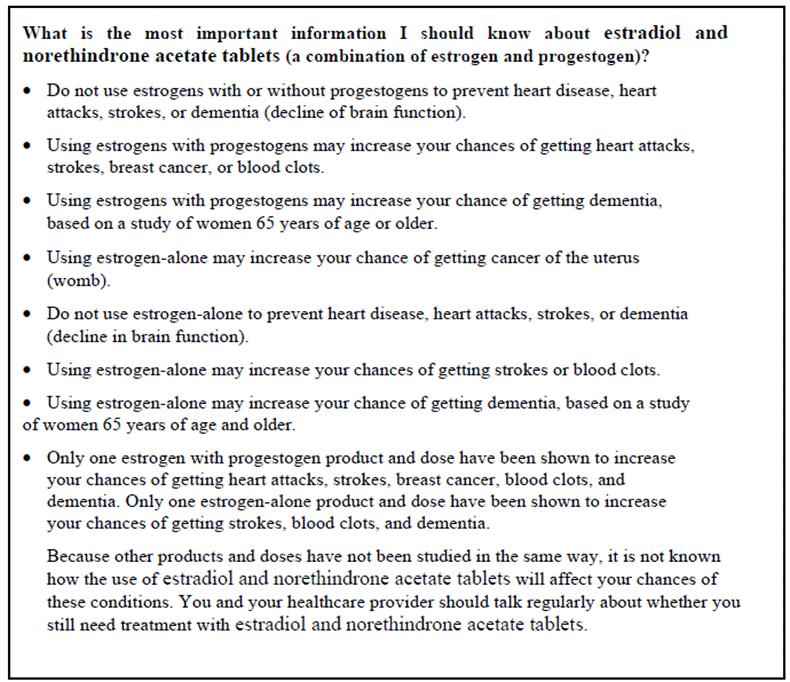
Do not use estrogen plus progestogen therapy for the prevention of cardiovascular disease or dementia [see Warnings and Precautions (5.1, 5.3), and Clinical Studies (14.5, 14.6)].
Breast Cancer
The WHI estrogen plus progestin substudy also demonstrated an increased risk of invasive breast cancer [see Warnings and Precautions (5.2), and Clinical Studies (14.5)].
Only daily oral 0.625 mg CE and 2.5 mg MPA were studied in the estrogen plus progestin substudy of the WHI. Therefore, the relevance of the WHI findings regarding adverse cardiovascular events, dementia and breast cancer to lower CE plus other MPA doses, other routes of administration, or other estrogen plus progestogen products is not known. Without such data, it is not possible to definitively exclude these risks or determine the extent of these risks for other products. Discuss with your patient the benefits and risks of estrogen plus progestogen therapy, taking into account her individual risk profile.
Prescribe estrogens with or without progestogens at the lowest effective doses and for the shortest duration consistent with treatment goals and risks for the individual woman.
Estrogen-Alone Therapy
Endometrial Cancer
There is an increased risk of endometrial cancer in a woman with a uterus who uses unopposed estrogens. Adding a progestogen to estrogen therapy has been shown to reduce the risk of endometrial hyperplasia, which may be a precursor to endometrial cancer. Adequate diagnostic measures, including directed or random endometrial sampling when indicated, should be undertaken to rule out malignancy in postmenopausal women with undiagnosed persistent or recurring abnormal genital bleeding [see Warnings and Precautions (5.2)].
Cardiovascular Disorders and Probable Dementia
The WHI estrogen-alone substudy reported increased risks of stroke and DVT in postmenopausal women (50 to 79 years of age) during 7.1 years of treatment with daily oral CE (0.625 mg)-alone, relative to placebo [see Warnings and Precautions (5.1), and Clinical Studies (14.5)].
The WHIMS estrogen-alone ancillary study of the WHI reported an increased risk of developing probable dementia in postmenopausal women 65 years of age and older during 5.2 years of treatment with daily CE (0.625 mg)-alone, relative to placebo. It is unknown whether this finding applies to younger postmenopausal women [see Warnings and Precautions (5.3), Use in Specific Populations (8.5), and Clinical Studies (14.6)].
Do not use estrogen-alone therapy for the prevention of cardiovascular disease or dementia [see Warnings and Precautions (5.1, 5.3), and Clinical Studies (14.5, 14.6)].
Only daily oral 0.625 mg CE was studied in the estrogen-alone substudy of the WHI. Therefore, the relevance of the WHI findings regarding adverse cardiovascular events and dementia to lower CE doses, other routes of administration, or other estrogen-alone products is not known. Without such data, it is not possible to definitively exclude these risks or determine the extent of these risks for other products. Discuss with your patient the benefits and risks of estrogen-alone therapy, taking into account her individual risk profile.
Prescribe estrogens with or without progestogens at the lowest effective doses and for the shortest duration consistent with treatment goals and risks for the individual woman.
Estradiol and norethindrone acetate tablets are indicated for:
Use estrogen-alone, or in combination with a progestogen, at the lowest effective dose and the shortest duration consistent with treatment goals and risks for the individual woman. Reevaluate postmenopausal women periodically as clinically appropriate to determine whether treatment is still necessary.
Estradiol and norethindrone acetate tablets, USP are available in two strengths:
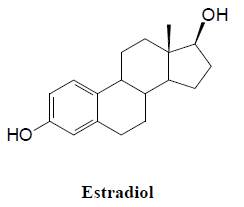
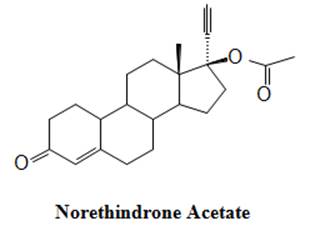
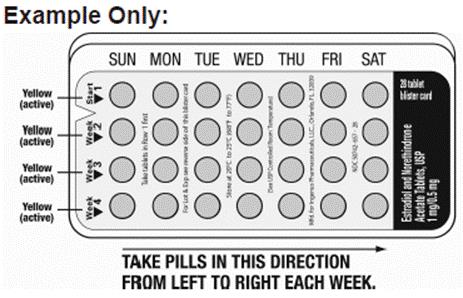
- Each tablet of estradiol and norethindrone acetate 1 mg/ 0.5 mg contains 1 mg of estradiol and 0.5 mg of norethindrone acetate. The tablets are yellow, round, bi-convex tablets debossed "J2" on one side.
- Each tablet of estradiol and norethindrone acetate 0.5 mg/ 0.1 mg contains 0.5 mg of estradiol and 0.1 mg of norethindrone acetate. The tablets are pale yellow, round, bi-convex tablets debossed "J1" on one side.
- Cardiovascular Disorders [see Boxed Warning, Warnings and Precautions (5.1)]
- Malignant Neoplasms [see Boxed Warning, Warnings and Precautions, (5.2)]
Estradiol and norethindrone acetate tablets are contraindicated in women with any of the following conditions:
• Undiagnosed abnormal genital bleeding [see Warnings and Precautions (5.2)]
• Breast cancer or history of breast cancer [see Warnings and Precautions (5.2)]
• Estrogen-dependent neoplasia [see Warnings and Precautions (5.2)]
• Active DVT, PE, or history of these conditions [see Warnings and Precautions (5.1)]
• Active arterial thromboembolic disease (for example, stroke and MI), or a history of these conditions [see Warnings and Precautions (5.1)]
• Known anaphylactic reaction, angioedema, or hypersensitivity to estradiol and norethindrone acetate tablets
• Hepatic impairment or disease
• Protein C, protein S, or antithrombin deficiency, or other known thrombophilic disorders
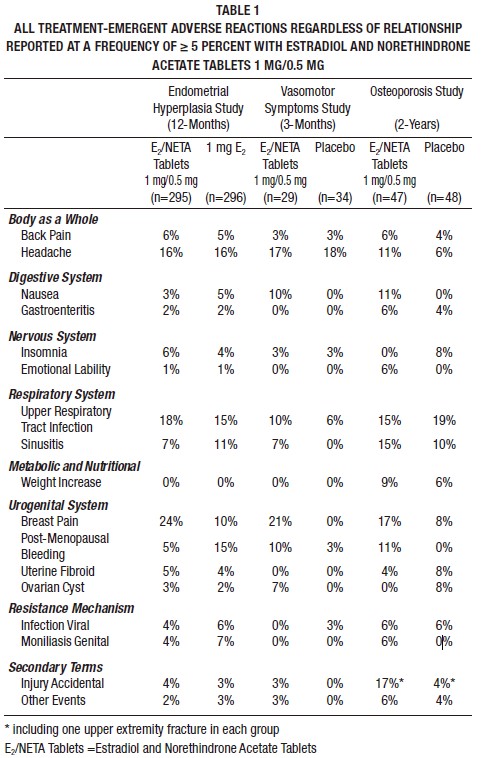
The following serious adverse reactions are discussed elsewhere in the labeling:
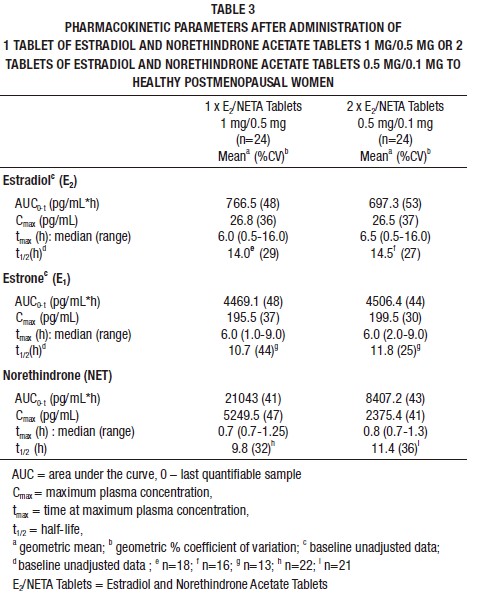
Co-administration of estradiol with norethindrone acetate did not elicit any apparent influence on the pharmacokinetics of norethindrone acetate. Similarly, no relevant interaction of norethindrone acetate on the pharmacokinetics of estradiol was found within the NETA dose range investigated in a single dose study.
Estradiol
In-vitro and in-vivo studies have shown that estrogens are metabolized partially by cytochrome P450 3A4 (CYP3A4). Therefore, inducers or inhibitors of CYP3A4 may affect estrogen drug metabolism. Inducers of CYP3A4 such as St. John's wort (Hypericum perforatum) preparations, phenobarbital, carbamazepine, and rifampin may reduce plasma concentrations of estrogens, possibly resulting in a decrease in therapeutic effects and/or changes in the uterine bleeding profile. Inhibitors of CYP3A4 such as erythromycin, clarithromycin, ketoconazole, itraconazole, ritonavir and grapefruit juice may increase plasma concentrations of estrogens and result in adverse reactions.
Norethindrone Acetate
Drugs or herbal products that induce or inhibit cytochrome P-450 enzymes, including CYP3A4, may decrease or increase the serum concentrations of norethindrone.