The following adverse reactions have been identified from clinical studies or postmarketing reports of metoclopramide. Because these reactions are reported voluntarily from a population of uncertain size, it is not always possible to reliably estimate their frequency or establish a causal relationship to drug exposure.
The most common adverse reactions (in approximately 10% of patients receiving 10 mg of metoclopramide four times daily) were restlessness, drowsiness, fatigue, and lassitude. In general, the incidence of adverse reactions correlated with the dosage and duration of metoclopramide administration.
Adverse reactions, especially those involving the nervous system, occurred after stopping metoclopramide including dizziness, nervousness, and headaches.
- Tardive dyskinesia, acute dystonic reactions, drug-induced parkinsonism, akathisia, and other extrapyramidal symptoms
- Convulsive seizures
- Hallucinations
- Restlessness, drowsiness, fatigue, and lassitude occurred in approximately 10% of patients who received 10 mg four times daily. Insomnia, headache, confusion, dizziness, or depression with suicidal ideation occurred less frequently.
- Neuroleptic malignant syndrome, serotonin syndrome (in combination with serotonergic agents).
Endocrine Disorders: Fluid retention secondary to transient elevation of aldosterone. Galactorrhea, amenorrhea, gynecomastia, impotence secondary to hyperprolactinemia
Cardiovascular Disorders: Acute congestive heart failure, possible atrioventricular block, hypotension, hypertension, supraventricular tachycardia, bradycardia, fluid retention
Gastrointestinal Disorders: Nausea, bowel disturbances (primarily diarrhea)
Hepatic Disorders: Hepatotoxicity, characterized by, e.g., jaundice and altered liver function tests, when metoclopramide was administered with other drugs with known hepatotoxic potential
Renal and Urinary Disorders: Urinary frequency, urinary incontinence
Hematologic Disorders: Agranulocytosis, neutropenia, leukopenia, methemoglobinemia, sulfhemoglobinemia
Hypersensitivity Reactions: Bronchospasm (especially in patients with a history of asthma), urticaria; rash; angioedema, including glossal or laryngeal edema
Eye Disorders: Visual disturbances
Metabolism Disorders: Porphyria
Manifestations of metoclopramide overdosage included drowsiness, disorientation, extrapyramidal reactions, other adverse reactions associated with metoclopramide use (including, e.g., methemoglobinemia), and sometimes death. Neuroleptic malignant syndrome (NMS) has been reported in association with metoclopramide overdose and concomitant treatment with another drug associated with NMS
[see Warnings and Precautions (
5.1,
5.2,
5.3)].
There are no specific antidotes for metoclopramide tablets overdosage.
If over-exposure occurs, call your Poison Control Center at 1-800-222-1222 for current information on the management of poisoning or overdosage
.
Methemoglobinemia can be reversed by the intravenous administration of methylene blue. However, methylene blue may cause hemolytic anemia in patients with glucose-6-phosphate dehydrogenase (G6PD) deficiency, which may be fatal.
Hemodialysis and continuous ambulatory peritoneal dialysis do not remove significant amounts of metoclopramide.
Metoclopramide hydrochloride, the active ingredient of metoclopramide tablets, is a dopamine-2 receptor antagonist. Metoclopramide hydrochloride (metoclopramide monohydrochloride monohydrate) is a white crystalline, odorless substance, freely soluble in water. Its chemical name is 4-amino-5-chloro-N-[2-(diethylamino)ethyl]-2-methoxy benzamide monohydrochloride monohydrate.
The molecular formula is C
14H
22ClN
3O
2•HCl•H
2O. Its molecular weight is 354.28. The structural formula is:
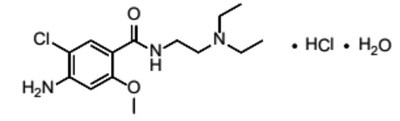
Metoclopramide Structure (Metoclopramide Structure)
Metoclopramide tablets are for oral administration. Metoclopramide tablets are available as 5 mg and 10 mg tablets.
- Each metoclopramide 5 mg tablet contains 5 mg metoclopramide (equivalent to 5.909 mg of metoclopramide hydrochloride USP). Inactive ingredients consist of microcrystalline cellulose, lactose monohydrate and magnesium stearate.
- Each metoclopramide 10 mg tablet contains 10 mg metoclopramide (equivalent to 11.818 mg metoclopramide hydrochloride USP). Inactive ingredients consist of microcrystalline cellulose, lactose monohydrate and magnesium stearate.
FDA approved dissolution test specifications differ from USP.
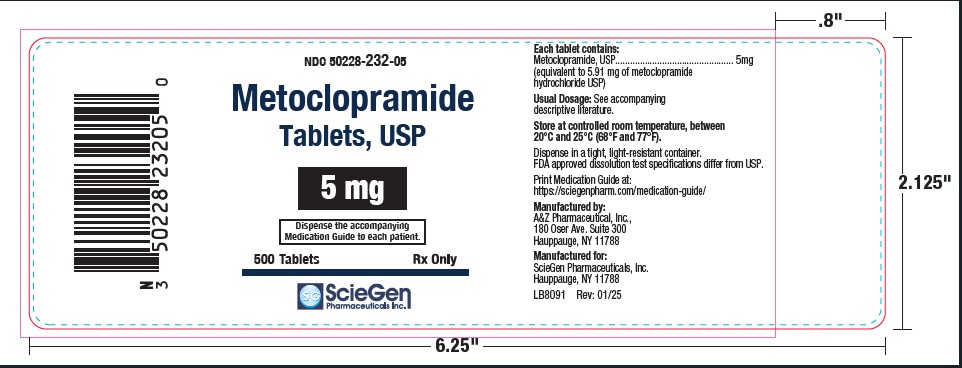
White, round, biconvex tablet contains 5 mg of metoclopramide. The tablet is debossed with “345” on one side and plain on the other side. Available in bottles of 100 tablets (NDC 50228-232-01) and 500 tablets (50228-232-05).
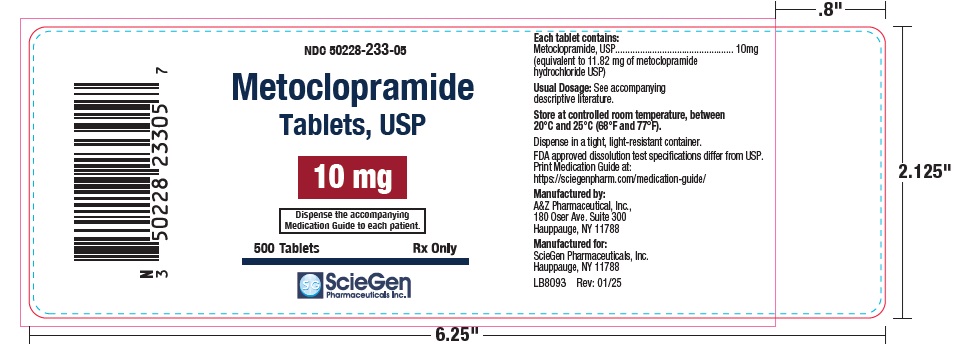
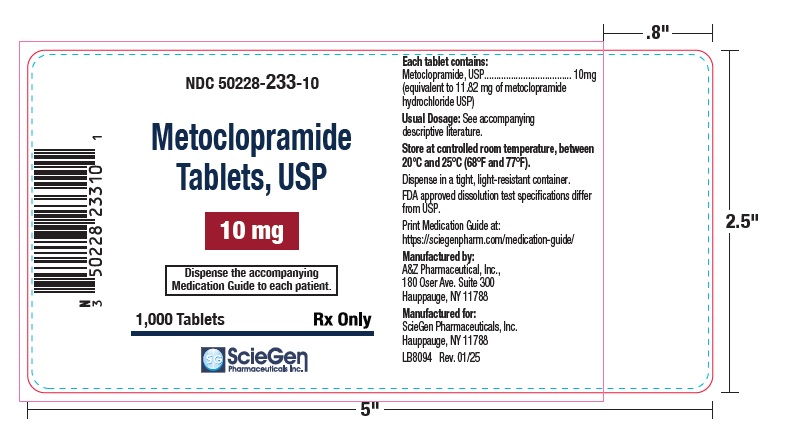
White, round, biconvex tablets contains 10 mg of metoclopramide, debossed with “346” on one side and plain with a white bisect on the other side. Available in bottles of 100 tablets (NDC 50228-233-01), bottles of 500 (50228-233-05) tablets and 1000 tablets (NDC 50228-233-10).
Dispense tablets in tight, light-resistant container. Store tablets at controlled room temperature between 20°C and 25°C (68°F and 77°F).