Clinical studies (described below) examined the efficacy of Droxidopa in the short-term (1 to 2 weeks) and over longer-term periods (8 weeks; 3 months). Studies 301 and 306B showed a treatment effect of Droxidopa at Week 1, but none of the studies demonstrated continued efficacy beyond 2 weeks of treatment.
Study 306B was a multi-center, double-blind, randomized, placebo-controlled, parallel-group study in patients with symptomatic nOH and Parkinson’s disease. Patients entering the study were required to have a decrease of at least 20 mm Hg or 10 mm Hg, respectively, in systolic or diastolic blood pressure, within 3 minutes after standing, as well as symptoms associated with neurogenic orthostatic hypotension. The study had an initial dose titration period that lasted up to 2 weeks in which patients received placebo or 100 mg to 600 mg of Droxidopa three times daily, followed by an 8-week treatment period.
Efficacy was measured using the OHSA Item #1 score (“dizziness, lightheadedness, feeling faint, and feeling like you might black out”) at Week 1, in patients who had completed titration and 1 week of maintenance therapy.
A total of 171 patients were enrolled, and 147 patients were included in the efficacy analysis. The mean age was 72 years, and patients were mostly Caucasian. During the study, 94% of placebo-treated patients and 88% on Droxidopa were taking dopa-decarboxylase inhibitors; 17% of placebo-treated patients and 26% on Droxidopa were taking fludrocortisone. There were more premature discontinuations in the Droxidopa group (28%) than in the placebo group (20%).
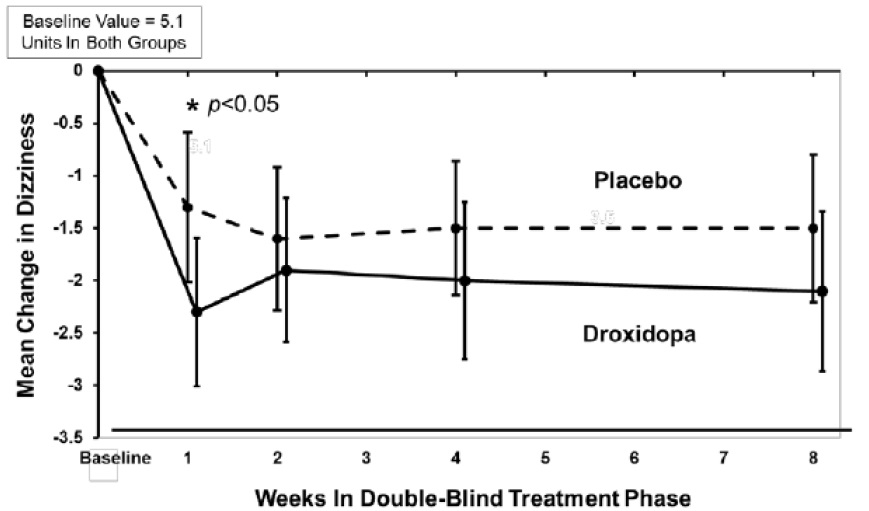
In both groups, the mean baseline dizziness score was 5.1 on an 11-point scale. At Week 1, patients showed a statistically significant mean 0.9 unit decrease in dizziness with Droxidopa versus placebo (
P=0.028), but the effect did not persist beyond Week 1. The data at all time points are shown in Figure 1.
Patients receiving Droxidopa also had a greater increase, compared to placebo, in the Week 1 lowest standing systolic blood pressure within 3 minutes after standing (5.6 mm Hg;
P=0.032).
Figure 1. Mean Change in OHSA Item 1 Score by Week in Study 306B

Mean Change In Ohsa (Droxidopa Fig01)
Note: The graph is based on observed data only. The error bars are the 95% confidence interval of the mean change from baseline in OHSA Item 1 scores.
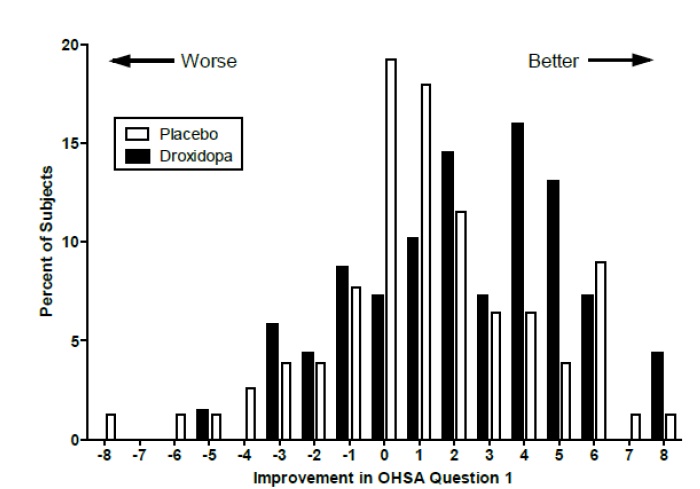
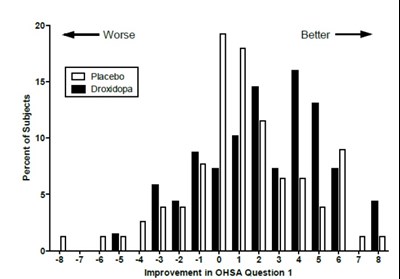
Figure 2. Distribution of Patients by Change in OHSA Item 1, Baseline to Week 1, in Study 306B
Figure 2 shows the distribution of changes from Baseline to Week 1 in the OHSA Item #1 score. Overall, the figure shows that patients treated with Droxidopa improved more than those treated with placebo.
Distribution Of Patients By Change In Ohsa (Droxidopa Fig02)
Study 301 was a multicenter, multinational, double-blind, randomized, placebo-controlled,
parallel-group study in patients with symptomatic neurogenic orthostatic hypotension. The study
included an initial open-label dose titration period, a 7-day washout period, and a randomized
double-blind 7-day treatment period. To be eligible for enrollment, patients were required to
have a decrease in systolic or diastolic blood pressure of at least 20 or 10 mm Hg, respectively,
within 3 minutes after standing. The study was enriched, such that only patients who had been
identified as “responders” during the titration period were randomized to Droxidopa or placebo.
To be considered a responder, a patient had to demonstrate improvement on the OHSA Item #1
score by at least 1 point, as well as an increase in systolic blood pressure of at least 10 mm Hg
post-standing, during the open-label dose titration period. Patients who dropped out during the
titration period because of side effects or other reasons were also not included in the double-blind
portion of the study.
Patients had a primary diagnosis of Parkinson’s disease (n=60), pure autonomic failure (n=36), or multiple system atrophy (n=26). The mean age was 60 years, and most were Caucasian. 45% of patients were taking dopadecarboxylase inhibitors, and 29% were taking fludrocortisone.
Efficacy was measured using the Orthostatic Hypotension Questionnaire (OHQ), a patient-reported outcome that measures symptoms of nOH and their impact on the patient’s ability to perform daily activities that require standing and walking. The OHQ includes OHSA Item #1 as one of several components. A statistically significant treatment effect was not demonstrated on OHQ (treatment effect of 0.4 unit,
P=0.19).
The mean baseline dizziness score on OHSA Item #1 (“dizziness, lightheadedness, feeling faint, and feeling like you might black out”) was 5.2 units on an 11-point scale. At Week 1 of treatment, patients showed a mean 0.7 unit decrease in dizziness with Droxidopa versus placebo (
P=0.06).
Study 302 (n=101) was a placebo-controlled, 2-week randomized withdrawal study of Droxidopa in patients with symptomatic nOH. Study 303 (n=75) was an extension of Studies 301 and 302, where patients received their titrated dose of Droxidopa for 3 months and then entered a 2-week randomized withdrawal phase. Neither study showed a statistically significant difference between treatment arms on its primary endpoint. Considering these data, the effectiveness of Droxidopa beyond 2 weeks is uncertain, and patients should be evaluated periodically to determine whether Droxidopa is continuing to provide a benefit.