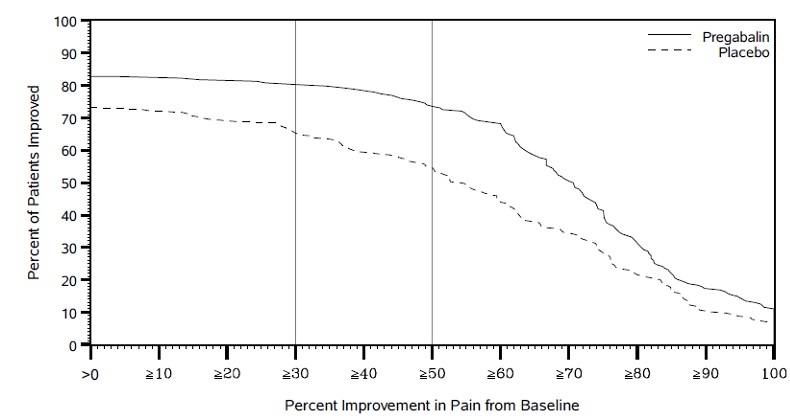
Controlled Study in Postherpetic Neuralgia
Adverse Reactions Leading to Discontinuation
In a clinical trial in patients with postherpetic neuralgia, 8.9% of patients treated with pregabalin extended-release tablets discontinued prematurely during the single-blind phase due to adverse reactions. The most common reasons for discontinuation due to adverse reactions were dizziness (2.1%), somnolence (0.87%), and peripheral edema (0.50%).
Most Common Adverse Reactions
Table 4 lists all adverse reactions, regardless of causality, occurring in greater than or equal to 1% of patients with postherpetic neuralgia who received pregabalin extended-release tablets, regardless of the phase of the study.
Table 4. Incidence of Adverse Reactions Reported in Greater Than or Equal to 1% of Subjects in Any Phase of the Pregabalin Extended-Release Tablets Study in Patients With Postherpetic Neuralgia
Table is limited to adverse reactions that occurred with higher incidence in pregabalin extended-release tablets-treated patients than in placebo-treated patients for the DB Phase of the study.
| System Organ Class Preferred Term | Single-Blind Phase | Double-Blind Phase |
|---|
Pregabalin extended-release tablets
[N=801]
n (%)
| Pregabalin extended-release tablets
[N=208]
n (%)
| Placebo
[N=205]
n (%)
|
|---|
| Ear and labyrinth disorders |
| Vertigo | 31 (3.9) | 2 (1.0) | 1 (0.5) |
| Eye disorders |
| Vision blurred | 30 (3.7) | 1 (0.5) | 0 |
| Diplopia | 8 (1.0) | 1 (0.5) | 0 |
| Gastrointestinal disorders |
| Dry mouth | 30 (3.7) | 1 (0.5) | 0 |
| Nausea | 24 (3.0) | 7 (3.4) | 0 |
| Constipation | 22 (2.7) | 0 | 0 |
| Diarrhea | 11 (1.4) | 2 (1.0) | 1 (0.5) |
| Vomiting | 9 (1.1) | 3 (1.4) | 1 (0.5) |
| General disorders and administration site conditions |
| Edema peripheral | 39 (4.9) | 8 (3.8) | 1 (0.5) |
| Fatigue | 31 (3.9) | 3 (1.4) | 2 (1.0) |
| Edema | 3 (0.4) | 3 (1.4) | 0 |
| Infections and infestations |
| Nasopharyngitis | 12 (1.5) | 3 (1.4) | 0 |
| Urinary tract infection | 11 (1.4) | 3 (1.4) | 1 (0.5) |
| Bronchitis | 4 (0.5) | 3 (1.4) | 2 (1.0) |
| Respiratory tract infection viral | 3 (0.4) | 3 (1.4) | 1 (0.5) |
| Sinusitis | 3 (0.4) | 2 (1.0) | 0 |
| Gastroenteritis viral | 2 (0.2) | 2 (1.0) | 0 |
| Investigations |
| Weight increased | 20 (2.5) | 8 (3.8) | 2 (1.0) |
| Alanine aminotransferase increased | 2 (0.2) | 3 (1.4) | 0 |
| Aspartate aminotransferase increased | 2 (0.2) | 2 (1.0) | 0 |
| Musculoskeletal and connective tissue disorders |
| Arthralgia | 6 (0.7) | 2 (1.0) | 1 (0.5) |
| Joint swelling | 0 | 4 (1.9) | 0 |
| Nervous system disorders |
| Dizziness | 137 (17.1) | 7 (3.4) | 1 (0.5) |
| Somnolence | 91 (11.4) | 1 (0.5) | 0 |
| Headache | 31 (3.9) | 4 (1.9) | 1 (0.5) |
| Balance disorder | 21 (2.6) | 1 (0.5) | 0 |
| Reproductive system and breast disorders |
| Erectile dysfunction | 2 (0.6) | 1 (1.4) | 0 |
| Respiratory, thoracic, and mediastinal disorders |
| Cough | 2 (0.2) | 2 (1.0) | 1 (0.5) |
| Skin and subcutaneous tissue disorders |
| Dermatitis contact | 0 | 2 (1.0) | 0 |
Other Adverse Reactions Observed During Clinical Studies with LYRICA and pregabalin extended-release tablets
In addition to the adverse reactions reported during the controlled studies with pregabalin extended-release tablets in postherpetic neuralgia, the following adverse reactions have been reported in patients treated with LYRICA and pregabalin extended-release tablets during all clinical studies. This listing does not include those adverse reactions already listed above. The adverse reactions are categorized by system organ class and listed in order of decreasing frequency according to the following definitions:
frequent adverse reactions are those occurring on 1 or more occasions in at least 1/100 patients;
infrequent adverse reactions are those occurring in 1/100 to 1/1000 patients;
rare reactions are those occurring in fewer than 1/1000 patients. Adverse reactions of major clinical importance are described in the
Warnings and Precautions section (5).
Cardiac Disorders –
Infrequent: Palpitations, Deep thrombophlebitis, Heart failure, Hypotension, Postural hypotension, Retinal vascular disorder, Syncope;
Rare: Cardiac failure, Tachycardia
Eye Disorders –
Infrequent: Periorbital edema
Gastrointestinal Disorders –
Frequent: Increased appetite;
Infrequent: Abdominal distension, Abdominal pain, Dysphagia, Pancreatitis, Tongue edema
General Disorders –
Frequent: Fever;
Infrequent: Chest pain, Face edema;
Rare: Facial pain, Mucosal dryness
Hemic and Lymphatic System Disorders –
Frequent: Ecchymosis;
Infrequent: Anemia, Eosinophilia, Hypochromic anemia, Leukocytosis, Leukopenia, Lymphadenopathy, Thrombocytopenia;
Rare: Myelofibrosis, Polycythemia, Prothrombin decreased, Purpura, Thrombocythemia
Infections and Infestations –
Infrequent: Otitis media, Pneumonia
Investigations –
Rare: Glucose urine present, Lipase increased, Neutrophil count increased, Proteinuria
Metabolic and Nutritional Disorders –
Rare: Glucose Tolerance Decreased, Urate Crystalluria
Musculoskeletal and Connective Tissue Disorders –
Frequent: Leg cramps, Myalgia, Myasthenia;
Infrequent: Joint stiffness;
Rare: Coccydynia, Myokymia
Nervous System Disorders –
Frequent: Anxiety, Depersonalization, Hypertonia, Hypoesthesia, Libido decreased, Nystagmus, Paresthesia, Sedation, Stupor, Twitching;
Infrequent: Coordination abnormal, Abnormal dreams, Agitation, Amnesia, Apathy, Aphasia, Circumoral paresthesia, Cognitive disorder, Dysarthria, Dysgeusia, Hallucinations, Hostility, Hyperalgesia, Hyperesthesia, Hyperkinesia, Hypokinesia, Hypotonia, Libido increased, Myoclonus, Neuralgia, Sciatica, Sleep phase rhythm disturbance;
Rare: Addiction, Altered state of consciousness, Bradykinesia, Cerebellar syndrome, Cogwheel rigidity, Coma, Delirium, Delusions, Depressed level of consciousness, Dysautonomia, Dyskinesia, Dystonia, Encephalopathy, Extrapyramidal syndrome, Psychomotor hyperactivity, Psychomotor skills impaired
Psychiatric Disorders –
Infrequent: Irritability
Respiratory System Disorders –
Rare: Lung edema
Skin Disorders –
Frequent: Pruritus;
Rare: Stevens-Johnson syndrome
Special Senses –
Frequent: Conjunctivitis, Tinnitus
Urogenital System Disorders –
Frequent: Anorgasmia, Impotence, Urinary frequency, Urinary incontinence;
Infrequent: Abnormal ejaculation, Albuminuria, Dysuria, Hematuria, Kidney calculus, Leukorrhea, Nephritis, Oliguria, Urinary retention
Pharmacodynamics
Although no pharmacokinetic interactions were seen with LYRICA and ethanol, lorazepam, or oxycodone, additive effects on cognitive and gross motor functioning were seen when LYRICA was co-administered with these drugs. No clinically important effects on respiration were seen in studies of LYRICA.
Signs, Symptoms and Laboratory Findings of Acute Overdosage in Humans
In the postmarketing experience, the most commonly reported adverse events observed with pregabalin when taken in overdose include reduced consciousness, depression/anxiety, confusional state, agitation, and restlessness. Seizures and heart block have also been reported. Deaths have been reported in the setting of lone LYRICA overdose and in combination with other CNS depressants.
Treatment or Management of Overdose
There is no specific antidote for overdose with pregabalin. If indicated, elimination of unabsorbed drug may be attempted by emesis or gastric lavage; observe usual precautions to maintain the airway. General supportive care of the patient is indicated including monitoring of vital signs and observation of the clinical status of the patient. Contact a Certified Poison Control Center for up-to-date information on the management of overdose with pregabalin.
Pregabalin can be removed by hemodialysis. Standard hemodialysis procedures result in significant clearance of pregabalin (approximately 50% in 4 hours).
Absorption
Pregabalin is absorbed from the small intestine and proximal colon. Pregabalin extended-release tablets absorption is linear and dose proportional.
The bioavailability of pregabalin extended-release tablets is reduced if taken on an empty stomach. The AUC is approximately 30% lower when pregabalin extended-release tablets is administered fasted relative to following an evening meal.
When pregabalin extended-release tablets is administered following a 600 to 750 calorie (50% carbohydrates, 20% protein, 30% fat) evening meal, peak plasma concentrations occur within approximately 8 to 10 hours and AUC is approximately 93% to 97% relative to a comparative dose of LYRICA. The rate and extent of pregabalin extended-release tablets absorption is similar when administered following a 400 to 500 calorie, 30% fat or an 800 to 1000 calorie, 15%, 30%, or 50% fat evening meal.
When pregabalin extended-release tablets is administered following an 800 to 1000 calorie (50% carbohydrates, 20% protein, 30% fat) morning meal, peak plasma concentrations occur within approximately 12 hours and AUC is 99% relative to a comparative dose of LYRICA. AUC decreases approximately 13% to 25% when pregabalin extended-release tablets is administered following a 400 to 500 calorie or 600 to 750 calorie (50% carbohydrates, 20% protein, 30% fat) morning meal relative to the 800 to 1000 calorie meal, while C
max remains the same.
Distribution
Pregabalin does not bind to plasma proteins. The apparent volume of distribution of pregabalin following oral administration is approximately 0.5 L/kg. Pregabalin is a substrate for system L transporter which is responsible for the transport of large amino acids across the blood brain barrier. Although there are no data in humans, pregabalin has been shown to cross the blood brain barrier in mice, rats, and monkeys. In addition, pregabalin has been shown to cross the placenta in rats and is present in the milk of lactating rats.
Elimination
Metabolism
Pregabalin undergoes negligible metabolism in humans. Following a dose of radiolabeled pregabalin, approximately 90% of the administered dose was recovered in the urine as unchanged pregabalin. The N-methylated derivative of pregabalin, the major metabolite of pregabalin found in urine, accounted for 0.9% of the dose. In preclinical studies, pregabalin (S-enantiomer) did not undergo racemization to the R-enantiomer in mice, rats, rabbits, or monkeys.
Excretion
Pregabalin is eliminated from the systemic circulation primarily by renal excretion as unchanged drug with a mean elimination half-life of 6.3 hours in subjects with normal renal function. Mean renal clearance was estimated to be 67.0 to 80.9 mL/min in young healthy subjects. Because pregabalin is not bound to plasma proteins this clearance rate indicates that renal tubular reabsorption is involved. Pregabalin elimination is nearly proportional to CLcr
[see
Dosage and Administration (2.5)]
.
Specific Populations
Age: Geriatric Patients
Pregabalin oral clearance tended to decrease with increasing age. This decrease in pregabalin oral clearance is consistent with age-related decreases in CLcr. Reduction of pregabalin dose may be required in patients who have age-related compromised renal function
[see
Dosage and Administration (2.5)]
.
Sex
Population pharmacokinetic analyses of the clinical studies showed that the relationship between daily dose and pregabalin extended-release tablets drug exposure is similar between genders.
Race/Ethnicity
In population pharmacokinetic analyses of the clinical studies of LYRICA and pregabalin extended-release tablets, the pharmacokinetics of pregabalin were not significantly affected by race (Caucasians, Blacks, and Hispanics).
Renal Impairment
Pregabalin clearance is nearly proportional to CLcr. Dosage reduction in patients with reduced renal function is necessary. Pregabalin is effectively removed from plasma by hemodialysis. Following a 4-hour hemodialysis treatment, plasma pregabalin concentrations are reduced by approximately 50%. For patients on hemodialysis, treatment with pregabalin extended-release tablets is not recommended
[see
Dosage and Administration (2.5)]
.
Drug Interaction Studies
In Vitro Studies
In vitro studies showed that pregabalin is unlikely to be involved in significant pharmacokinetic drug interactions. Pregabalin, at concentrations that were, in general, 10-times those attained in clinical trials, does not inhibit human CYP1A2, CYP2A6, CYP2C9, CYP2C19, CYP2D6, CYP2E1, and CYP3A4 enzyme systems.
In vitro drug interaction studies demonstrate that pregabalin does not induce CYP1A2 or CYP3A4 activity. Therefore, an increase in the metabolism of co-administered CYP1A2 substrates (e.g., theophylline, caffeine) or CYP3A4 substrates (e.g., midazolam, testosterone) is not anticipated.
In Vivo Studies
With the exception of erythromycin, the interactions of pregabalin extended-release tablets with co-administration of other drugs have not been systematically evaluated.
Additional studies have been performed with LYRICA
[see
Drug Interactions (7)]
. No pharmacokinetic interactions were observed between LYRICA and carbamazepine, ethanol, gabapentin, lamotrigine, lorazepam, oral contraceptive, oxycodone, phenobarbital, phenytoin, topiramate, and valproic acid. A similar lack of pharmacokinetic interactions would be expected to occur with pregabalin extended-release tablets.
The drug interaction studies described in this section were conducted in healthy adults, and across various patient populations.
Erythromycin
Multiple-dose administration of erythromycin (500 mg every 6 hours for 18 hours) in healthy subjects resulted in a 17% decrease in AUC of pregabalin extended-release tablets (330 mg single dose).
Ethanol
Multiple-dose administration of pregabalin (300 mg twice a day) in healthy subjects had no effect on the rate and extent of ethanol single-dose pharmacokinetics and single-dose administration of ethanol (0.7 g/kg) had no effect on the steady-state pharmacokinetics of pregabalin. Additive effects on cognitive and gross motor functioning were seen when LYRICA was co-administered with ethanol. No clinically important effects on respiration were seen
[see
Drug Interactions (7)]
.
Gabapentin
The pharmacokinetic interactions of pregabalin and gabapentin were investigated in 12 healthy subjects following concomitant single-dose administration of 100-mg pregabalin and 300-mg gabapentin and in 18 healthy subjects following concomitant multiple-dose administration of 200-mg pregabalin every 8 hours and 400-mg gabapentin every 8 hours. Gabapentin pharmacokinetics following single- and multiple-dose administration were unaltered by pregabalin co-administration. The extent of pregabalin absorption was unaffected by gabapentin co-administration, although there was a small reduction in rate of absorption.
Lorazepam
Multiple-dose administration of pregabalin (300 mg twice a day) in healthy subjects had no effect on the rate and extent of lorazepam single-dose pharmacokinetics and single-dose administration of lorazepam (1 mg) had no effect on the steady-state pharmacokinetics of pregabalin. Additive effects on cognitive and gross motor functioning were seen when LYRICA was co-administered with lorazepam. No clinically important effects on respiration were seen
[see
Drug Interactions (7)]
.
Oral Contraceptive
Pregabalin co-administration (200 mg 3 times a day) had no effect on the steady-state pharmacokinetics of norethindrone and ethinyl estradiol (1 mg/35 mcg, respectively) in healthy subjects.
Oxycodone
Multiple-dose administration of pregabalin (300 mg twice a day) in healthy subjects had no effect on the rate and extent of oxycodone single-dose pharmacokinetics. Single-dose administration of oxycodone (10 mg) had no effect on the steady-state pharmacokinetics of pregabalin. Additive effects on cognitive and gross motor functioning were seen when LYRICA was co-administered with oxycodone. No clinically important effects on respiration were seen
[see
Drug Interactions (7)]
.
Carbamazepine, Lamotrigine, Phenobarbital, Phenytoin, Topiramate and Valproic Acid
Steady-state trough plasma concentrations of phenytoin, carbamazepine, and carbamazepine 10,11 epoxide, valproic acid, and lamotrigine were not affected by concomitant pregabalin (200 mg 3 times a day) administration.
Population pharmacokinetic analyses in patients treated with pregabalin and various concomitant medications suggest the following:
| Therapeutic class | Specific concomitant drug studied |
|---|
| Concomitant drug has no effect on the pharmacokinetics of pregabalin |
| Hypoglycemics | Glyburide, insulin, metformin |
| Diuretics | Furosemide |
| Antiepileptic Drugs | Tiagabine |
| Concomitant drug has no effect on the pharmacokinetics of pregabalin and pregabalin has no effect on the pharmacokinetics of concomitant drug |
| Antiepileptic Drugs | Carbamazepine, lamotrigine, phenobarbital, phenytoin, topiramate, valproic acid |
Carcinogenesis
A dose-dependent increase in the incidence of malignant vascular tumors (hemangiosarcomas) was observed in 2 strains of mice (B6C3F1 and CD-1) given pregabalin (200 mg/kg, 1000 mg/kg, or 5000 mg/kg) in the diet for 2 years. Plasma pregabalin exposure (AUC) in mice receiving the lowest dose that increased hemangiosarcomas was approximately equal to the human exposure at the maximum recommended human dose (MRD) of 660 mg/day. A no-effect dose for induction of hemangiosarcomas in mice was not established. No evidence of carcinogenicity was seen in 2 studies in Wistar rats following dietary administration of pregabalin for 2 years at doses (50 mg/kg, 150 mg/kg, or 450 mg/kg in males and 100 mg/kg, 300 mg/kg, or 900 mg/kg in females) that were associated with plasma exposures in males and females up to approximately 15 and 26 times, respectively, human exposure at the MRD.
Mutagenesis
Pregabalin was not mutagenic in bacteria or in mammalian cells
in vitro, was not clastogenic in mammalian systems
in vitro and
in vivo, and did not induce unscheduled DNA synthesis in mouse or rat hepatocytes.
Impairment of Fertility
In fertility studies in which male rats were orally administered pregabalin (50 mg/kg to 2500 mg/kg) prior to and during mating with untreated females, a number of adverse reproductive and developmental effects were observed. These included decreased sperm counts and sperm motility, increased sperm abnormalities, reduced fertility, increased preimplantation embryo loss, decreased litter size, decreased fetal body weights, and an increased incidence of fetal abnormalities. Effects on sperm and fertility parameters were reversible in studies of this duration (3 to 4 months). The no-effect dose for male reproductive toxicity in these studies (100 mg/kg) was associated with a plasma pregabalin exposure (AUC) approximately 4 times human exposure at the MRD of 660 mg/day.
In addition, adverse reactions on reproductive organ (testes, epididymides) histopathology were observed in male rats exposed to pregabalin (500 mg/kg to 1250 mg/kg) in general toxicology studies of 4 weeks or greater duration. The no-effect dose for male reproductive organ histopathology in rats (250 mg/kg) was associated with a plasma exposure approximately 10 times human exposure at the MRD.
In a fertility study in which female rats were given pregabalin (500 mg/kg, 1250 mg/kg, or 2500 mg/kg) orally prior to and during mating and early gestation, disrupted estrous cyclicity and an increased number of days to mating were seen at all doses, and embryolethality occurred at the highest dose. The low dose in this study produced a plasma exposure approximately 10 times that in humans receiving the MRD. A no-effect dose for female reproductive toxicity in rats was not established.
Dermatopathy
Skin lesions ranging from erythema to necrosis were seen in repeated-dose toxicology studies in both rats and monkeys. The etiology of these skin lesions is unknown. At the MRD of 660 mg/day, there is a 2-fold safety margin for the dermatological lesions. The more severe dermatopathies involving necrosis were associated with pregabalin exposures (as expressed by plasma AUCs) of approximately 3 to 8 times those achieved in humans given the MRD. No increase in incidence of skin lesions was observed in clinical studies.
Ocular Lesions
Ocular lesions (characterized by retinal atrophy [including loss of photoreceptor cells] and/or corneal inflammation/mineralization) were observed in 2 lifetime carcinogenicity studies in Wistar rats. These findings were observed at plasma pregabalin exposures (AUC) greater than or equal to 2 times those achieved in humans given the maximum recommended dose of 660 mg/day. A no-effect dose for ocular lesions was not established. Similar lesions were not observed in lifetime carcinogenicity studies in 2 strains of mice or in monkeys treated for 1 year.